
«Less routine. More time for what matters.»
1. Media Concept
Format: digital informational and educational media.
Focus: practical application of artificial intelligence and neural networks to solve everyday work tasks.
Target Audience: employed professionals, freelancers, small business owners, students, and emerging specialists.
Core ConceptNEURO is a medium that translates the complex capabilities of artificial intelligence into clear instructions, vetted tools, and ready-to-use prompts. The project is not focused on the technical architecture of neural networks or industry news. Its mission is to demonstrate how a specific AI tool can help a person tackle a real-world task—whether it’s writing an email, preparing a presentation, analyzing a spreadsheet, structuring information, or automating repetitive actions.
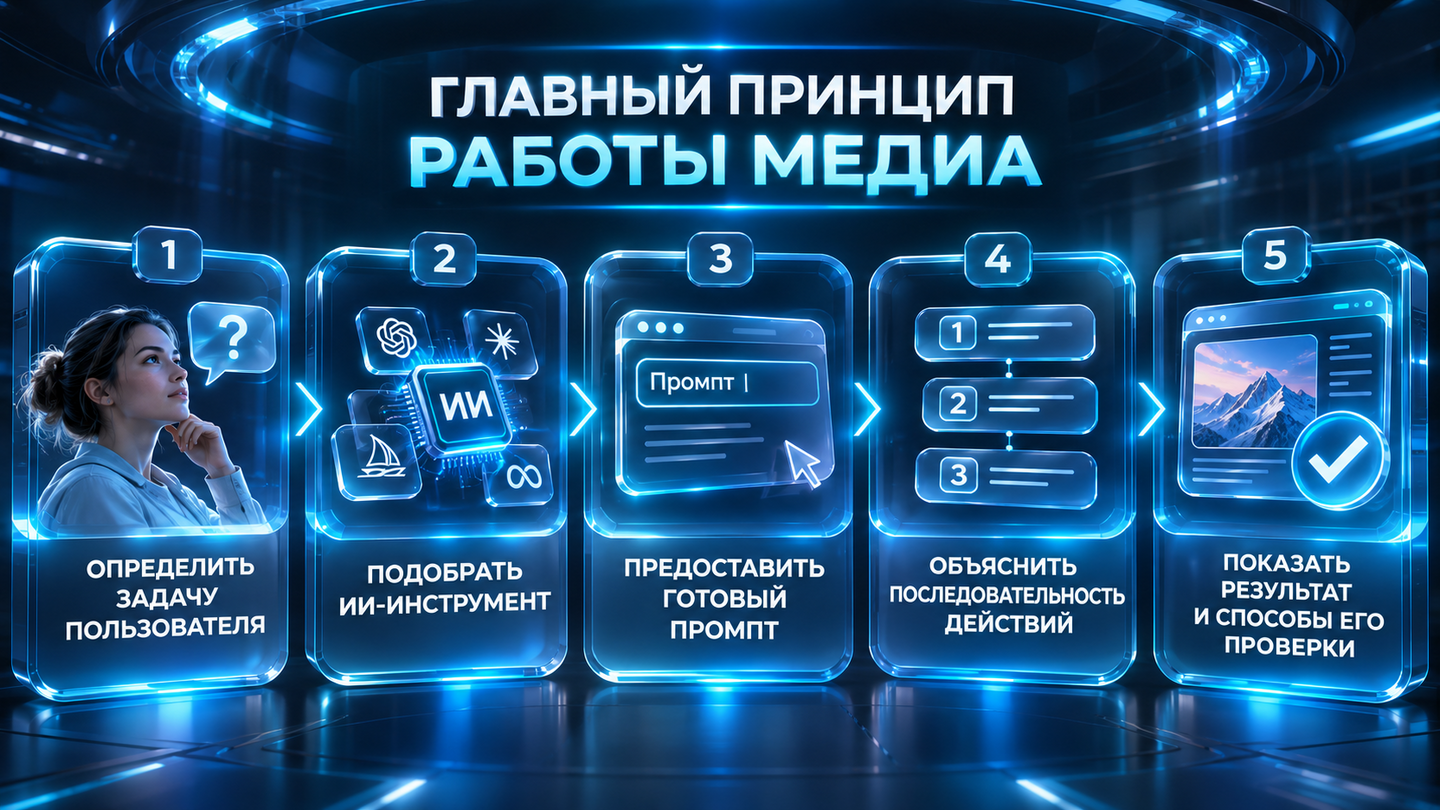
Positioning: NEURO is not a news feed about artificial intelligence—it is a practical digital assistant.
Tone of Voice: Friendly, calm, clear, and professional. Free from overly technical jargon or unsubstantiated promises.
2. Data Sources for Media
To generate materials, NEURO utilizes several groups of sources. These sources allow for the acquisition of current information, verification of AI service capabilities, and consideration of the audience’s real needs.
Data Selection Principle: Priority is given to primary sources and practical testing. Information regarding costs, rates, and features is verified immediately before publication.
3. Data schema with separation for human and machine processing
The media utilizes a hybrid model: the machine assists in collecting, structuring, and processing information, while the human is responsible for editorial judgment, accuracy, and final publication.
3.1. Data Processing
Machine processing involves processes that can be partially or fully automated using digital services and neural networks.— Gathering information from official websites and documentation. — Recognizing and extracting information from documents. — Structuring materials by thematic categories. — Drafting articles and instructions. — Generating headlines, descriptions, and prompts. — Preparing visual assets. — Adapting publications for different platforms.
3.2. Human Data Processing
Humans oversee the quality of information and make decisions that cannot be fully delegated to automated systems.
— Selecting relevant topics for publication.
— Verifying the accuracy of information.
— Testing AI tools on real-world tasks.
— Assessing the quality of generated results.
— Editing text and visual materials.
— Checking for limitations and confidentiality.
— Approving and publishing the final material.
— Analyzing audience response.
3.3. General Interaction Schema
Conclusion: Machine processing allows for the accelerated production of content, while human involvement preserves the authenticity, quality, and practical value of the materials. The final decision regarding publication always remains with the editorial team.
4. Guidelines for Automated Services in the Scheme
For content production, NEURO utilizes automated services that assist at various stages of the workflow—from information retrieval to preparing visual assets and publishing. The main principle is that each service performs a specific function, and its output undergoes editorial review.
4.1. Automated Services Utilized
4.2. Terms of Service Usage
1. Working with Textual Information
— Providing the service with a specific task and the necessary source data.
— Specifying the format, volume, and style of the resulting material.
— Prohibiting the generation of unverified facts and figures.
— Verifying the received text against the primary sources.
2. Working with Visual Content
— Utilize image generation for illustrations and visual concepts.
— Maintain a unified style across all media оформления.
— Verify that images align with the publication’s content.
— Do not use images that misrepresent real events or individuals.
3. Data Search and Analysis
— Prioritize official sources.
— Verify the publication date and timeliness of the information.
— Cross-reference data from multiple sources.
— Do not publish automatically generated facts without verification.
4. Publication Automation
— Utilize automation for content migration, draft preparation, and publication scheduling.
— Mandate manual review and approval before any material goes live.
— Do not grant automated systems the authority to publish unverified information independently.
5. Security and Privacy
— Do not upload personal or confidential data without appropriate permission.
— Verify the terms for data storage and processing by the services.
— Do not share access credentials or passwords in prompts.
— Observe copyright and material usage rules.