Небо вместо потолка
Иллюзорные росписи итальянского барокко XVII века
Concept
The ceiling is usually perceived as the natural boundary of a room—a surface that completes the space and separates a person from the outside world. However, in the 17th century, Italian artists began to change this common perception. Instead of merely decorating the ceilings of palaces and churches, they created entire illusory spaces on them, where the architecture seemed to continue upward, the walls dissolved, and an infinite sky opened above the viewer. The pictorial representation became so convincing that it was difficult for a person to distinguish the real architecture from the painted one.
It is this transformation—turning an ordinary ceiling into an illusion of open space—that forms the foundation of my research. I am interested in understanding how artists managed to achieve such an effect and why it became such an important element of Baroque art. I will examine not only the frescoes themselves but also the ways painting interacts with architecture, as well as with the person standing inside the space and viewing the image from below.
To create an illusion, artists utilized various artistic and perspective techniques. They depicted continuations of real architectural elements, constructed complex perspective compositions, applied strong angular foreshortening to figures, and generated an impression of depth where only a flat surface physically existed. One of the main techniques was quadratura—a specific form of painting in which non-existent architectural structures—columns, cornices, arches, and balconies—were depicted on the ceiling. This gave the viewer the sensation that the room extended beyond its actual walls.
Such murals were originally designed with a specific viewer position in mind. Artists factored in the room’s height, viewing angle, and perspective, so the image could appear voluminous and convincing only from the chosen vantage point. This meant the viewer became an integral part of the artistic conception: to fully perceive the illusion, one had to be inside the space, looking up, and experiencing the mural in conjunction with the surrounding architecture.
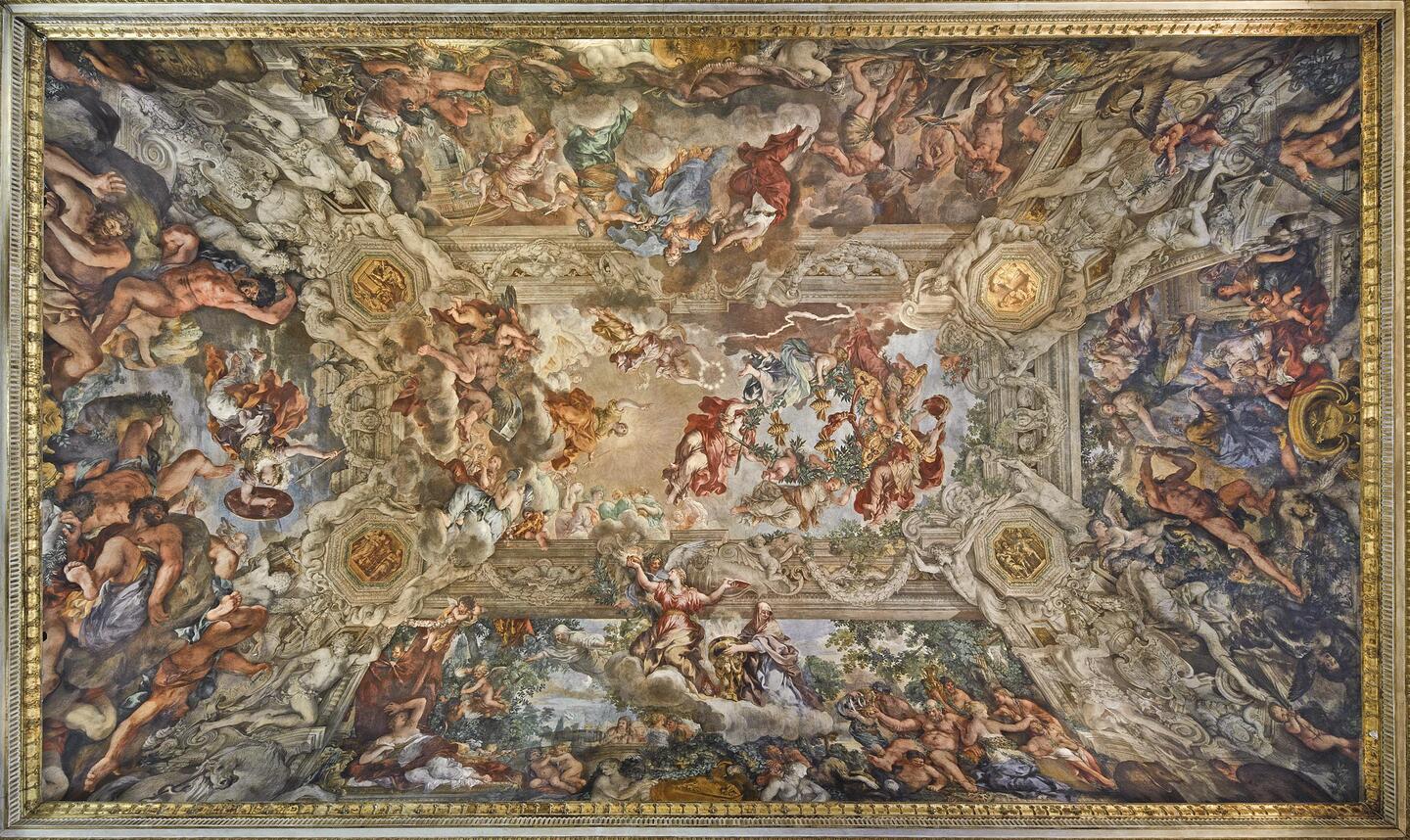
In this study, I examine several works from 17th-century Italian Baroque that particularly illuminate the development of illusionism. Among these are Pietro da Cortona’s fresco in the Palazzo Barberini, Giovanni Battista Gaulli’s «Triumph of Jesus» in the Church of Il Gesù, and the works of Andrea Pozzo in the Church of Sant’Ignazio.
Through their work, one can trace how the methods of creating illusory space evolved: from large-scale, multi-figure compositions to complex perspective constructions in which painting virtually transforms the perception of architecture.
Illusion was not merely a decorative technique; it helped convey ideas, intensify the emotional impact of the work, and alter the very perception of space.
The visual research is built upon a sequential examination of the historical prerequisites, the most representative works, and the primary artistic techniques used in creating illusionistic frescoes.
Particular significance will be given to the analysis of individual details: transitions between actual and painted architecture, perspective foreshortening, the placement of figures, and the nuances of perceiving the frescoes from different viewpoints.
The central premise of this research is that Baroque illusionistic frescoes altered the conventional role of the ceiling in architecture. It ceased to be merely the upper boundary of a space and transformed into an independent artistic expanse that visually expanded the interior, creating a sensation of transcendence beyond its actual confines.
By studying these works, I want to demonstrate how, using painting, perspective, and precise calculation, 17th-century artists created the illusion of space—a space that did not actually exist, but which the viewer could believe in.
Premises of Illusionistic Painting
Techniques for creating illusory space appeared long before the 17th century. Even Renaissance artists experimented with perspective, angles, and the depiction of architecture that visually expanded the real boundaries of a room. These experiments became a vital foundation for the further development of Baroque painting.
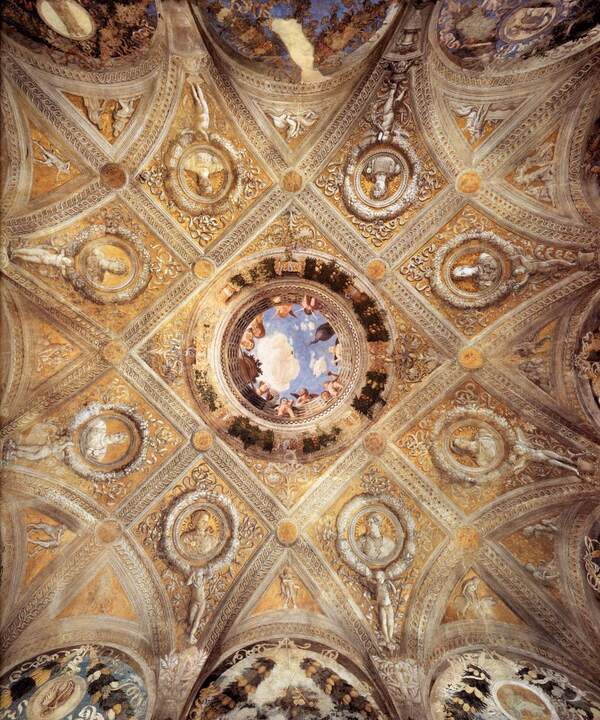
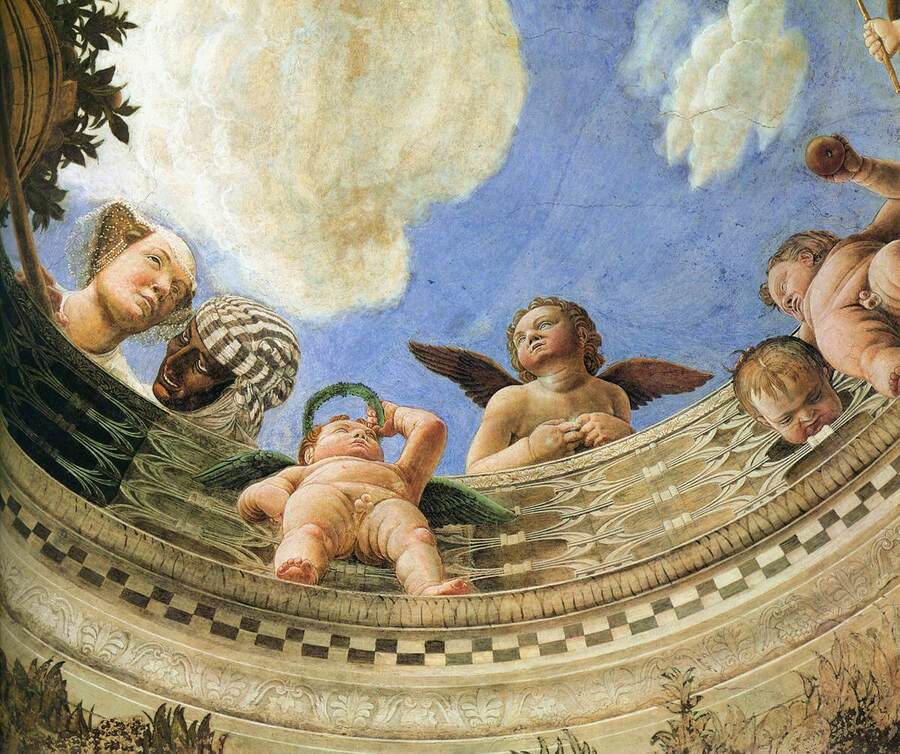
Andrea Mantegna. «Oculus.» Ceiling fresco in the Camera degli Sposi, 1465–1474. Ducal Palace, Mantua, Italy.
Andrea Mantegna depicted a circular opening in the ceiling, through which the sky seems to open. The use of perspective creates the illusion that the ceiling genuinely has a hole.
Here, Mantegna employs the di sotto in sù technique—“from below looking up.» The figures are depicted accounting for the perspective of a person standing beneath the ceiling; we see them as if they are truly above us.
This technique allowed the artist to transform a flat surface into the illusion of open space.
Antonio da Correggio. «The Assumption of the Virgin.» 1526–1530. Fresco painting of the Parma Cathedral dome, Parma, Italy.
The artist sought to create the impression that the dome did not end in a vault, but transitioned into the celestial expanse. The figures seem to ascend, gradually receding from the viewer.
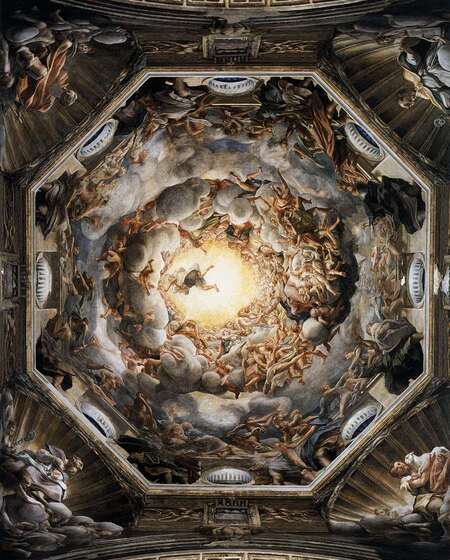
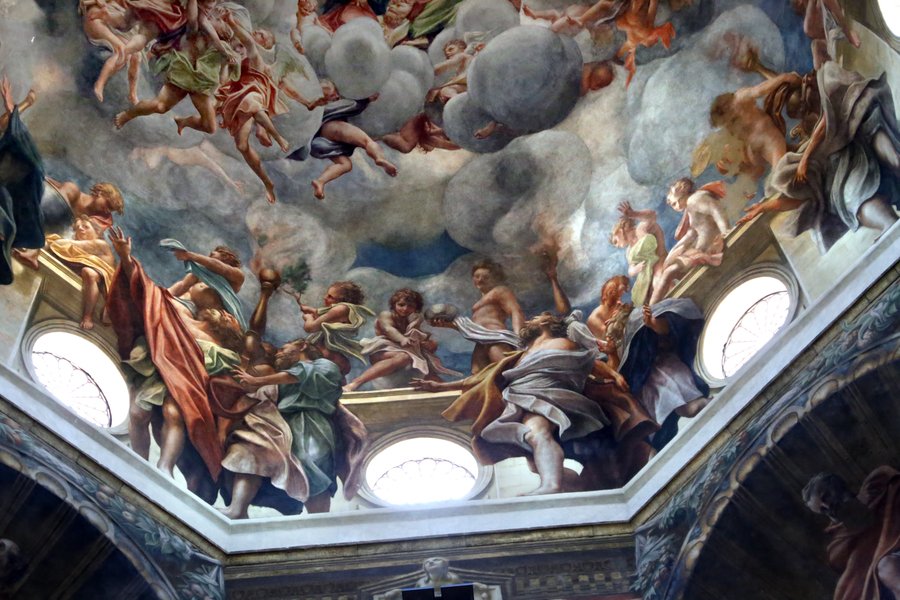
In the fresco of the Parma Cathedral dome, Correggio develops the technique of depicting figures from a low to high angle. He utilizes perspective foreshortening: body parts closer to the viewer appear larger, and those further away appear smaller.
The figures are arranged on different levels amidst clouds, creating movement toward the center of the dome.
Unlike Mantegna’s small illusory opening, almost the entire surface of the dome is transformed by Correggio into a single celestial space.
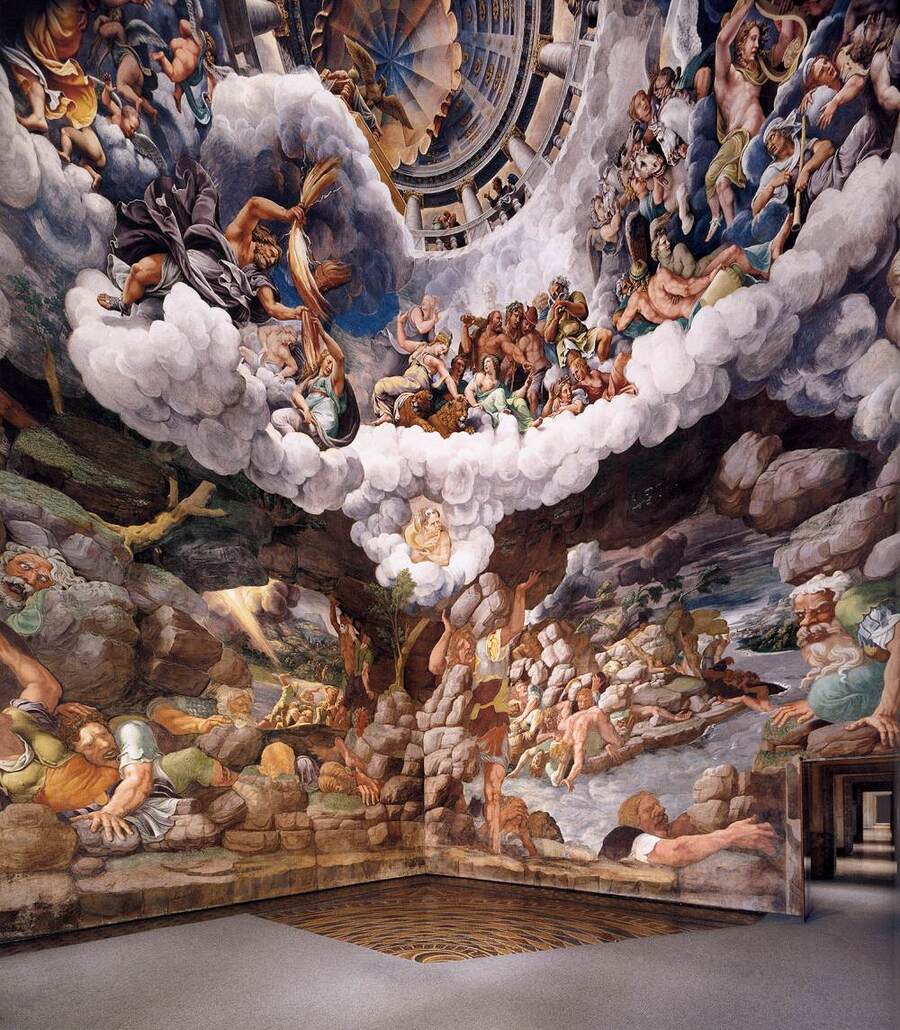
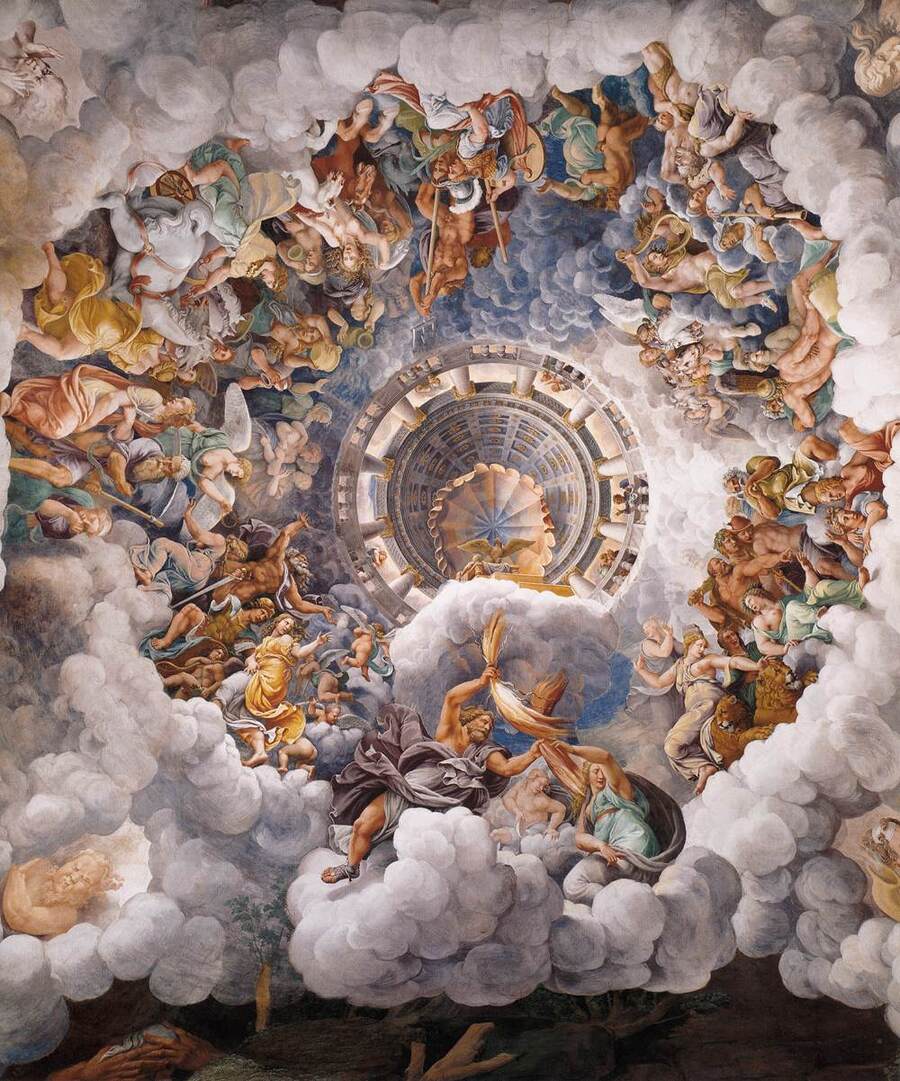
Giulio Romano and workshop. «The Fall of the Giants.» c. 1532–1535. Fresco in the Hall of Giants, Palazzo Te, Mantua, Italy
The walls and ceiling of the space are unified into one large composition. The depicted space seems to envelop the viewer, and the boundaries between individual surfaces almost vanish.
In the Hall of Giants, painting is not limited to individual canvases on the walls. It envelops the entire space, creating the impression of a singular event. The viewer finds themselves inside the depicted world—a principle especially vital for understanding Baroque frescoes, where the interior becomes integral to the artistic composition.
Annibale Carracci and the Workshop. Fresco Painting of the Farnese Gallery Vault. 1597–1602. Palazzo Farnese, Rome, Italy.
The composition consists of numerous images framed by drawn architectural and decorative elements. The ceiling resembles a collection of paintings arranged within an intricate system of frames.
Caracci employed illusionistic frames, sculptural elements, and architectural details to organize the ceiling space. In contrast to Correggio, who created the impression of a single celestial space, Caracci divides the vault into individual compositions. Nevertheless, the painted architectural elements create an illusion of volume and help unify the different scenes into a single whole.