Москва закрашенная: боится ли мэрия граффити?
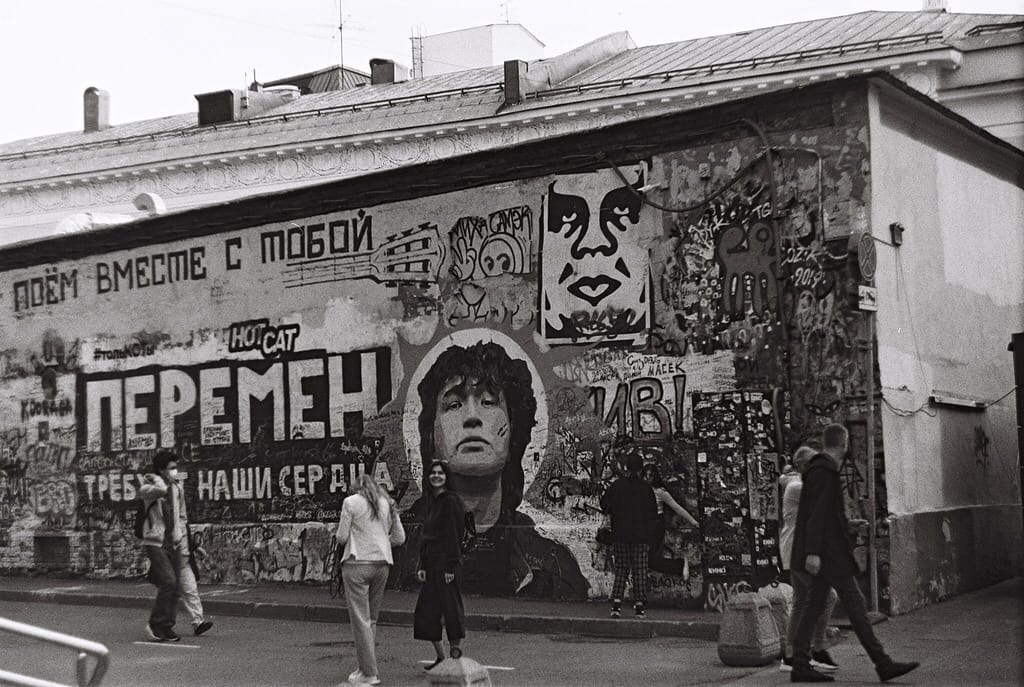
On June 9, 2025, Moscow’s most famous wall was painted over.
From the Viktor Tsoi memorial on Old Arbat, building 37, only the name and a fresh coat of stucco remained by morning.
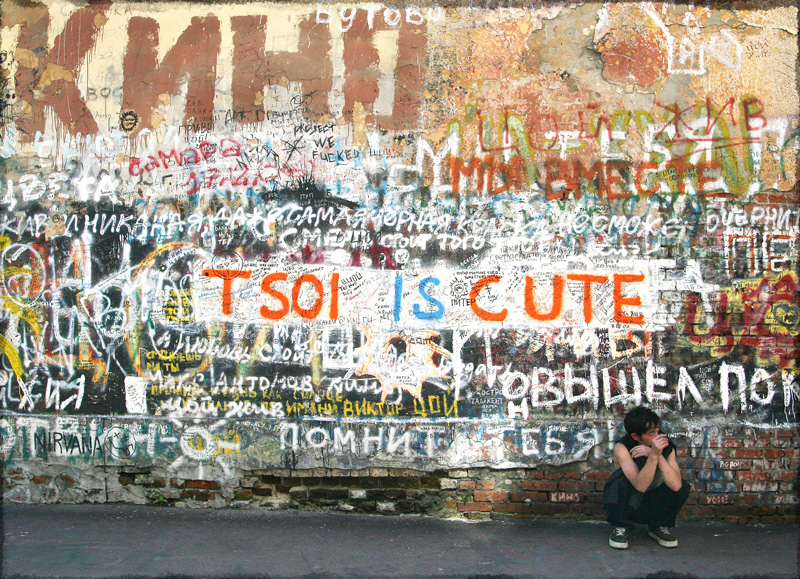
Limitchik
Officially, by the city’s decree, it was repainted, and in return, a large portrait of the musician, a recognizable face from the film «The Needle, ” was promised. For a wall that had existed with spontaneous graffiti for thirty-five years, this was an unprecedented turn. Previously, the local residents covered and restored it themselves, but now the city administration took up the brush.
The history of this wall reflects the entire history of Moscow’s relationship with street art. It first appeared in 1990, right after Tsoi’s death: someone wrote „Tsoi lives,“ and soon the inscription was surrounded by hundreds of others. The residents of the building would paint over the wall, tired of the pilgrims, the housing office would repaint it, and other fans would plaster over it. In the spring of 2025, a real graffiti war broke out here. Fans of the late rapper Pasha Tekhnik painted over Tsoi and wrote their own message over it, but Tsoi’s fans soon restored it. Before that, in 2019, fans of „Dynamo“ offered their own vision of Arbat. The wall has been repainted so many times that its current appearance is always just the latest layer in a decades-long accretion of paint.
There are many places like this in the city. Moscow has long operated on a rhythm where some draw while others color in, and this cycle repeats for months and years.
Sometimes, what lands on the brush isn’t a protest, but art—usually by pure chance. In Belyaevo, on Profsoyuznaya Street, there lived for many years a mural titled «AY"—a massive portrait of the poet and artist Dmitry Prigov, created by the Zukclub team. In June 2022, a local housing manager painted it over during routine facade repairs, classifying the piece as graffiti slated for removal. Following protests from residents and media attention, the mural was restored. The artist, street artist Sergei Ovseikin, has since often stressed that street art in Moscow has no protection from the municipal brush: today a piece adorns a neighborhood, tomorrow it is painted over by a mandated crew.
Moscow, 1-y Kolobovsky 7/10, gable wall painting.
This incident is not isolated. In 2019, an entire wave of graffiti occurred throughout the city that urban preservationists remembered by name. Back then, Finan Magie’s mural on Rozhdestvenskaya Street disappeared, a piece on Begovaya vanished, and a portrait on Bauman Street was painted over. These works were featured in guidebooks and on tourist maps, yet for municipal crews, they were cataloged just like tags in the courtyard—simple markings on the facade.
The history of legal graffiti in Moscow is short and quite telling. The starting point was the summer of 2013, when the Department of Culture, under Sergey Kapkov, hosted the «Best City in the World» festival, and its graffiti program was developed in collaboration with the creative collective Artmosfera. In a couple of months, the city sprouted dozens of works by renowned street artists, ranging from Moscow locals like Zukclub to international stars. At the time, the system was temporary: organizers would petition the district administration, receive approval for a specific wall, then negotiate with the building owner, and the entire process relied on a mayoral decree issued specifically for the festival.
Permanent rules only appeared six years later. On July 16, 2019, Moscow Government Decree No. 877-PP was issued—the first document in Russia to lay the foundation for the legalization of street art.
Moscow became the first city in the country to establish some formal procedure: where to take a sketch, who to consult with, and who is responsible for a wall. The law also has a downside, which led artists to view it ambiguously. Under the law, anyone who creates artwork in the city is obligated to budget for its restoration within the next five years, and this responsibility falls to either the creator or the property owner. In practice, the approval process is drawn out across several city agencies—from Moscomarchitecture to the property management company—making it so difficult to bring an idea to a legal wall that the artist is left to draw without permission and wait for it to be painted over. According to municipal services, approximately seventeen thousand unauthorized inscriptions and drawings are removed in Moscow every year. Seventeen thousand is about forty-six per day, without weekends.
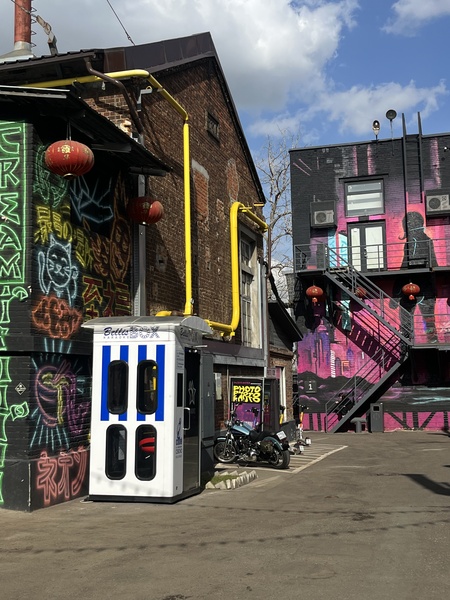
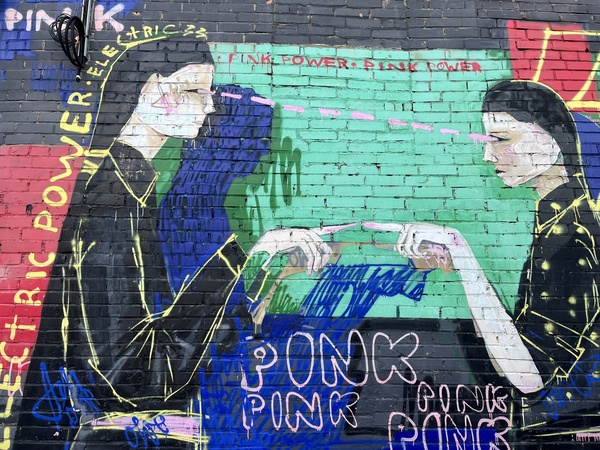
Flacon Design Factory
The same city that erases seventeen thousand drawings annually simultaneously hosts the «Artmosfera» street art festival, maintains legal venues at «Vinzavod» with its famous «Wall» and at «Flakon,» and the chief architect of Moscow, Sergey Kuznetsov, publicly discusses the development of street art and opens graffiti exhibitions near «Kurskaya.» There are also unofficial halls of fame—the courtyards at Mendeleevskaya and Pushkinskaya—where drawing is almost openly permitted. This creates a dichotomy: graffiti on designated sites is considered urban culture and a «highlight,» while on ordinary facades, it is considered trash that must be scrubbed off within 24 hours.
It’s not about fear at all. The city is fine with graffiti as long as it can control it. A sanctioned mural on a designated wall, a festival with curators, an exhibition with signage—that’s a version of street art that can be displayed without anyone taking responsibility. You can’t predict spontaneous tagging on a residential building, so it’s easier to erase by default than to figure out whether it’s just litter or a piece on the level of a Prigovsky mural.
There is someone who views this topic from both sides. Curator Sabina Chagina created street projects for the city, including the famous «Best City in the World» campaign, which left about one and a half hundred murals in Moscow. A few years later, they began to be painted over. Her take on street art is this: graffiti artists show where the city is hurting. Tags appear on buildings and fences where something is wrong—where it is empty, abandoned, or run-down—and it’s cheaper to paint over it than to actually fix the building. Chagina and other artists have been advocating for years that the city establish a registry of protected murals—a list of works that cannot be altered during renovations. Since no registry exists, the fate of every wall is left to chance: it will either be noticed and protected or painted over along the way.
Is the mayor’s office afraid of graffiti? More accurately, it is taming it. The Tsoy wall beneath the official portrait from «Igla» is the pinnacle of this taming process: in place of the chaos of unapproved, uncontrollable colorful tags, one approved, beautiful, unchangeable image will stand. For thirty-five years, this wall breathed freely because no one controlled it. Soon, it will become a landmark that cannot be touched.