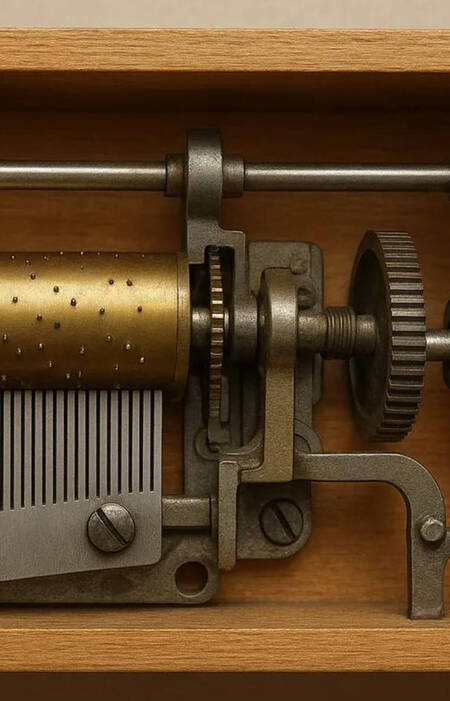
Sound Generation Mechanism in a Music Box: Interaction of the Pin Wheel and Comb
Theme and Concept
The place of the mechanical music box in the history of sound technology is unique: it is neither an extension of a «musical instrument» in the traditional sense (as there is no physical involvement from a performer, nor is there continuous excitation of strings or pipes), nor is it a «sound recording device, ” because the music it „reproduces“ is not the result of capturing a past acoustic event. The music box stores a set of spatially organized instructions specifying „when and which specific comb tooth should be set into vibration“; the sound it emits is the result of sequentially executing these instructions under the conditions of metal elasticity and acoustic interaction with the air. At its core lies the interaction between the pin cylinder and the comb of teeth.
The spatial distribution of pins on the cylinder surface represents a translation of a melody unfolding over time into a preserved spatial pattern; the vibration of the tongue after excitation, in turn, releases this pattern again as temporal sound events. The interaction between the pin cylinder and the comb of the tongues generates something that can be termed a «mechanical sound image»: it is simultaneously an auditory phenomenon and, in its own mechanism of generation, intrinsically contains visual and spatial legibility. It is this duality that makes the music box in 19th-century culture both a marvel of precision mechanics and a vessel for intimate emotion.
The History of the Music Box: Origin and Development

Early Golden Musical Tabatière
Early Origins of Mechanical Music The appearance of the music box was not sudden; it was the result of humanity’s long search for ways to achieve automated, mechanical sound production. Long before the mechanical music box existed, people were already using gear trains, rollers, and mechanical devices to control the playing of bells and carillons. Early automatic carillons utilized a rotating roller with studs that, through mechanical movement, sequentially activated different bells, producing a pre-set melody. This method laid the foundation for the subsequent mechanical sound production principle of the music box.
1796: A crucial starting point in the history of the modern music box In 1796, the Geneva watchmaker Antoine Favre-Salomon combined tuned metal reeds with a mechanical drive system, creating an early comb mechanism for the music box. This innovation freed the music box from the need to rely on traditional bells: different pitches were now created by metal reeds of varying lengths, allowing mechanical musical devices to become more compact.
Swiss Geneva Singing Bird Musical Box (c. 1820)
The 19th Century: Maturity and Diffusion of the Music Box In the 19th century, the Swiss town of Sainte-Croix gradually became an important center for music box production. The design of the music boxes was continuously refined: combs with a greater number of tuning pins appeared, more complex melodies were introduced, and interchangeable cylinders were developed. By the end of the 19th century, music boxes began to incorporate more sophisticated sound mechanisms, and some models started featuring bells, drums, and other percussion instruments.
Swiss Enamel and Gold Musical Snuff Box
Conclusion of the historical research: the evolution of the music box reflects the transition of mechanical technology from automatic movement control to automatic sound control. Its key innovation lay in transforming a musical melody into information that could be read and performed by a mechanical construction.
Internal mechanical mechanism of a music box
Antique Swiss Cylinder Music Box Mechanism
A traditional music box with a cylinder consists mainly of the following mechanical units:
Spring Mechanism The spring is the power source of the music box. When the user turns the key or handle, it causes elastic deformation in the internal metal spring, which accumulates mechanical energy. Upon starting the music box, the spring gradually releases its energy, driving the gear system.
Gear Train A gear system transfers the energy released by a spring to a roller and regulates its rotation. The gear ratio between different cogs determines the roller’s rotational speed and affects the pace of the music playback.
Speed Governor The speed governor serves to limit and stabilize the rotational frequency of a mechanical system, preventing the shaft from spinning too fast or unevenly when the spring energy is released.
Pin Roller The surface of the roller features metal pins arranged in a specific musical sequence. As the roller spins, these pins alternately strike the various tines of the sound comb.
Sound comb A sound comb is typically made from a solid piece of steel that has undergone precise machining and tuning. It consists of numerous metal tines of varying lengths and with different vibrational characteristics; each tine corresponds to a specific pitch.
Resonant Body The wooden body and internal mounting structure influence sound propagation and resonance, which makes the sound produced by the tiny metal tines clearer and richer.
Antique Cylinder Music Box Movement
Vintage Reuge Swiss Music Box Mechanism
Antique Longue Marche Cylinder Music Box
Victorian Cylinder Music Box Mechanism (c. 1880)
Swiss Music Box Mechanism
Pin Roller: Mechanical Encoding of Melody
Pin Barrel Mechanism The pin barrel is the central component of a music box, responsible for storing and playing back melodic information. It typically consists of a metal cylinder affixed with numerous small metal pins on its surface. The position of each pin is precisely calculated so that, as the barrel rotates, it activates the corresponding comb tine. The pins on the barrel are not arranged randomly; their mechanical placement corresponds to the notes, rhythm, and performance sequence of the musical piece.
LeCoultre Frères Pinned Brass Cylinder (c.1880)
The Principle of Mechanical Melody Encoding The pins on the roller surface can be seen as a type of mechanized score: • Position along the roller axis: corresponds to the tines of the comb with different pitches. • Position around the circumference: determines when the note is sounded. • Density of pin placement: influences the chord structure and rhythmic execution. • Number and distribution of pins: define the musical content to be played. As the roller turns, the pins located in different positions activate the comb tines in a set sequence, forming a complete melody.