What should a student reading for the first time in their academic life read? The Ad Marginem publishing house surveyed several teachers, translators, and editors to help the emerging university generation navigate their catalog of published literature.
Among those who shared their recommendations was Associate Professor Alexey Salin from the HSE Art and Design School. With the kind permission of the publisher Ad Marginem, we are publishing the advice he compiled.
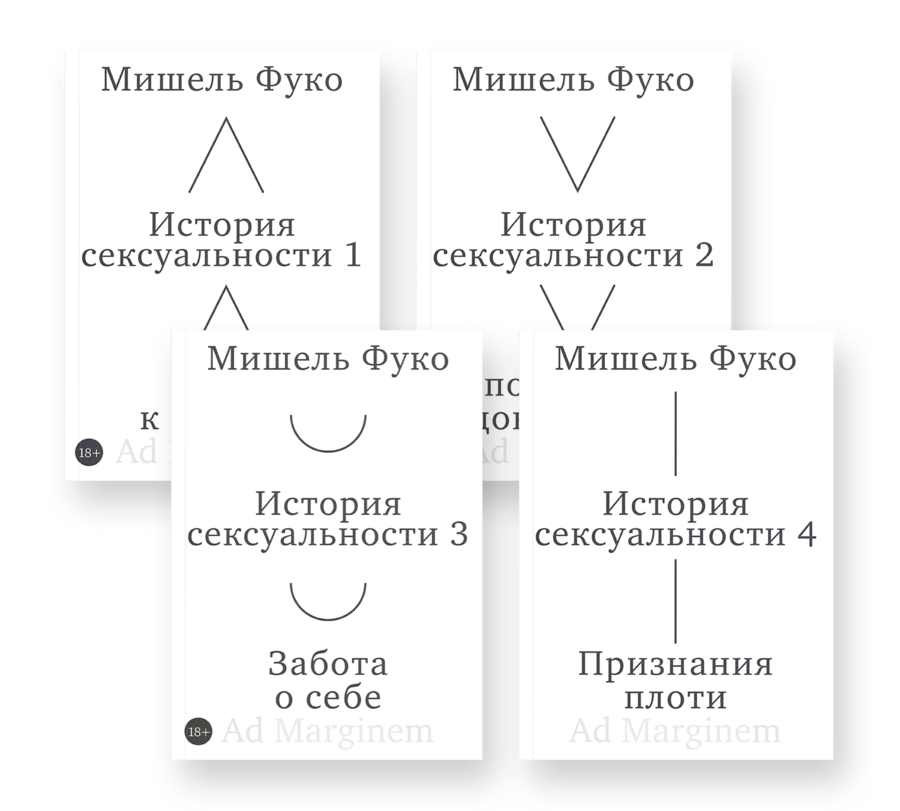
Michel Foucault’s foundational research will be valuable to students in the new academic year because it allows them to view classical texts from an unconventional perspective—through the history of practices where the subject constructs the self through interaction with self and other—such as the philosopher, teacher, spiritual advisor, or psychoanalyst. This approach starkly contrasts with the standard cataloging of names, dates, or summarizing main points, or at best, discussing the nuances of translating classical texts, which is often heard in philosophy history classes. Foucault’s work is a prime example of how the study of classical texts can remain contemporary and even highly relevant, given how politically charged the topics of psychotherapy, sexuality, and self-care have become today.
This book will serve as an excellent starting point for delving into Stoicism. The author’s works are already familiar to the Russian reader, but while their previous writings focused on popular science on how to apply the ideas of Marcus Aurelius and Epictetus to modern life, this volume is a fundamental scholarly treatise. This is evident, at the very least, in the bibliography and the meticulous handling of sources, quotations, and so on. Much like Foucault’s foundational research, this book will be a valuable resource for student papers, presentations, and essays.
Karl Schmitt. Land and Sea
This text allows students to engage with the living source of contemporary geopolitical reflections on land civilizations and sea civilizations, using Dugin’s terminology of talassocracies and tellurocracies. The book is fascinating because it is simultaneously a phenomenological experience, a survey of world history, and an excursion into the history of ideas—all of which Schmitt originally addressed to his twelve-year-old daughter, lending it a remarkably narrative quality. The book will be valuable for students across all social and humanities disciplines as an introduction to the current geopolitical situation, particularly in the fields of seafaring and international maritime law.
Wolfram Ailenberger. The Time of Magicians. The Flame of Freedom. The Spirit of Modernity
Wolfram Eisenberger proposes viewing the history of twentieth-century philosophy as a series of thematic intersections that sometimes overlap and bring together the studied authors. The 1920s emerge as a period of debates concerning language as a universal medium for philosophy and the understanding of the world in general—among Benjamin, Heidegger, Cassirer, and Wittgenstein—a theme explored in «The Time of Magicians.» The 1930s and 1940s were a time of searching for freedom in common with the world, shared by four heroines: Rand, Adorno, de Beauvoir, and Weil—which is detailed in the second volume of Eisenberger’s intellectual biographies, «The Flame of Freedom.» Finally, «The Spirit of Modernity» addresses the search for ways to protect the very freedom that the heroines of the previous book sought, and to prevent the resurgence of oppressive fascist ideas about authenticity and identity: here, Foucault, Sontag, Adorno, and Feyerabend emerge as the main figures. Being as easy to read as works of fiction, Eisenberger’s intersecting intellectual biographies will allow students to take a break from complex philosophical treatises while simultaneously providing a clear foundation for their understanding based on the lives of the authors. Finally, understanding how difficult it was for their idols to navigate the numerous challenges of their own academic years will surely offer comfort to students facing many problems during their studies.
Theodor W. Adorno. Introduction to the Sociology of Music
I must recommend this book as its translator. The book is timely because it offers a sociological analysis not only of the social context of music and its reception but ventures into the deepest territory—to sociologically interpret the musical content of the compositions themselves. For example, Beethoven’s works are read through the lens of the bourgeoisie’s struggle for its rights, making them isomorphic to the great works of German classical philosophy, particularly the «Phenomenology of Spirit.» At the same time, music does not merely reflect musical antagonisms or attempt to level or legitimize them as a superstructure in classical Marxist philosophy; it also becomes the site where the antagonism between productive forces and production relations unfolds. This occurs, for instance, when avant-garde works technically appropriate to the evolution of music fail to resonate with the general public, who demands excellent and authentic performances of classical masterpieces. The book is relevant to a wide range of students: sociologists, art historians, philosophers, and cultural theorists.
Today, people consume too much: the convenient ability to effortlessly access countless ideas stored in books and newspapers is training—or has already trained—the average person not to think independently or to recontextualize what they read, and that is the only way to make it truly their own.