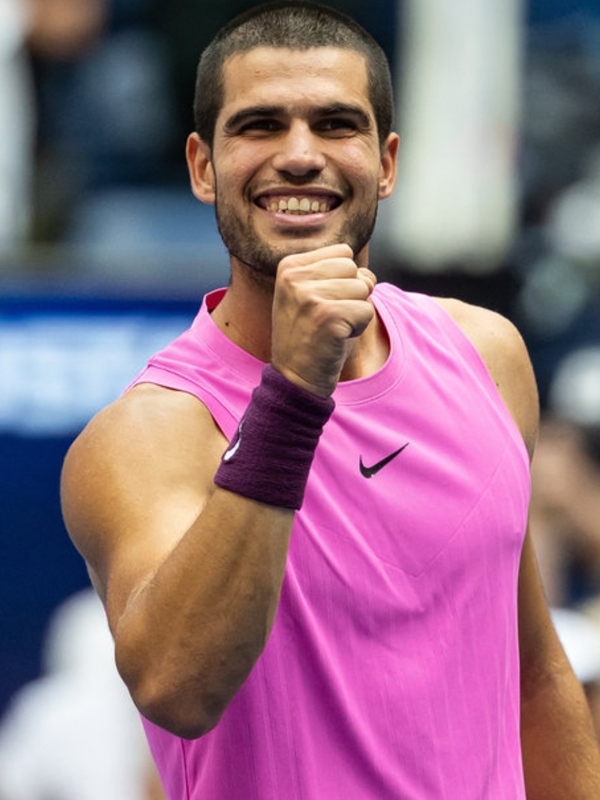
When the careers of Roger Federer and Rafael Nadal wound down, and Novak Djokovic approached 40, men’s tennis faced a central question: who would become the next superstar and lead the next generation? For a long time, it seemed the scale of the «Big Three» era was unparalleled. But it took Carlos Alcaraz only a couple of seasons to force everyone to take him seriously. Now, the discussion is no longer about whether the Spaniard can become a great athlete, but about what place he will occupy in the pantheon of legends.
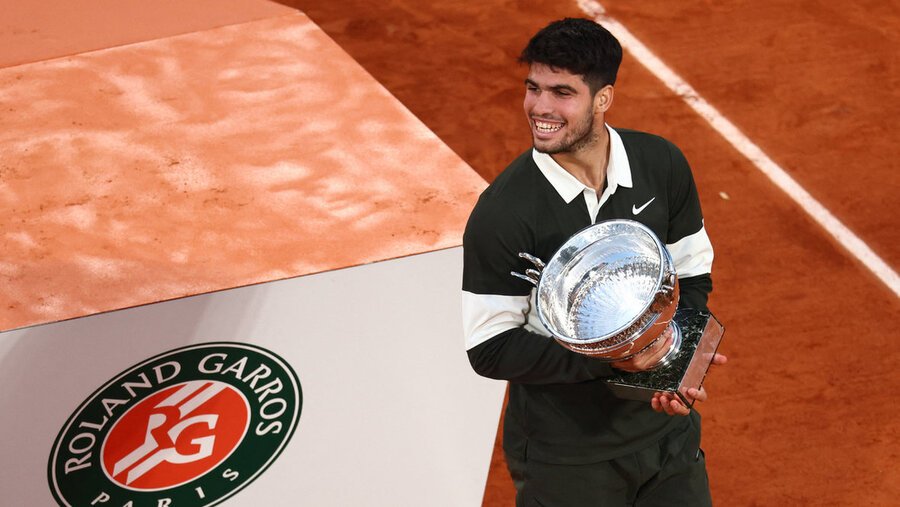
Photo by Reuters
By the age of 23, Carlos Alcaraz was already a world number one, holding four Grand Slam titles and starring in the matchups against Jannik Sinner. But it’s not just about the trophies. Alcaraz is a rare type of tennis player who combines attributes from different eras: the power of the modern athlete, the reliability of a baseline player, and a love for drop shots, net rushes, and pure improvisation.
We break down ten stages of his journey that transformed the Spanish tennis player into one of the leading athletes of the new generation.
1. Tennis has been with him since birth.
Alcaraz’s story doesn’t begin in a major academy or even one of Spain’s premier tennis centers. He was born in El Palmar—a small settlement near Murcia.
But tennis was in the Alcaraz family long before Carlos himself.
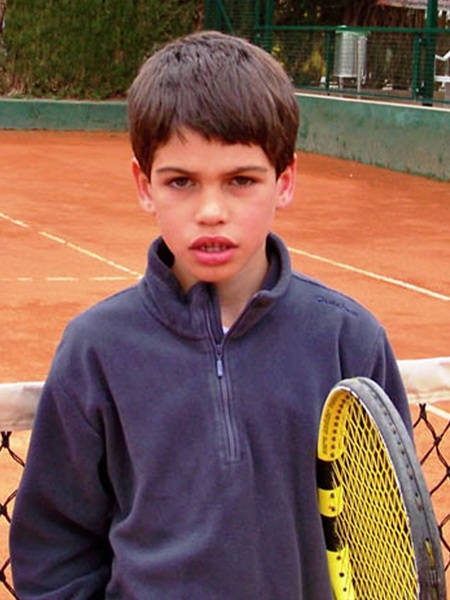
Around 40 years ago, his great-uncle was involved in establishing a local tennis club on the site of a clay pigeon shooting range. Carlos’s grandfather joined the project, and later, his father, Carlos Alcaraz Gonzalez, became the club’s director. His father was also involved in tennis and attempted to build a professional career, but at some point, he was forced to give it up, partly due to financial constraints.
Therefore, the saying «born with a racquet in hand» hardly seems like an exaggeration in Alcaraz’s case. He received his first racquet around the age of four. His father recalls that Carlos hated ending his practice sessions so much that he would become upset when it was time to leave the court and go home.
Tennis was not just a family matter for his father and son. Alvaro’s older brother also participated in tournaments, and his younger brothers grew up within the same tennis environment.
But even as a child, Carlos possessed a distinguishing trait. He wasn’t simply interested in hitting the ball from the baseline. He loved to be creative: to slice shots, advance to the net, change direction, and alter pace.
This early habit would later form the foundation of the adult Alcaraz. Many contemporary players build their game around a few incredibly effective tools. Alcaraz, conversely, seems to be constantly seeking yet another way to win a rally and experiment with his play.
At the age of 15, his career was entrusted to a person who was himself a world-class leader.
The next decisive step was Juan Carlos Ferrero. For Spanish tennis, this is by no means a random name. Ferrero won Roland Garros in 2003 and became the world number one. After retiring, he moved into coaching and eventually saw potential in the teenager from Murcia. Alcaraz began working with him in 2018, when he was only 15 years old.

Ferro’s task was not to teach the teenager how to hit the ball correctly—his talent was already evident. He needed to transform an exceptionally gifted junior into an athlete capable of handling the physical and psychological demands of professional tennis.
Alcaraz needed to become stronger, improve his serve, learn when to time an attack more accurately, and discern when his fondness for spectacular solutions helps, and when it forces him to take unnecessary risks.
This is why Ferro’s influence on his career cannot be reduced to a typical «coach–player» relationship. Alcaraz arrived as a teenager and left as a multiple Grand Slam champion and former world number one. Their collaboration lasted seven years, concluding only at the end of 2025.
By that time, Alcaraz had completed the journey from a promising junior to a global superstar. After finishing his work with Ferro, Samuel Lopez became his head coach.
3. The first ATP match ended at three in the morning and already told us a lot about Alcaraz’s future.
In February 2020, Carlos was 16 years old. In the world rankings, he held the 406th position.
The Spaniard gained entry into the ATP 500 tournament in Rio de Janeiro via a wild card. This is a special personal invitation from the tournament organizers that allows a player to enter the main draw or the qualifying rounds, bypassing standard ranking procedures or prerequisite rounds. His opponent was a significantly more experienced compatriot, Albert Ramos-Vinolas.
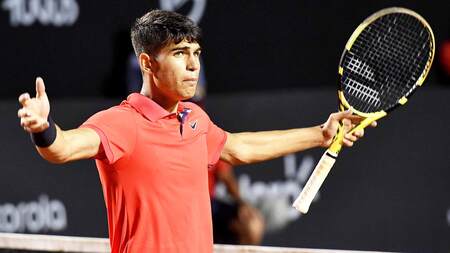
For most 16-year-olds, simply participating in such a tournament would have been a significant experience. Alcaraz went further and won a grueling match.
The match lasted 3 hours and 37 minutes, concluding at three in the morning local time. Alcaraz won 7–6, 4–6, 7–6. At that moment, it was the longest and most intense match of his career.
After the match, he said he would remember Rio forever. But what is even more interesting is that a quality manifested then—one that would become one of his hallmarks several years later.
Alcaraz is comfortable in chaos.
He can lose an advantage, drop several games in a row, and still continue looking for a way to turn the match around. He is not a tennis player who requires a perfect scenario to win.
Rio was still far from the «Grand Slam, ” but this first ATP match unexpectedly became a miniature version of many of Alcaraz’s future victories: long, nervous, dramatic, and with a feeling that at the decisive moment, he plays even bolder and more confidently.
4. At eighteen, the word «promising» felt too modest for him.
The 2021 season was the moment Alcaraz stopped being merely a prospect for Spanish tennis. In July, he won his first ATP title in Umag, Croatia, at the age of 18. However, what was even more significant was the level of results he began producing across the numerous tournaments he entered.

At the US Open, Alcaraz defeated world number three Stefanos Tsitsipas to reach the quarterfinals. Later, Matteo Berrettini, who was ranked in the top 10, also won. He has increasingly demonstrated that he is capable of playing against physically developed ATP stars right now, rather than waiting several years.
The season culminated at the Next Gen ATP Finals in Milan—a tournament for the best young players.
Alcaraz navigated it almost flawlessly: five wins in five matches and only one lost set. In the final, he defeated Sebastian Cordu 4–3, 4–2, 4–2.
The ATP also noted another telling detail: Alcaraz became the youngest tennis player since 1992 to win 32 ATP-level matches in a single season.
However, numbers only explain part of what happened.
On the court, the Alcaraz the world would soon recognize was already emerging: a powerful forehand, a drive to play inside the court, the ability to abruptly shorten his shots after several difficult strikes, and a constant drive to attack his opponents.
In a single season, he progressed from the number 32 to the youngest world No. 1 player.
If 2021 was a breakthrough, 2022 looked like the accelerated playback of a superstar’s career.
Alcaraz began the season ranked 32nd in the world. Then, he started winning so quickly that the rankings struggled to keep pace with his results.
He won the ATP 500 tournament in Rio, followed by his first Masters 1000 in Miami. But arguably his most significant performance was in Madrid.

In just a few days, Alcaraz sequentially defeated Rafael Nadal, Novak Djokovic, and Alexander Zverev. The first two victories were particularly symbolic: the Spanish teenager nearly consecutively beat two figures who had defined men’s tennis over the previous fifteen years.
But the real transition into a different category occurred at the US Open.
The tournament turned into an exhausting marathon. Alcaraz played several grueling five-set matches, including the famous quarterfinal against Jannik Sinner. The match ended late at night and already offered the first glimpse into what the main rivalry of the next generation could become.
In the final, Alcaraz beat Casper Ruud and won his first Grand Slam title at the age of 19.
Simultaneously with the trophy, he achieved the status of the world number one. Alcaraz became the youngest man ever to lead the ATP rankings.
6. Wimbledon 2023 proved that Alcaraz is capable of defeating great competitors even when he does not have the advantage.
By the start of the tournament, Alcaraz already held a Grand Slam title and the top ranking.
But one important question remained.
The Spaniard had primarily developed on clay courts and had significantly less experience on grass compared to hard or clay. On the other side of the net in the final, he was set to face Novak Djokovic.
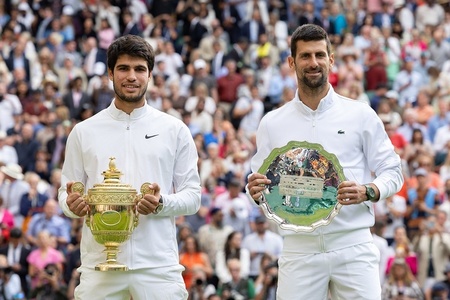
Djokovic had won the previous four Wimbledon tournaments, and on the Center Court, he hadn’t lost for ten years—since the 2013 final.Furthermore, just a few weeks earlier, he had defeated Alcaraz in the Roland Garros semifinal, where the Spaniard experienced spasms under immense pressure.It seemed the psychological advantage was entirely on the Serb’s side, and the final lasted almost five hours.Alcaraz lost the first set 1–6, but instead of completely falling apart, he gradually restructured his game. He began using drop shots more actively, moved toward the net more frequently, and tried to prevent Djokovic from dictating his usual pace.Ultimately, the Spaniard won in five sets.This is perhaps one of the most crucial matches for understanding Alcaraz. He didn’t just defeat Djokovic. He did it on a surface where he had less experience, after a disastrous first set, and against one of the greatest players in history.A year later, he proved it wasn’t a fluke: in the 2024 Wimbledon final, Alcaraz defeated Djokovic again, this time in three sets.
7. Alcaraz’s «new school» is that he can do practically everything
If one were to try and explain Alcaraz’s phenomenon in a single word, it would likely be versatility. Modern men’s tennis has become incredibly physical. A player must move rapidly, endure heavy exchanges from the baseline, and generate immense ball speed. Alcaraz possesses all of these qualities.
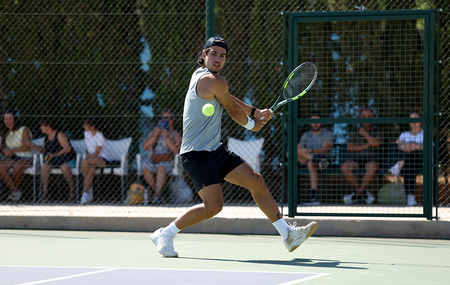
His forehand is capable of ending the rally from almost any part of the court. The speed allows him to retrieve shots that already look like winners for his opponents. When necessary, he can sustain intense exchanges from the baseline for hours.
But then comes what makes him special.
After two or three powerful strokes, Alcaraz suddenly executes a drop shot. He can come to the net, change the height of the ball, play a slice, or suddenly accelerate his forehand so dramatically that the rally ends in a single shot.
Because of this, an opponent constantly has to solve not just one problem, but several.
Are you far behind the baseline trying to cope with the power? Alcaraz will drop short.
Are you getting closer? You will receive a deep forehand.
Are you trying to predict his direction? He changes the rhythm.
This is precisely why comparisons to one representative of the «Big Three» don’t entirely hold up. With Nadal, you can see the physical intensity and the Spanish clay-court foundation. With Federer, he shares a love for variety and attack. With Djokovic, it is the ability to find solutions on almost any surface.
But Alcaraz himself has gradually forged a style of his own out of all of this.
This is why the term «new school» fits him particularly well: it isn’t a rejection of old tennis. Rather, it is an attempt to take the best from different eras of the sport and augment it with the physical capabilities of the modern athlete.
8. Roland Garros made him the youngest Grand Slam champion on all three surfaces.
By 2024, Alcaraz’s collection already included the US Open and Wimbledon.
He was missing the symbolically significant title—Roland Garros.
For the Spanish tennis player, who grew up on clay courts and inevitably faced comparisons to Nadal, the tournament in Paris held special significance.
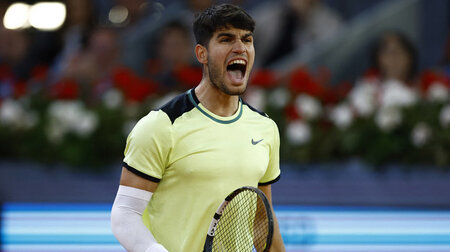
In the semifinal, Alcaraz defeated Jannik Sinner in five sets. In the final against Alexander Zverev, the situation became even more perilous: after three sets, the Spaniard was down 1–2.And once again, Alcaraz demonstrated his ability to thrive amid chaos. He won the fourth and fifth sets, becoming the Roland Garros champion for the first time.At 21 years old, Alcaraz thus secured the «Grand Slam» across three different surfaces: hard court at the US Open, grass at Wimbledon, and clay at Roland Garros.He became the youngest man to achieve this feat.A few weeks later, the story became even more interesting. Alcaraz won Wimbledon again, completing the famous Channel Slam—Roland Garros and Wimbledon in the same season.These tournaments take place almost consecutively, yet they demand vastly different styles of tennis. On slow clay, players glide and have more time to build a rally; on grass, the ball travels lower and faster, requiring decisions to be made much earlier.Therefore, winning both tournaments in one summer is historically regarded as one of the greatest indicators of versatility.
9. He learned to control not only the match but also his own emotions.
Beneath the vibrant play of Alcaraz, one of the main elements of his progress is easy to overlook. Over several years in the tour, he has not only changed technically and physically but has also become much calmer in his tennis during crucial moments.

At the beginning of his career, his emotional intensity both helped and hindered the Spaniard. Alcaraz always played with tremendous energy, actively engaged with the crowd, and was unafraid to take risks even in crucial points. However, the desire to constantly seek a spectacular solution sometimes led to unnecessary errors, and the pressure of big matches could directly impact his play.
The most telling episode occurred in the Roland Garros 2023 semi-final against Novak Djokovic. After two intense sets, Alcaraz began to experience severe cramps. Following the match, the Spaniard admitted that the cause was not solely physical strain: the nerves and the magnitude of the encounter with Djokovic played a huge role. He mentioned that he had never experienced such pressure before.
This match became an important lesson for him. Subsequently, Alcaraz repeatedly returned to the topic of psychological preparation, speaking about the necessity of maintaining composure in difficult moments, and his work with psychologist Isabel Baldo became part of his professional development. The tennis player himself noted that this work helped him better manage his emotions and understand what was happening to him on court.
That said, no one is trying to completely eliminate his emotionality from his game. It remains part of what the audience loves about Alcaraz: he smiles after incredible shots, rallies the crowd, and is capable of attempting a drop shot or advancing to the net in a moment when most players would opt for the safest decision.