Concept
Hikime Kagibana (jap. 引目鉤鼻) — the canon of traditional Japanese painting, originating during the Heian period (794–1185). The Hikime Kagibana technique developed within the genre of Yamato-e, a style that also emerged during the Heian period as a contrast to the Chinese style, Kara-e. The general trend of Yamato-e began in the late 9th century. This genre was primarily used to create images for folding screens (byōbu), sliding doors (fusuma), and horizontal illustrated scrolls (emakimono).
Yamato-e was employed to depict the daily life of the Japanese aristocracy, landscapes, historical chronicles, and illustrations for national literature. It is also worth noting that Yamato-e as a movement encompassed not only the Hikime Kagibana technique but also the Fukinuki Yatai technique—depictions of open-roofed interiors.
Speaking more specifically about the Hikime Kagibana canon, the style’s main characteristic is the schematic, featureless depiction of faces viewed from a specific angle. The «dot eyes» and «hooked noses» were, in a sense, the calling card of the entire movement.
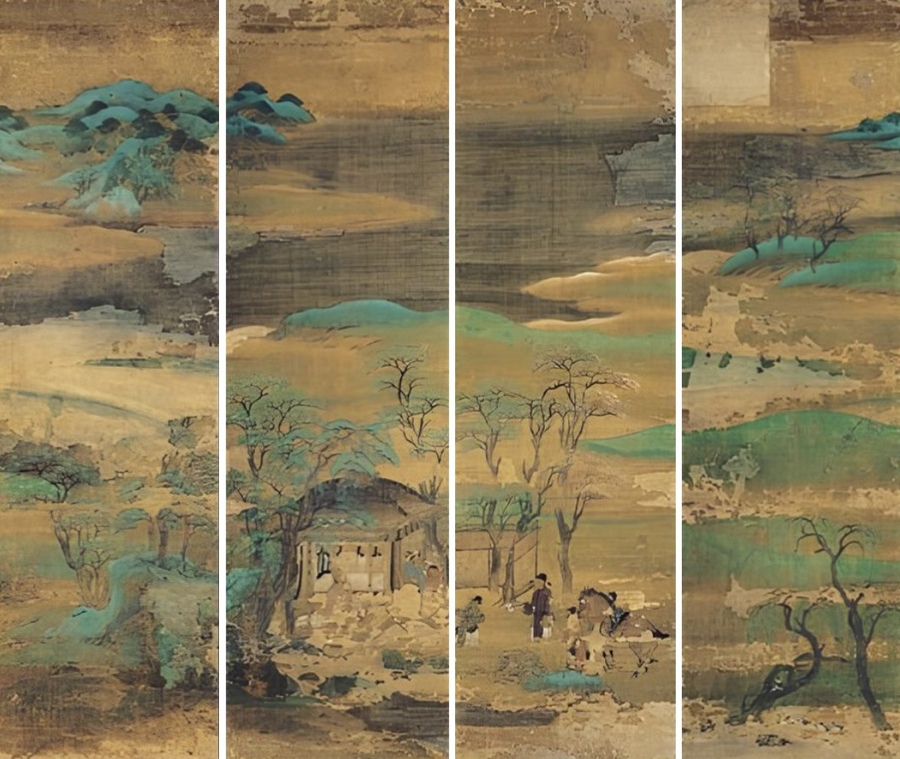
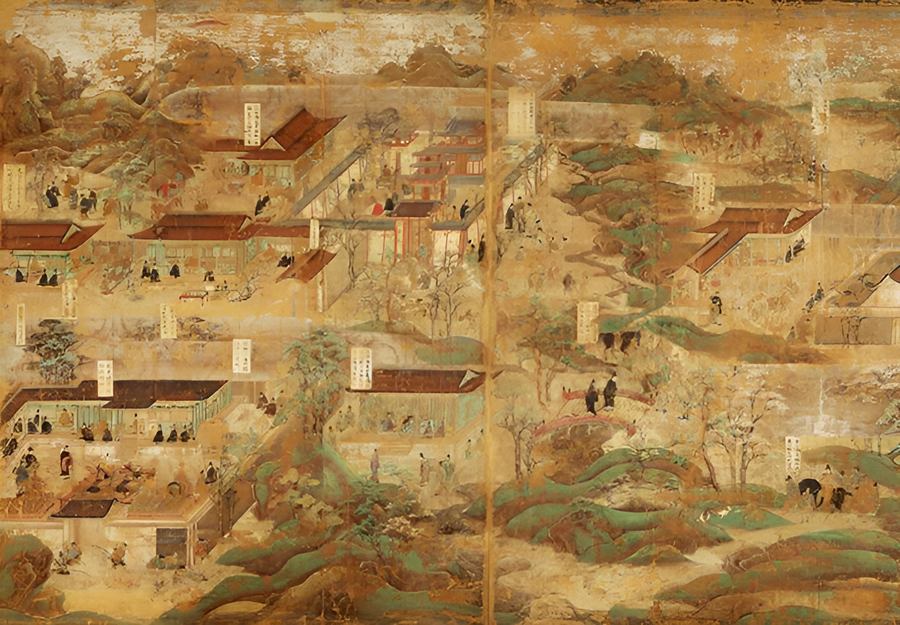
«Landscape Screen» («Senzu Byobu») from Todji Temple, anonymous, 11th century (Yamato-e style work) — fragment
Artistic Immaturity or Visual Code: What Underpinned Hikime Kagibana?
The Hikime Kagibana style is often perceived as a sign of artistic immaturity in traditional Japanese art due to its visual simplicity. However, all art is multifaceted, even if it appears simplified at first glance. The core question of this research is whether the Hikime Kagibana motif was an intentional simplification of an image or if it embodied a composite interplay of forms, ideas, and intentions. The primary objective of this study is to re-evaluate the artistic trends of the Heian period in Japanese art; the goal is to prove the hypothesis that the traditional art of this era was executed with far greater complexity than it initially appears.
For a more detailed analysis of the visual material, the work is divided into several chapters, each examining and presenting visual art objects based on distinct illustrative components: the facial anatomy in the Hikime Kagibana style, the positioning of the observer (viewer) in the Fukinuki Yatai style, and the rendering of garments and costumes, as well as the overall interaction of all previously mentioned elements.
The research will primarily utilize early illustrations from classical Japanese literature of the early eleventh century: The Tale of Genji and The Pillow Book by Murasaki Shikibu, along with other works related to the Heian period and the Hikime Kagibana canon. A very limited number of works from this selected period survive to the present day; therefore, one of the research objectives is to focus on various details within the same works of Japanese art to achieve a more precise consideration of the entire composition and its meaning.
Chapter I. Hikime Kagibana — Face Imagery
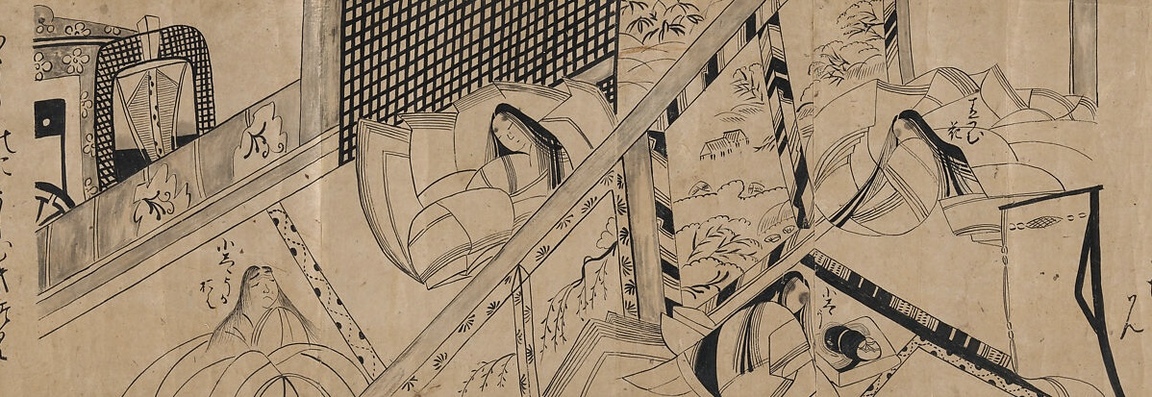
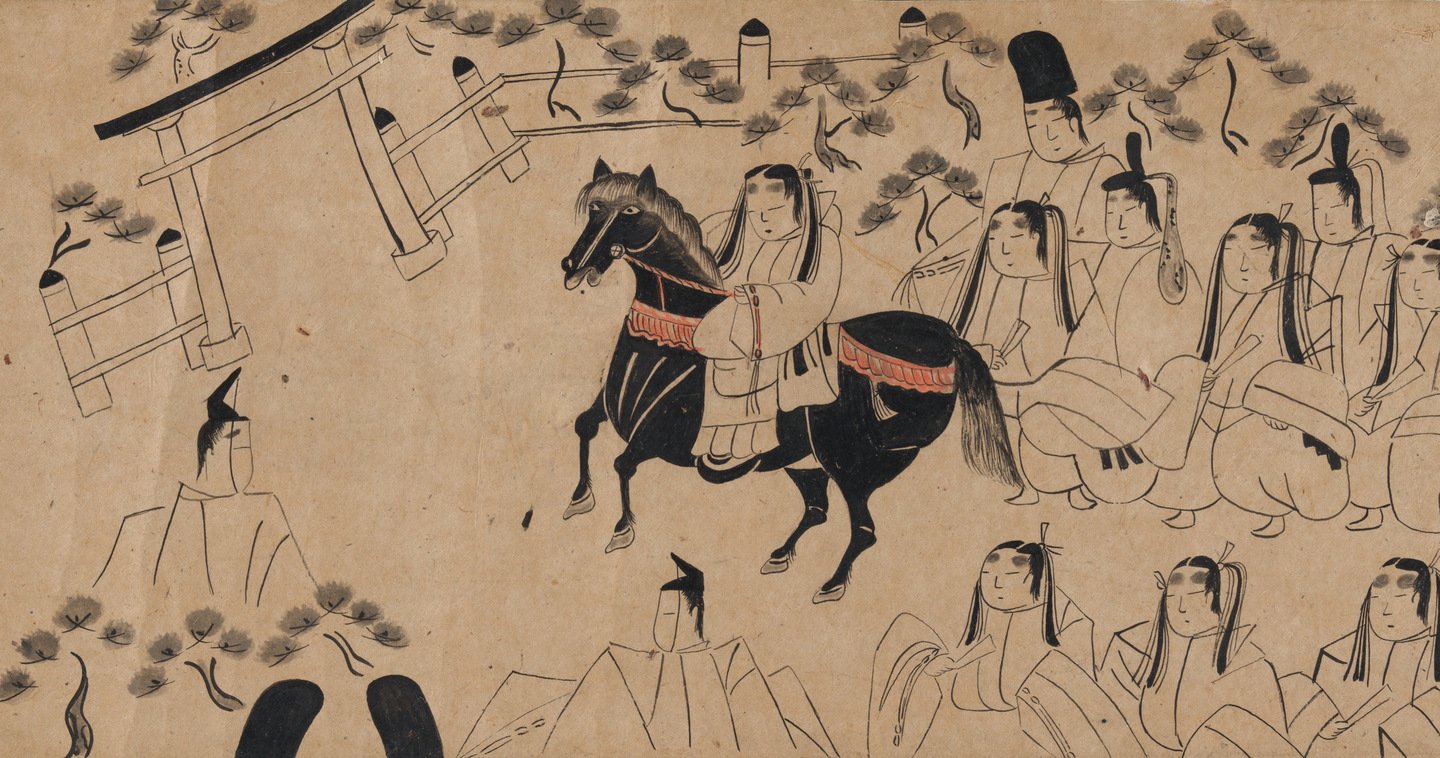
Scroll with a monochrome ink drawing, created in the spirit of the novel The Tale of Genji, artist unknown, 14th century (Muromachi period) — fragment
First and foremost, I would like to separate the hikime-kagibana technique from the other illustration fragments and analyze the human faces exclusively. As noted before, the hikime-kagibana technique is built upon a specific rendering of facial features: the eyes are thin, straight lines, the noses are curved lines, and other details are rendered formally, almost as if they exist only for the sake of their presence. This technique strips the face of volume, leaving only schematically drawn sensory organs to suggest their placement and the general identification of the person.
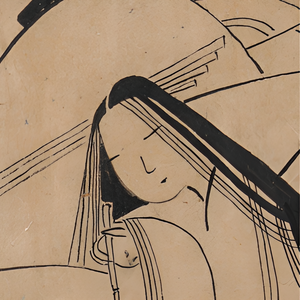
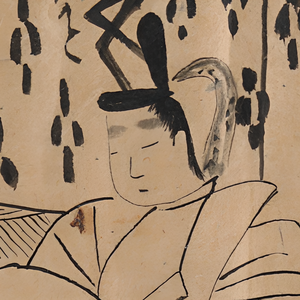
Свиток с монохромным рисунком тушью, созданный по мотивам романа «Повесть о Гэндзи», автор неизвестен, XIV в. (период Муромати) — фрагменты
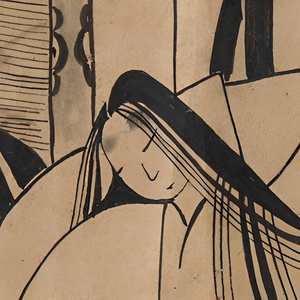
Equal attention should be paid to the character’s entire head, not just the facial features. Artists working in the hikime-kagibana style drew heads either in a strict profile or in a three-quarter view.
Murasaki Shikibu Nikki-ema, Fujiwara no Buson, 13th Century — Fragment
In broad strokes, the hime-kagibana style deprives the human face of volume, emotional nuance, and overall individuality. In illustrations for The Tale of Genji, the outline of the head is quite clear; the eyes, nose, eyebrows, and small lines for the mouth are distinctly visible, yet the facial expression remains neutral, conveying no specific emotional intent. The images in The Pillow Book retain this identical visual message but take on a slightly unsettling quality: the contour is no longer so crisp; only black spots and streaks are discernible across the face where the eyes should be, making it impossible to interpret the scene’s emotional content through facial expressions or gestures.
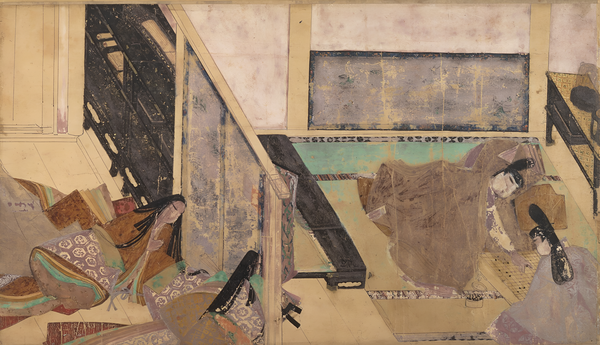
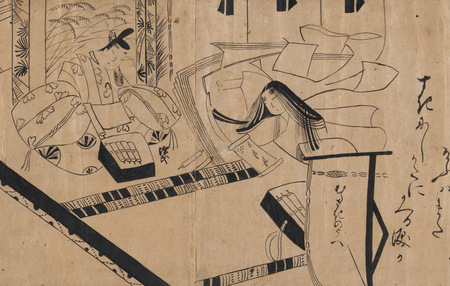
«Genji Monogatari Emaki, ” author unknown, 12th century // Scroll with a monochrome ink drawing based on Murasaki Shikibu’s novel „The Tale of Genji, ” author unknown, 14th century (Muromachi period) — fragments
We can also observe the «depersonalization» effect when separately comparing the illustrations for «The Tale of Genji» rendered in different styles. The systematic nature is maintained in the depiction of faces: the angle of the head and the absence of facial expressions or emotional scene background. It is also worth noting that this canon was used to portray aristocratic and courtly figures, drawing from Japanese culture: openly displaying emotions was considered poor taste since ancient times, so facial expressiveness was minimized. This approach allows the viewer to avoid distraction by minute expressions, to immerse themselves more deeply in the events, and to empathize with the characters.Comparing the works of different artists leads to a clear conclusion: across different studios, with varied stylistic approaches and color palettes, the face remains consistent. This proves that hikime kagibana is not an individual artistic quirk, but rather a canonical technique essential for depicting aristocracy.
The next question arising from the previous discussion is: what is the purpose of visualizing scenes from literature if doing so does not allow us to gauge the characters' emotional states?
Chapter II. Fukinuki Yatai — The Observer’s Position
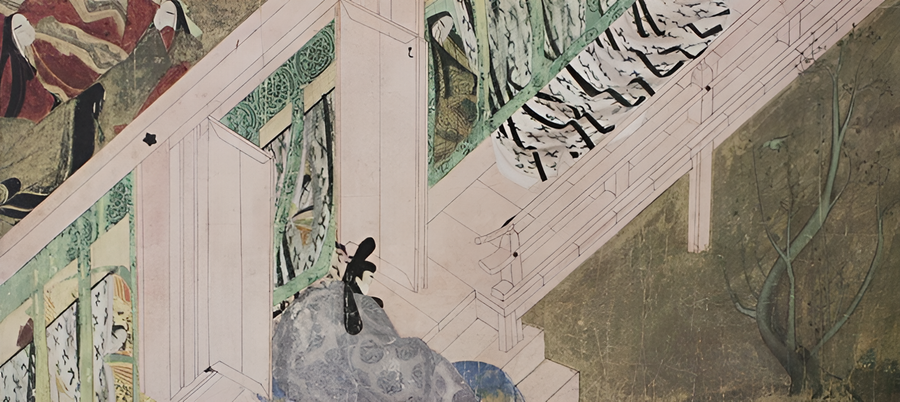
«Genji Monogatari Emaki,» unknown artist, 12th century.
If the previous chapter analyzed the details of small facial features, this section will instead present an overall plan—specifically, the viewer’s position within the scene’s space.Fukinuki yatai is an artistic technique where roofs and ceilings are intentionally left undrawn to suggest an indoor setting.
Observation Position
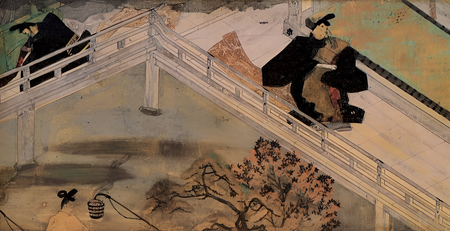
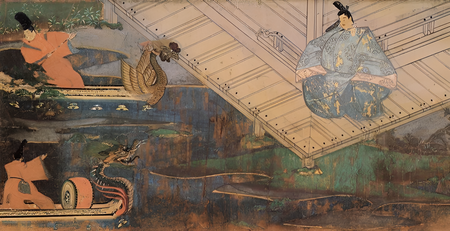
The first thing that draws attention when examining Heian-era scrolls is the angle from which the scene is presented. The gaze always falls slightly from an overhead angle, remaining detached from the narrative yet actively observing the unfolding events.