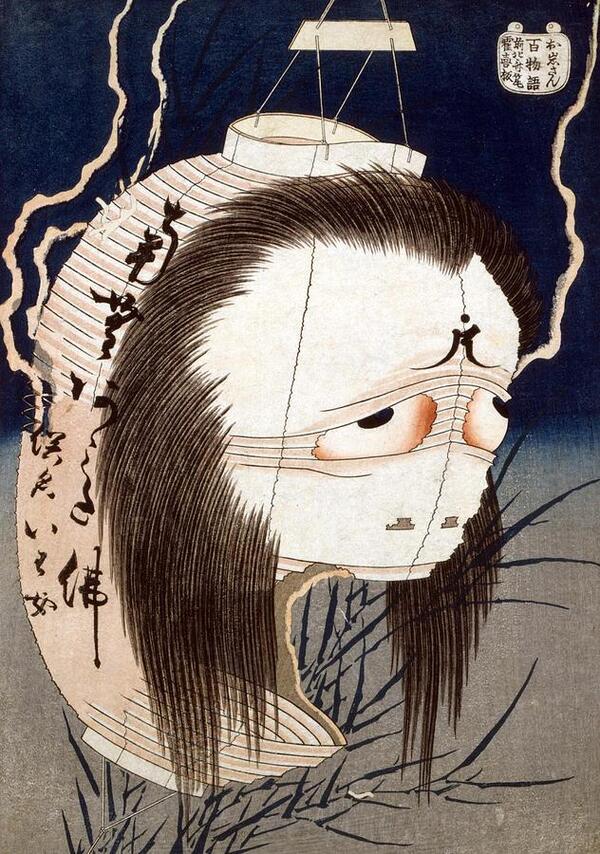
CONCEPTUALIZATION
Japanese culture possesses a rich tradition of depicting supernatural beings—yokai—which have held a special place in folklore, literature, and visual arts for centuries. They embody fears, superstitions, natural phenomena, and unexplained events, taking on a vast array of forms: from humanoid spirits and demons to animals and animated objects. Traditionally, their depictions were fixed in scrolls, book illustrations, and woodblock prints, particularly within ukiyo-e art.However, yokai have never remained exclusively part of ancient mythology. With the development of printmaking, mass culture, and modern visual communication tools, their imagery has been continually reinterpreted by artists and illustrators. Some creators preserved the traditional aesthetic of Japanese prints, while others transformed folkloric beings into fantastical characters, experimenting with anatomy, proportion, color, and form. Consequently, the same mythological figure could acquire an entirely different visual reading depending on the time period and artistic context.While yokai are often viewed as an object of study within Japanese folklore and mythology, the evolution of their visual language in contemporary Japanese graphic design and illustration warrants a separate comparative study.
Goal of the Visual Research — to determine how the images of Japanese yokai have transformed in the graphic art and illustration of the 20th–21st centuries, to identify differences in artistic interpretations of traditional mythological subjects, and to trace the influence of historical and cultural context on their visual realization.
The research examines the hypothesis that contemporary interpretations of yōkai are not simply reproductions of traditional folklore figures. Artists use Japanese mythology as a foundation to create a distinct visual language, merging traditional artistic techniques with new graphic styles, technologies, and aesthetic movements. Even with significant alterations to their appearance, the recognizable characteristics of these beings may remain intact.
The study is limited to the 20th and 21st centuries. The lower time boundary allows us to observe the transition from traditional methods of depicting supernatural beings to contemporary, authorial graphic work. The upper boundary encompasses current interpretations of yōkai in modern illustration. Earlier works of Japanese art will be used as historical and visual context for the analysis but will not form the main body of the research material.
Research Material
The material consists of works by Japanese artists and illustrators who engage with yōkai imagery, selected based on the following criteria:- Reference to Japanese folklore and traditional narratives about supernatural beings.
- Pronounced authorial style and individual interpretation of mythological figures.
- Belonging to the fields of graphic art and illustration, including printmaking, book illustration, and independent graphic projects.
- The potential to trace the evolution of artistic techniques and visual language across different periods of the 20th and 21st centuries.
The analysis is built upon three levels:
Formal Image Analysis: composition, color palette, plasticity, line, texture, characteristic features, and methods of stylizing supernatural beings.
Comparative Analysis of Authorial Interpretations: comparing depictions of identical or similar mythological characters by different artists to identify common motifs and individual artistic choices.
Historical-Visual Analysis: tracing the evolution of yokai depictions throughout the 20th and 21st centuries, determining how art movements, technologies, and mass culture influenced their visual reinterpretation.
Введение.
Who are Yokai?
Историческая и визуальная основа.
The concept of «yōkai» (妖怪, from the Japanese word for «monster») encompasses a wide range of supernatural phenomena and beings from Japanese folklore. These include ghosts, demons, shapeshifting animals, nature spirits, and animated objects.
Yōkai do not form a unified system of characters with fixed traits; their imagery was shaped by regional legends, religious concepts, superstitions, and popular imagination.Gradually, these stories found visual embodiment in Japanese illustrated scrolls—emaki. These images not only allowed for storytelling about the supernatural but also helped create recognizable forms of these creatures, cementing them in the collective imagination.The very phrase «Hyakki Yagyō» is a long-established folkloric motif: the belief that on summer nights, a procession of diverse spirits, demons, and monsters passes through the streets of human settlements and disappears at dawn. It is believed that encountering such a parade without a protective amulet poses a threat of mortal danger. [1]
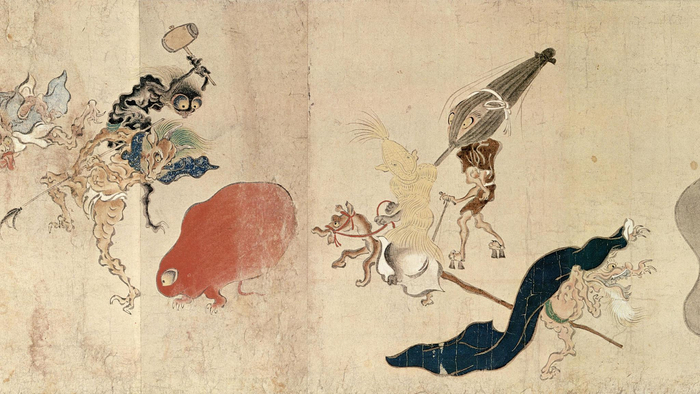
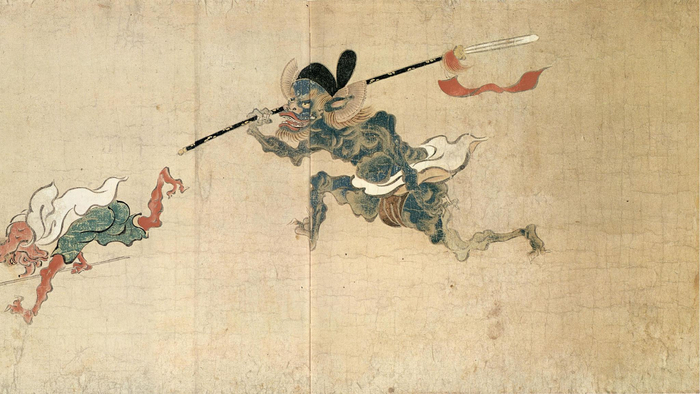
Hokusai, Yagyō Emaki. «Night Parade of One Hundred Demons.» Muromachi Period (1336–1573).
During the Edo period (1603–1868), images of yokai gained widespread popularity due to the development of printing and color woodblock printing. Collections began to appear where supernatural beings became independent characters with their own names and distinctive traits.
Toriyama Sekien released Gazu Hyakki Yagyō — «The Illustrated Night Procession of a Hundred Demons» — in 1776. His works here establish an independent system of imagery that later had a significant influence on the depiction of yokai in Japanese art.
Unlike traditional scrolls, where a procession of demons was depicted as a continuous scene, Toriyama divided it into individual pages, each featuring one yokai with a detailed description. This allowed readers to compare, memorize, and choose their favorite creatures. In fact, Toriyama’s work became a future encyclopedia of yokai. [2]
Toriyama Sekien. «Illustrated Night Parade of the Twelve Demons.» 1776
By the 19th century, yōkai became full-fledged characters in artistic works. Now, however, artists use them to create dramatic, comedic, and grotesque scenes. This trend is especially evident in the works of Utagawa Kuniyoshi and Kawabata Kōsaku, where fantastical creatures become participants in scenes of everyday life and other circumstances.
By the time we reach this period, artists begin to move away from canonical traditions and start to visually interpret the images of yōkai in different ways.
Utagaway Kuniyosi. «The Earth Spider Gives Birth to Monsters in Lord Minamoto Yorimitsu’s Mansion.» 1843
Kawanabe Kyosai. «One Hundred Kiyosai Follies: Endless Comical Prayers.» 1864
Глава 1.
The Legacy of Traditional Graphicsㅤ
От традиционной графики к авторской интерпретации.
Послевоенный период.
Глава 2.
Yokai in Mass Visual Culture
Современная японская иллюстрация.
Comparative Analysis and Conclusions
Scroll depicting the Night Parade of a Hundred Demons //URL: https://www.bestiary.us/images/svitok-s-izobrazheniem-nochnogo-parada-sta-demonov/en?ysclid=mwc3lq0g3242015398 (Accessed: November 11, 2026)
Sakiei Toriyama. Illustrated Night Parade of a Hundred Demons. 1776 //URL: https://yokai.jp/en/collections/gazu-hyakki-yakou (Accessed: November 11, 2026)
Cover. Katsushika Hokusai. Hokusai Ghost, 1830 //URL: https://grangerartondemand.com/featured/hokusai-ghost-1830-granger.html?utm_source=chatgpt.com (Accessed: 11.11.2026)
Hyakki Yagyō Emaki. Night Parade of a Hundred Demons. Muromachi Period (1336–1573) //URL: https://k.sina.cn/article_1191867367_p470a73e7027008a71.html.com (Accessed: 11.11.2026)
Toriyama Sekien. Illustrated Night Parade of a Hundred Demons. 1776 //URL: NDL Image Bank https://www.ndl.go.jp/en/imagebank/column/sekienyokai (Accessed: 11.11.2026)
Utagawa Kuniyoshi. «The Earth Spider Gives Birth to Monsters in the Mansion of Lord Minamoto Yorimitsu.» 1843 //URL: https://www.christies.com/en/lot/lot-6307247?utm.com (Accessed: 11.11.2026)
Kawanabe Kyosai. One Hundred Kyosai Follies: Endless Comical Prayers. 1864 //URL: https://www.invaluable.com/auction-lot/kawanabe-kyosai-1831-1889-one-hundred-kyosai-foll-57-c-54c483a80c?utm.com (Accessed: 11.11.2026)