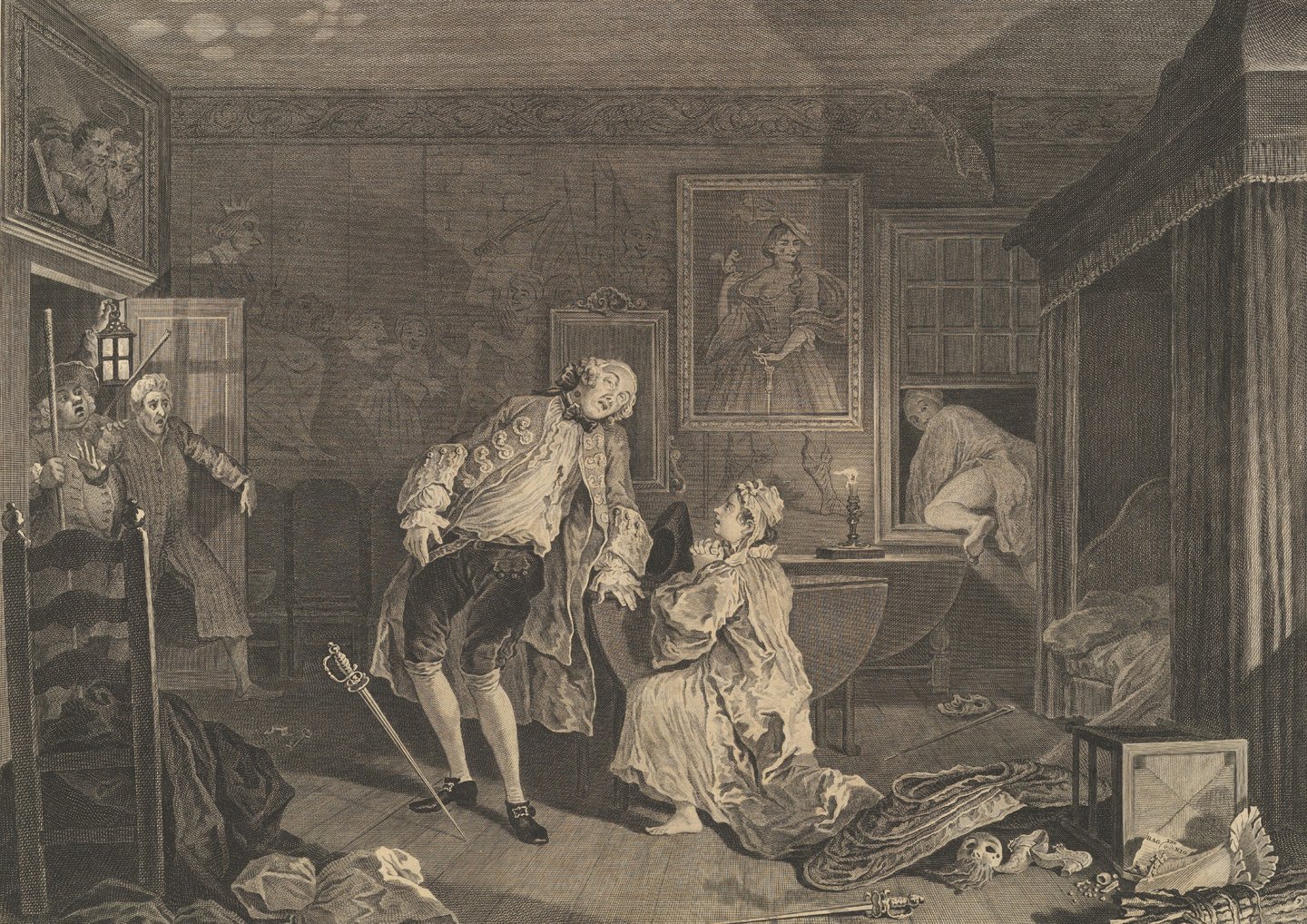
In his paintings, everything is alive and moving. […] Even the paintings on the walls have their own expression.
Research Concept
In William Hogarth’s «Tête-à-Tête, ” a painting hangs in the back room, almost completely obscured by a curtain. A bare foot is visible beneath the fabric. It is this specific part of the image that draws attention, although it is difficult to discern what is happening within the frame. I became interested in why Hogarth left such a small detail visible and how it alters the perception of the scene.
Hogarth painted six canvases for „Marriage A-la-Mode“ around 1743 [1]. The cycle begins with an arranged marriage contract between the count’s son and the daughter of a wealthy London alderman. Through this union, one family hopes to improve its financial standing, while the other gains the opportunity to connect with the aristocracy. Beth Harris and Steven Zucker describe the premise of the cycle for Smarthistory as an exchange of money for social status [3, 1:46–2:25]. The terms of the marriage are known to the viewer from the first scene. He learns about the development of the couple’s relationship gradually by observing their behavior and closely examining the details of the rooms where the action unfolds.
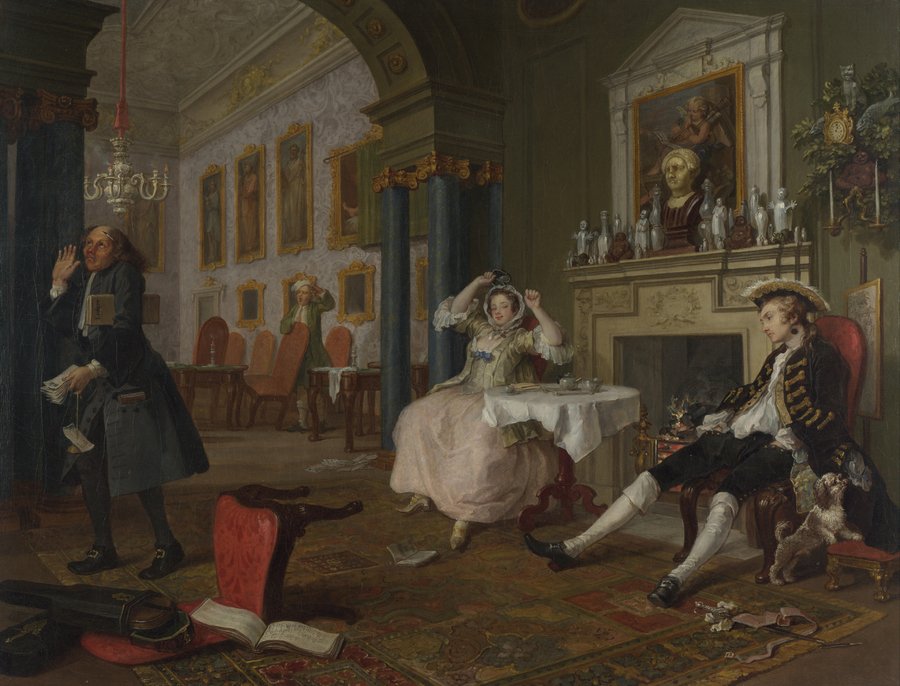
William Hogarth. «Tête-à-tête.» Circa 1743. National Gallery, London
Research Objective
To determine how the images within the interiors of The Happy Marriage help the viewer understand the characters' relationships and evaluate their actions. What can be learned about a character by comparing their gesture, posture, or gaze with the image next to them?
Research Hypothesis
Hogarth connects the images in the rooms to the action in such a way that they provide the viewer with information that is difficult to ascertain by looking at the characters alone. A character’s gesture can transform an image into a clue about their intention. In other instances, the connection must be found within the composition itself—for example, in the proximity of figures or in the direction of their gaze. Here, the image helps suggest what the character is feeling or shows how Hogarth prompts an assessment of their action.
Basis of the Study
The study includes all six paintings in the cycle. The primary material consists of the wall paintings and portraits. I also include other images in the analysis when their relationship to the action can be verified through reproductions. For example, a character’s gesture draws attention to the folding screen, and the anatomical model in the doctor’s office becomes part of the composition along with the skeleton.
Research Methods
I verify the dating and sequence of the scenes using museum cards; I check the attributions and interpretations using Judy Egerton’s catalog; and I use technical analysis to determine how the painting’s concept evolved during the working process. The Russian titles of the scenes are provided according to the engraving catalog of the Pushkin State Museum of Art [7].
What do the images in the interiors reveal about the characters in Hogarth’s «Marriage A-la-Mode»?
Categories
- «Marriage Contract.» What the paintings reveal about the bride
- «One-on-One.» What can be discerned from the hidden image
- «Medical Examination.» What the figures in the closet add
- «The Countess’s Boudoir.» What the Countess leaves visible
- «In a Public House.» Where the woman in the portrait is looking
- «The Countess’s Death.» Why domestic scenes appear in the finale
- Scene Comparison
- Conclusion
1. «Prenuptial Agreement.» What Do Paintings Say About the Bride?
William Hogarth. «Marriage A-la-Mode.» c. 1743. National Gallery, London.
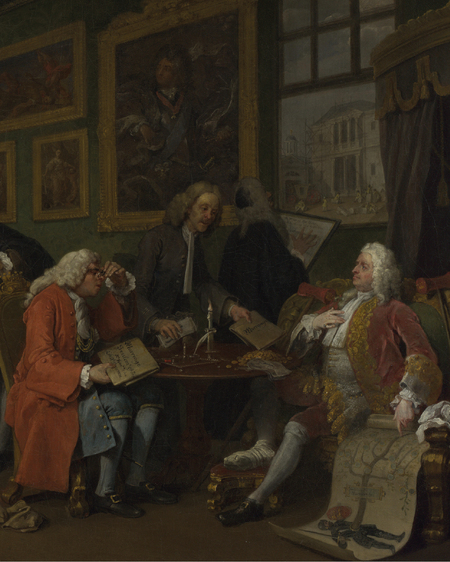
In the center of the painting, two fathers discuss a prenuptial agreement. The count gestures toward his family tree while the alderman examines the document. The groom is preoccupied with his own reflection. The bride sits to the side, tracing the ring across her veil. Silvertong, her father’s lawyer, leans toward her [1, pp. 157–158]. To track her reaction, one must shift the gaze from the central document to the edge of the composition, and then lift it toward the images above the young woman.
Hovering over the bride, Hogwarts places a painting of Medusa’s head. Judy Egerton identifies a reference to Caravaggio’s «Shield with a Medusa Head» in it [1, p. 158, note 81]. Her open mouth and writhing snakes contrast with the girl’s reserved posture as she fiddles with her ring while her fathers discuss the marriage contract. Judy Egerton suggests that Medusa’s scream represents the indignation the bride cannot openly express [1, p. 158]. Under this interpretation, her silence may conceal dissent from her fathers' decision.
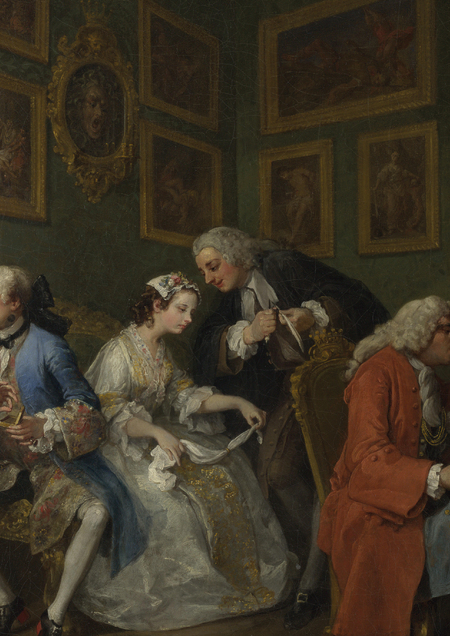
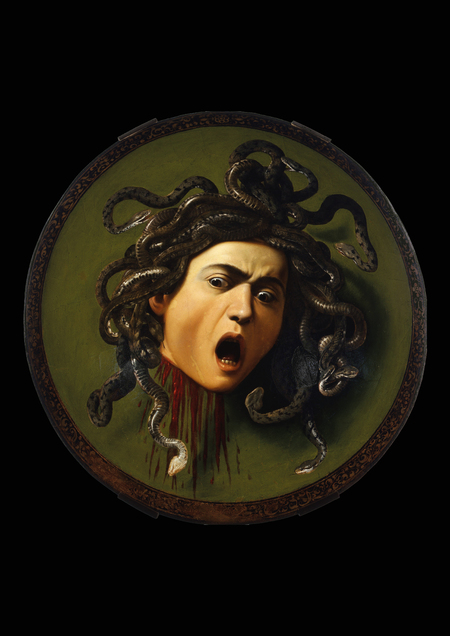
Left: William Hogarth. «Marriage A-la-Mode.» c. 1743. National Gallery, London, NG113. Fragment featuring the bride and the head of Medusa above her. Right: Caravaggio. «Shield with the Head of Medusa.» 1596–1598. Uffizi Galleries, Florence.
To the left of Silvertonge’s head hangs a painting depicting Cain killing Abel. Egerton recognizes Titian’s composition within it. In Hogarth’s work, it is shown in a mirror image relative to the Venetian canvas, leading Egerton to suggest the artist referenced a print [1, p. 158, note 84]. Beneath the painting, the lawyer leans toward his fiancée and sharpens his quill. Egerton connects the image of Cain to the young count’s death in the fifth scene [1, p. 158]. This allusion is revealed upon a subsequent viewing of the cycle, when the audience is already aware of Silvertonge’s role in the resolution.
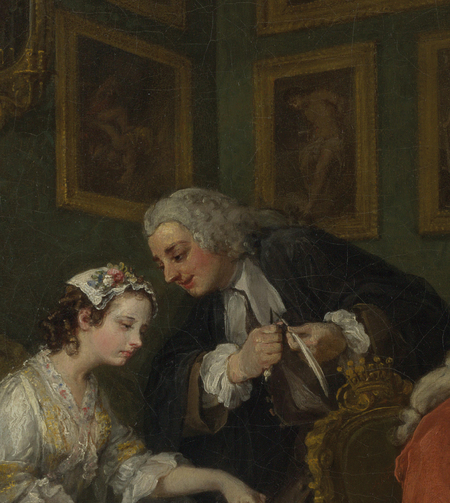
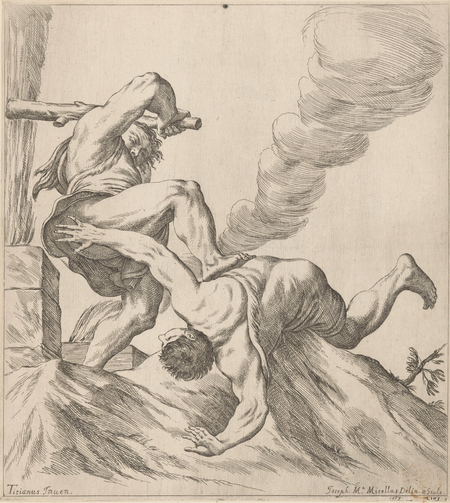
Left: William Hogarth. «Marriage A-la-Mode.» c. 1743. National Gallery, London, NG113. Fragment featuring Silvertonge and a painting of Cain and Abel. Right: Giuseppe Maria Micheli after a composition by Titian. «Cain Kills Abel.» 1669. Etching. Rijksmuseum, Amsterdam.
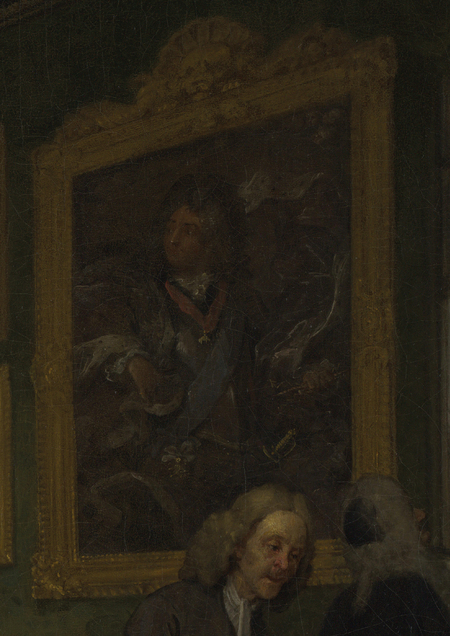
In the large portrait by the window, Egerton recognizes the count from his youth. He is depicted in armor, holding lightning like Jupiter. Egerton sees a parody of the grand, ceremonial portrait [1, p. 158]. The count’s demonstrative gesture, pointing to the lineage, continues in the foreground what Hogarth satirizes in the portrait.
The comparison of Medusa with the bride changes the meaning of her restraint. While the fathers discuss the contract, the girl remains silent, turning the ring over in her hand. According to Egerton, Medusa’s scream expresses the indignation that the bride herself is suppressing. The formal portrait of the Count functions differently: his armor and lightning flaunt his nobility, just as the gesture with which he presents his lineage does. Thus, Hogarth shows both the groom’s family claims and the possible disagreement of the one being decided for, all in one room [1, p. 158].
2. «One-on-One.» What can you learn from a hidden image?
William Hogarth. «Tête-à-Tête.» Circa 1743. National Gallery, London.
The couple sits side-by-side, each in a different pose. The Viscount leans back in his armchair while the dog reaches toward the woman’s bonnet tucked into his pocket. The Viscountess stretches, holding a small mirror in her hand. The National Gallery connects the bonnet to the Viscount’s probable nocturnal adventure [4].
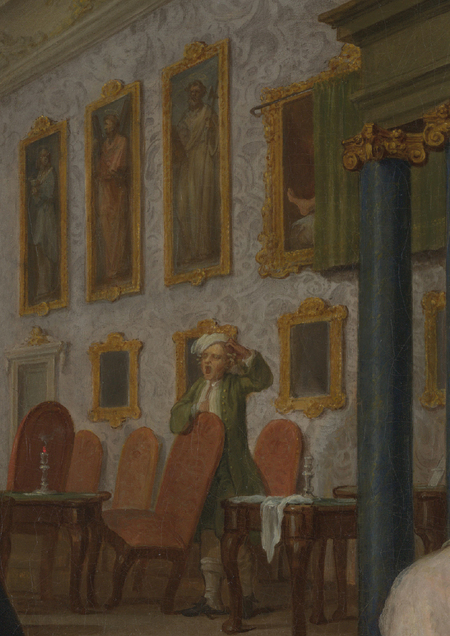
Through the columns, paintings depicting saints are visible. Their figures are completely revealed, which makes it easier to discern what the curtain is doing in relation to the adjacent image. Beneath the fabric, a bare foot is visible, resting on a bed [4].
In the museum card, the exposed foot was interpreted as an allusion to an indecent subject concealed by fabric [4]. Upon close examination, it is clear how little Hogarth left outside the curtain. In the first scene, the open mouth and the snake allow for the identification of Medusa, but the episode depicted here must be guessed.
William Hogarth. «A Repast.» c. 1743. Infrared reflectogram of a fragment. David Bomford and Ashok Roy, 1982, Fig. 10, p. 51.
David Bomford and Ashok Roy discovered another image beneath the top layer of paint. The infrared reflectogram reveals a Madonna and Child and the back of a kneeling figure. The researchers interpret the early subject matter as a scene of adoration, leaving open the question of whether they were shepherds or Magi. The reflectogram also showed that the foot and ankle do not continue beyond the painted edge of the fabric [2, pp. 51, 55].
In «Tête-à-Tête, ” both details hint at events that the audience learns about indirectly. The hat alludes to the Viscount’s nocturnal adventure, and the curtain lends an air of mystery to the glimpsed foot, as noted by the National Gallery [4]. Together, these allusions help articulate the estrangement between the couple. They are seated in a common drawing-room, yet the details of their life must be reconstructed from fragmented traces. Egerton links this discord to the fact that each spouse already has their own diversions [1, pp. 159–160].
3. «Medical Examination.» What do the figures in the closet add?
William Hogarth. «The Medical Examination.» Circa 1743. National Gallery, London.
The Viscount raises his cane and addresses the doctor. The girl stands between his knees, holding a small box of pills. Another box lies next to the Viscount. The National Gallery connects these details to the treatment of a venereal disease [9].
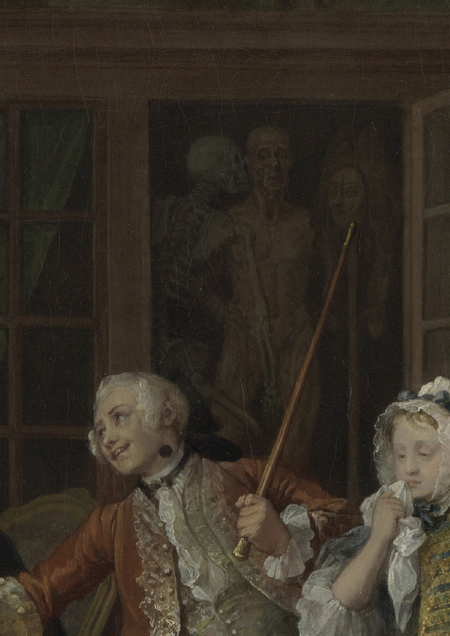
In the open cabinet stand a skeleton and an écorché—an anatomical model displaying exposed musculature. The skeleton is oriented toward the model, extending a hand toward it. The figure’s eyes are open. Egerton notices her unusually expressive face and interprets the skeleton’s pose as flirtation [1, pp. 165–166].The general fragment shows two groups. In the foreground, Hogarth depicts a viscount and a young girl with boxes, while in the background, he places figures whose poses resemble courtship. The National Gallery links the skeleton’s imagined flirtation to the themes of sickness and death [9]. The proximity of these groups allows one to trace this connection within the composition.
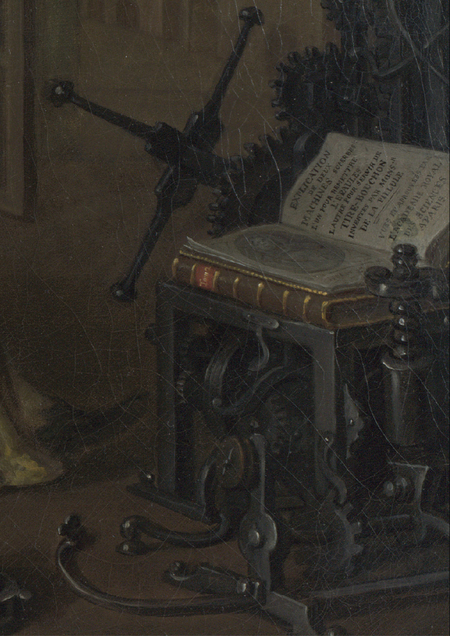
Opposite the title page, there is an engraved portrait of the book’s author, Mr. de la Pillule. According to Judy Egerton, Hogarth depicted the same physician in his youth [1, p. 165]. The title names two of his inventions: a device for straightening shoulders and a corkscrew [1, p. 165]. The engraved portrait accompanies the portrayal of the author as an inventor. In the foreground, the Viscount, holding his cane, appeals to the physician with a complaint about his treatment [9]. This juxtaposition questions the doctor’s authority: the book emphasizes his inventiveness, while the Viscount’s complaint makes one question the efficacy of the treatment.