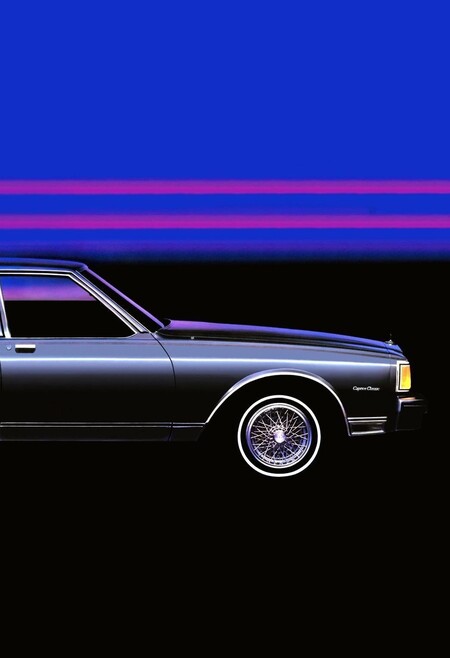
In the mid-1970s, the American autoprom faced severe trials. The 1973 oil crisis and the tightening of environmental standards in the United States have made a difference in the era of giant and hungry cars. The General Motors' response to the current situation in 1977 was a completely updated Chevrolet Capric Classic, a car that, although smaller in size, preserved the essence of the great American sedan and set a new standard for a decade.

The model was developed under severe constraints. The engineers and designers of Chevrolet, led by Bill Mitchell, were instructed to radically reduce the size and mass of the car, without having to produce the spaciousness of the salon and its recognizable appearance. The new sedan was based on a platform from the so-called «colonnad» GM model series, which led to a significant reduction in body size. The model row was combined into a four-door sedan, a two-door compartment and a universal. The GM resulted in a revolutionary designer philosophy for the company, debuting at Cadillac Seville a year earlier. It was characterized by rigid, almost rectangular body and wing lines, as well as a minimum amount of chrome.
Technical characteristics
Despite the markedly reduced dimensions of the new Caprice, engineers managed to maintain the spaciousness of his predecessor, with a more rational structure that increased the height of the ceiling and the foot space of the rear row passengers. Plus, he grew up in the trunk. The car was offered in two main sets: the more accessible Impala and the most equipped Capric Classic, the latter being the best-selling vehicle: 212,840 four-door sedans, Caprice Classic, was released in 1977.

The heart of the 1977 model was a tested 5.7-litre V8 LM1 engine equipped with a four-chamber Rochester carburettor. However, in the era of environmental struggle and economy, its capacity was significantly reduced compared to previous years (170 lc). A less powerful V8 engine with a capacity of 5.0 l and a power of 145 l, and even a row of six, was also proposed as the base engine for Caprice. The three-stage automatic transmission Turbo Hydramatic was used in the engine pair. In terms of performance, the new Caprice was a huge step forward. It was much easier and more manoeuvring than its predecessors, and its cost-effectiveness, though still very modest by modern standards, has improved markedly compared to previous models. During the combined cycle, the car consumed about 18.2 — 18.7 litres of petrol per 100 km. Chevrolet was proud to say: «The strategic elimination of extra inches and ounces made it possible to create a car that is more impressive, more controlled in parking and more economical to operate — without denying the spaciousness, smoothness and comfort of a large machine.»
Heritage and Impact
Chevrolet Capric Classic of 1977 became a model that successfully adapted the classic American full-size sedan to the new reality. Its commercial success and positive press feedback have proved that consumers are willing to accept smaller sizes in exchange for regulation and economy. The concept of the car proved to be so successful that it remained in production with minimal changes up to 1990 — for the car-prom, this is a demonstration of exceptional design. Moreover, the strength, endurance, and spacious body predetermine the fate of Caprice as the ideal machine for service. It has built popular police cars (9C1) and taxis (9C6), which have served American (and not only) cities for decades.
Even today, when the era of the big frame sedans has come to an end, Caprice of 1977 is not perceived as the last of outdated muscles, but as a classic style and one of the first balanced cars of our time.