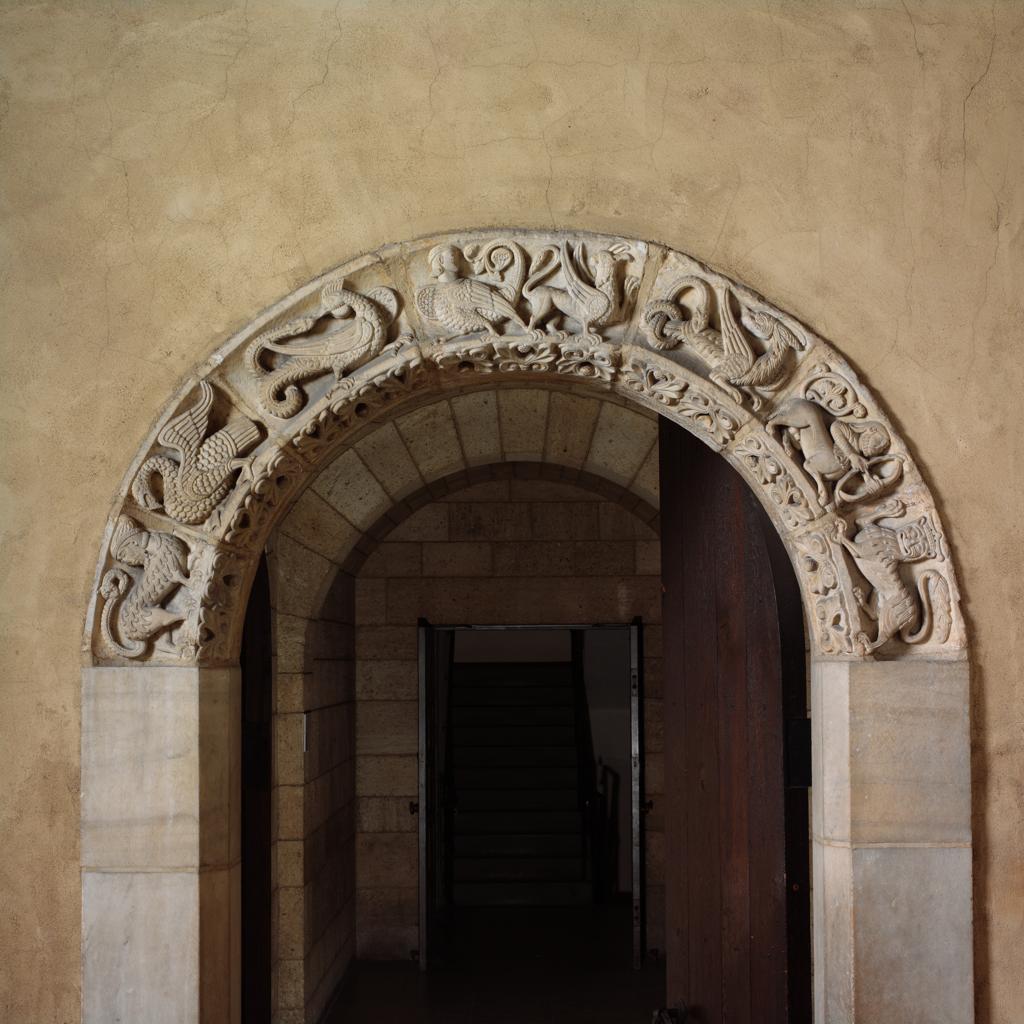
Где заканчивается человек?
Необычные образы в средневековой архитектурной скульптуре XI–XIV веков
Research Concept
Chapter 1. Human and Plant: Foliate Masks in Medieval Sculpture
Chapter 2. Human and Animal: Hybrid Creatures in Romanesque and Gothic Art
Chapter 3. Beyond Nature: Fantastic Creatures and Grotesques in Medieval Sculpture
Chapter 4. Human as Part of Architecture: Figures Supporting and Adorning Buildings
Conclusion
Sources
Research Concept
Research ConceptWhen you examine the details of European medieval cathedrals, a strange, dualistic feeling arises. Alongside the stern faces of saints and familiar biblical scenes, entirely different, almost chthonic imagery suddenly appears. Dense branches sprout from stone mouths, human torsos unsettlingly merge with animal paws, and incredible, grotesque creatures grimace from the cornices. A separate fascination involves human figures seemingly embedded in the stone—it appears as if they are holding the weight of architectural elements on their shoulders with their last strength.This theme captured my interest precisely because of its paradox. Why and how did medieval sculptors place these frightening, strange images within the sacred space of the church? Was it deep symbolism, a peculiar message to the congregation, or merely the outpouring of a specific master’s imagination? In my work, I attempt to understand the rules by which the image of the human being transformed in the architectural plasticity of that era and what role these bizarre visual metamorphoses played.Key Research QuestionTo phrase the problem more rigorously, I am concerned with the following: through what specific techniques did masters of the 11th–14th centuries alter conventional human anatomy, blending it with flora, fauna, or the very geometry of the building? And crucially—how did the specific placement of the sculpture (whether on a tight capital, a corbel, or a keystone) affect its form and potentially change the viewer’s perception of the image?
Hypothesis
I do not wish to reduce these hybrid forms merely to amusing decoration—to whimsical «margin vignettes» of medieval architecture. My working hypothesis is that behind these distorted bodies lay specific representations of the medieval person’s self and their surrounding world.
The same «green people» (foliage masks) may have been perceived not simply as ornament, but as images connected to nature, life, or renewal. Hybrids of human and animal sometimes might have hinted at human vices and passions. And the strangest monsters may have deliberately evoked anxiety, surprise, or even laughter in the viewer. However, I understand that similar images did not necessarily carry the same meaning, and some of them might have functioned primarily on a decorative level.
Yet, it seems to me that many unusual forms were also born from the constraints of the material and the space itself. The master craftsman had to fit a figure onto a small capital, a corbel, or a narrow arch niche—and the human body would begin to curve, elongate, and assume unconventional poses. The architectural form literally dictated the plasticity of the image.
Structure
To avoid drowning in the vast mass of medieval sculpture, I structured the research logic around specific types of transformation. The text is divided into four chapters.
I dedicated the first section entirely to foliage masks. It is important for me to analyze the mechanics of this symbiosis: precisely how the face merges with the foliage, and where the human visually ends and the plant begins.
In the second chapter, I examine the half-human, half-beast figures: centaurs, sirens, and other zoomorphic hybrids. The most interesting aspect for me here is to pinpoint the boundary between the human and the animal—to analyze which body parts the masters kept human and which ceded to the «beast.» The third chapter is about chimeras and grotesques—creatures assembled from anatomically incompatible fragments. I aim to illustrate how monsters that have no direct natural counterparts were created, and the role deliberately distorted proportions played in this process. The focus shifts in the fourth chapter to the human figure as an element of architectural design. These are sculptures that seem to support cornices, columns, and arches. Here, I explore how the figure’s pose and the form of the architectural detail compel the body into unusual, sometimes even agonizing postures. Moreover, this support may not be a real structural function, but merely an illusion created by the sculptor. Ultimately, this approach will allow me to compare different methods of visual distortion and attempt to find a common logic among them. Principle of Selection Material for a topic like this can be collected infinitely, so I have placed fairly strict limits on my sample: I am focusing on stone and wooden architectural sculpture from 11th–14th century Europe. I am selecting monuments that feature an explicit connection between a human and a plant, animal, or fantastic creature, as well as images where the human body is incorporated into the architecture in an unusual way. When I select specific sculptures, I examine them almost like an anatomist: how the elements are joined, how much the proportions have been altered, and what is happening with the facial expressions and posture. It is important to me that the works differ from one another and that they can be not just viewed in isolation, but also compared.
For the visual component, I make an effort to select photographs where the details of the sculpture are clearly visible. Whenever possible, I use both close-ups and wide shots to convey the sculpture’s placement within the building. Before including any photograph in my research, I verify that it genuinely pertains to the specified monument and aligns with the chosen historical period.
Naturally, to avoid relying on mere speculation, I cross-reference my visual observations with historical sources. I rely on museum catalogs, confirm dating details, and consult academic publications on medieval art. If researchers propose differing interpretations of a single image, it is important for me to consider all these versions rather than immediately selecting the most unusual one.
This approach helps maintain balance: on one hand, I trust my own observations and analyze the form itself; on the other, I check how closely my conclusions correspond to the historical context of the era.
Chapter 1. Human and Plant
In this chapter, I examine one of the most unusual forms of medieval sculpture—the leaf mask. At first glance, it is simply a human face surrounded by botanical ornamentation. However, in some instances, leaves literally replace hair and beards, and sprouts emerge directly from the mouth, as if the human is gradually transforming into a plant. I am interested in understanding where the boundary lies between the face and the foliage. To this end, I first examine the botanical forms themselves, and then compare several sculptures from the 11th to 14th centuries, paying close attention to their expression, proportions, and placement within the architecture.
Acanthus leaf. Contemporary botanical photography.
First, I want to draw attention to the shape of a typical leaf. Its edges form deep incisions, and the surface itself curves to create a complex silhouette. Such organic forms are easy to render in stone carving: the master only needs to emphasize the individual curves to transform the leaf into a decorative pattern.
Capital with vegetal ornamentation. France. Early 12th century. Black marble. Metropolitan Museum of Art, New York.
Here, the plant ceases to be merely a part of nature and transforms into a stone ornament. The leaves conform to the shape of the capital, filling its surface. I am interested that the master is not trying to accurately copy a real plant. Instead, he uses its form to embellish an architectural detail. While there is no human face in this carving yet, the principle of merging natural form with stone is already clearly visible.
But what happens if a human face appears among these leaves? It is here that a common botanical ornament transforms into a leafy mask. Such images are often called «green men,» although this familiar term became attached to medieval leafy heads much later. Therefore, I will use both designations, without assuming that all masks depict the same character.
Leaf mask on the capital of the south portal of the Church of St. Mary and David. Kilpeck, England. c. 1130–1140. Stone.
The first thing that catches the eye is the enormous, round eyes and the wide-open mouth. Two plant shoots emerge from it, curving out to the sides of the face. Due to the unusual proportions, the mask looks slightly unsettling. There is a feeling that the plant has taken over the head from the inside and is now trying to push its way out. Meanwhile, the shoots are arranged quite symmetrically. This creates a strange juxtaposition: the face appears alive and anxious, yet the leaves adhere to a strict decorative order.
If we step away from the mask and look at the entire portal, it becomes clear that it doesn’t exist in isolation but is part of a multitude of other carved details. Geometric patterns, fantastic heads, and organic forms surround the entrance.
I find it interesting how a small face becomes integrated into a large decorative composition. From a distance, it almost disappears among the other details, but up close, it emerges as one of the strangest elements of the portal. It turns out that the perception of the sculpture heavily depends on the viewing distance.
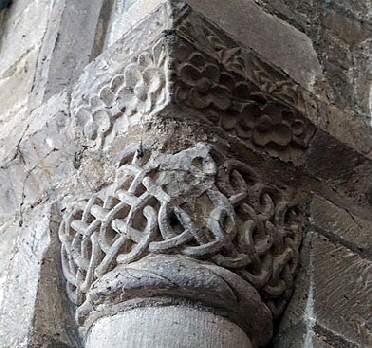
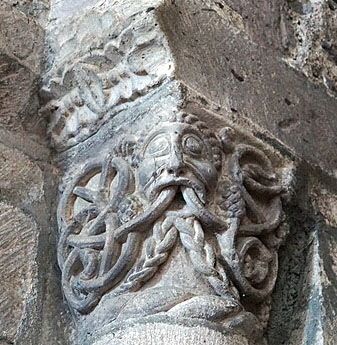
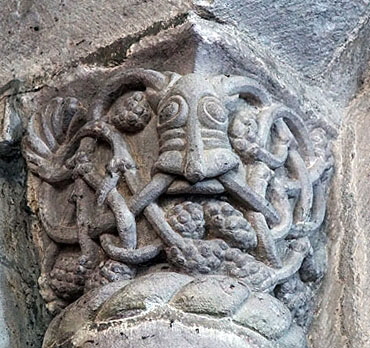
Foliage masks and plant ornament on the capitals of the western portal of the Monastery Church of Saints Peter and Paul. Leominster, England. Circa 1150. Stone carving. Herefordshire School.
In his photo gallery of the Leominster church, Lionel Wall, an expert researcher of English churches, draws attention to two masks adorned with grapevines. He notes that «one vaguely resembles a human face, while the other is distinctly grotesque» (translation from English, Lionel Wall, Leominster Priory Gallery).
When viewing both sculptures together, the difference becomes quite noticeable. One mask still retains discernible human features, although vines are already emerging from the mouth, and the beard is nearly transformed into a vegetative pattern. The other appears much stranger: the eyes, mouth, and intertwining vines form such a complex whole that the human features seem to be fading away.
Next to them is a capital featuring a standard interwoven ornament. I find this juxtaposition particularly interesting. In one instance, the stone lines coalesce into a pattern, while in the other, they form a living, somewhat unsettling face. It suggests that the master only needed to add a few human features for an ordinary decorative element to transform into an entirely unconventional image.
Wall, Lionel. Leominster Priory Gallery // Great English Churches. URL: https://www.greatenglishchurches.co.uk/html/leominster_priory_gallery.html (Accessed: 11.11.2026).
Photo Source: Lionel Wall, Leominster Priory Gallery, images Leominster Web1006 (2), Web1006 (3), Web1006 (1). Great English Churches. Accessed: 11.11.2026.
Keystone of a vault with a foliage mask. Paris, France. Circa 1280–1290. Limestone. Cloisters Museum, Paris.
Here, the leaves no longer just surround the human head. They seem to grow from it, gradually transforming into facial features. The large oak leaves, wrinkles, and wide-open mouth are particularly noticeable. I feel this mask looks much more intense than the previous ones. There’s a sensation, as if the face is trying to scream or break free from the stone ornament. Meanwhile, the entire composition is framed within the geometric shape of an architectural detail. It results in the plant, the human, and the architecture itself becoming unified in a single image.
Foliate motif on the tympanum of the North Portal of Saint Leonard’s Church. Lincoln, England. 12th century. Stone carving.
Unlike previous works, this piece depicts not just a head, but a full human figure. Plant shoots surround it, emerging from the mouth and filling the space of a semi-circular tympanum. The figure appears unusual because of its pose and stylized features. The vegetation seems to link it to the surrounding ornamentation. Although the carving has suffered significant damage from time, one can see how the artisans integrated the human form and the botanical pattern into a single composition.
Armed figure with a foliage mask. Choir carving from Winchester Cathedral. England. Circa 1308. Wood. Attributed to William Lingwood.
This is one of the most unusual examples because it depicts not just a face, but an entire human figure. In her hands, she holds a sword and a shield, and leaves are growing around her head. The vegetal motif merges with the image of an armed person.
Examining the foliage masks, I noticed the vast diversity in how medieval masters combined the human face with plants. Sometimes the shoots emerge from the mouth; at other times, leaves replace hair and beards, and occasionally the face virtually disappears into the botanical pattern.
It is particularly interesting that these images do not exist independently of architecture. Their form is dictated by the capital, portal, keystone, or other element upon which they are placed. Consequently, the human and the plant seem to fuse not only with each other but with the building itself.
However, I cannot definitively say that all foliage masks held a singular meaning. For now, what matters more to me is something else: how masters created a completely unconventional human image using simple leaves.
Chapter 2. Human and Animal
After looking at the leafy masks, I wanted to explore another way of altering the human form—by merging humans with animals. In medieval churches, one can find centaurs, sirens, and other creatures whose human anatomy unexpectedly continues into bestial or fish-like bodies.
These images feel simultaneously familiar and strange. We easily recognize a human face or hands, but beyond that, the figure begins to contradict our usual conception of a living being. I am interested in understanding how masters connected different body parts, what poses they chose for these hybrids, and how they integrated them into the architecture. I am also curious—why did these unusual characters appear in the decoration of Christian sanctuaries?
Capital with a centaur fighting a man with a bow. Palencia, Spain. Circa 1175–1200. Limestone. Metropolitan Museum of Art, New York.