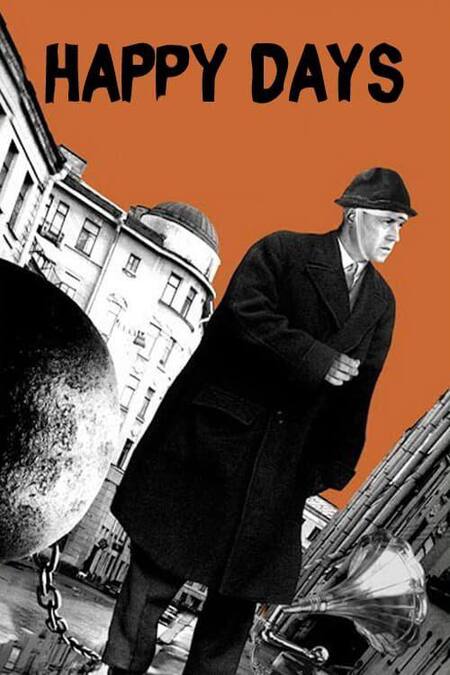
Explanation of the theatrical performance based on Alexei Balabanov film «Happy Days» (1991)
Working title: «Happy Days. An Attempt to Break Free»
Author of the idea: Ekaterina SudakovaThe idea is submitted for participation in the Stipendienplatz im Rahmen des Weimarer Regiestudios — Internationales Nachwuchsprogramm für Regie (m/w/d) DNT (Deutsches Nationaltheater und Staatskapelle Weimar)
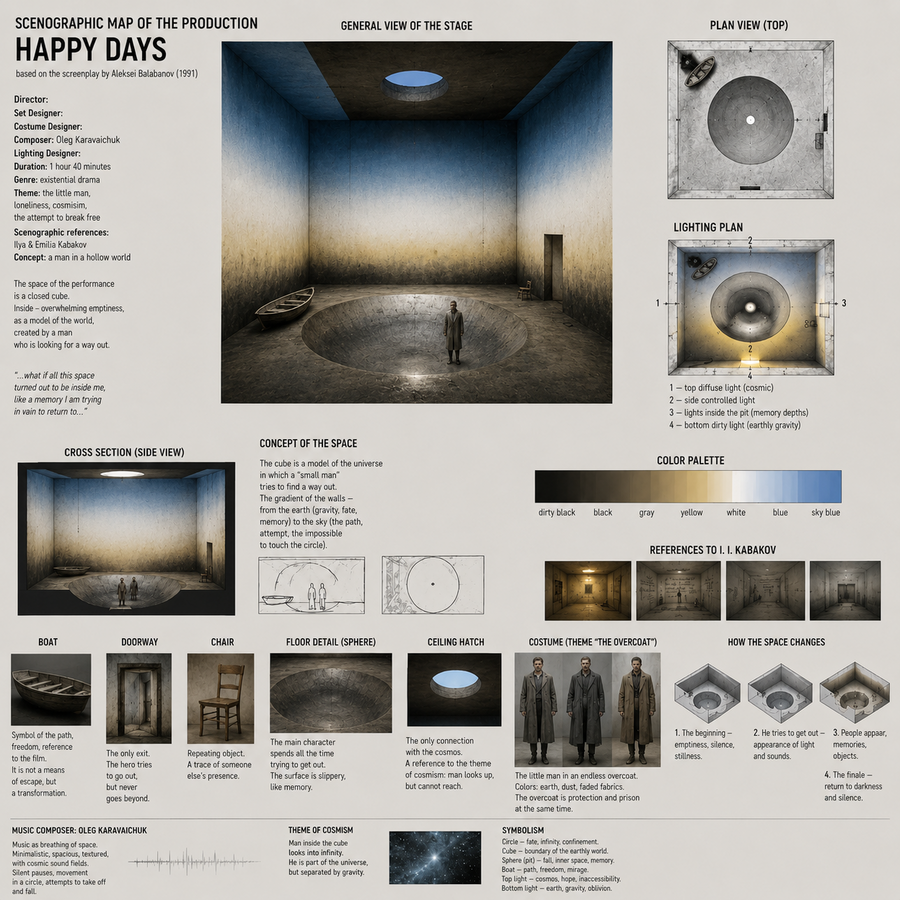
- General Concept of the PerformanceThe performance, based on Alexei Balabanov’s film «Happy Days,» is a theatrical exploration of loneliness, personal disintegration, and the inability to establish oneself in the world. The production draws not so much on the film’s plot as on its state: the feeling of being abandoned in a space devoid of memory, time, and stable connections.
The protagonist is a man without a name, without a past, and without a future. He moves through a ghost town, encountering people who either don’t recognize him or mistake him for someone else. The performance’s space becomes a territory of internal disintegration: the further the protagonist moves, the more the boundaries between reality, memory, and dream blur.
The production draws on the aesthetics of the late Soviet absurd, existentialist theater, and the dramaturgy of Samuel Beckett, whose influence is significant for the original film. However, the performance is not a direct adaptation of the film’s text. This is an independent theatrical statement about a person who has lost the ability to be seen.
- Theme and Overarching ObjectiveMain Theme: The inability of a person to be «seen» in the world, their struggle with their own invisibility.
Overarching Objective: Through the character’s physical and emotional struggle with space, to evoke in the viewer a feeling of existential anxiety and cosmic loneliness.
- Genre DefinitionExistential Drama / Theater of the Absurd / Plastic Parable
The performance is built on a combination of: psychological play, plastic theater, slow rhythm, visual metaphor, fragmented narrative.
Atmosphere is crucial: silence, pauses, unfinished actions, and repeated character paths.
- Scenographic SolutionThe main principle of the scenography: Space must simultaneously be real, conventional, empty, and infinitely enclosed.
4.1 The Cube as the Main Object
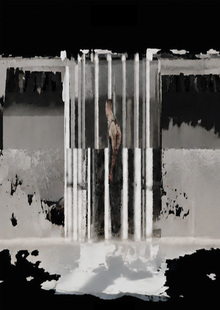
The stage is a cube, symbolizing the limited space of human life and the inner world. The cube’s walls are painted in a gradient: Bottom: dirty black, gray, and yellow—symbolic of everyday heaviness and earthly roughness. Middle: white—a space of transition and uncertainty. Top: blue—a hint of space, infinity, and the idea of cosmism.
4.2 The Central Object: A Spherical Recess
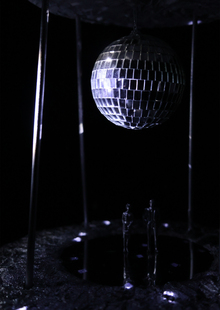
In the center of the stage, the floor has a huge concave depression, reminiscent of a bowl or plate. The protagonist constantly tries to escape from it, physically demonstrating his struggle with the limitations of space and his own destiny. The depression symbolizes both the difficulties of everyday life and the inner emptiness of a person, analogous to a black hole of cosmic proportions.
4.3 Boat (plus a lid made of a wooden board)
The boat is placed on stage as a metaphor for movement, travel, and salvation. It can be a periodically moving object that the hero attempts to use to escape from the depths. A reference to Balabanov’s film: the boat acts as a symbol of hope and the illusion of freedom. But the boat, like the form, is also a symbol of the coffin.
- Lighting SolutionThe overhead light is blue to suggest space. The lower dark tones create a recessed space, emphasizing depth and heaviness. Narrow spotlights are directed at the character as he attempts to escape the recess. Sharp spots of light create the effect of a search, the sudden discovery of the character. The lighting effects interact with the boat and the sphere: reflections on the walls create the effect of moving water and the illusion of infinite space.
- MusicComposer: Oleg Karavaichuk. Musical arrangement: Slow, haunting melodies, where every note is physically felt. Echoes, resonance, and occasional sonic «cracks» emphasize the protagonist’s anxiety and confusion. The music interacts with the action, emphasizing the protagonist’s movements in the depths, his attempts to rise, and his failures. The main goal: the music does not illustrate the action, but creates a space for the character’s mental state.
- CostumesProtagonist: costume in the style of Gogol’s «little man"—a loose, slightly worn coat, neutral dark colors, emphasizing the humiliating ordinariness.
Minor characters: conventional, slightly abstract costumes that can be easily transformed, emphasizing their cyclical and changeable nature.
Sometimes, the costumes may contain elements of cosmism—metallic, shiny, or blue accents, hinting at the characters' cosmic dimension.
- Plastique and ActingThe actors' movements are slow, fragmented, as if disrupted. Characters appear unexpectedly, freeze, and can repeat the same actions, sometimes existing as shadows or reflections of the protagonist’s consciousness. The repetition of routes emphasizes the impossibility of escape. The protagonist moves as if the space resists him. The protagonist’s movements are slow, fragmented, gravitating toward falling and crawling, emphasizing the heaviness of existence. Attempts to emerge from the depths are a metaphor for the struggle with oneself, with the «little man» within. Secondary characters appear and disappear suddenly, and can be simultaneously physical bodies and shadows of the protagonist’s consciousness. The emphasis is on small, everyday details, in the spirit of Kabakov: chairs, doorless doors, objects symbolizing a familiar but unsuitable space.8.1 Working with Characters
Protagonist: Lacks a stable biography. He is a «generic man,» having lost touch with himself. The actor’s task: to exist in a state of internal exhaustion, avoiding active emotionality, playing not feelings but a lack of support. The protagonist is almost constantly searching: for a place, for memory, for a name, for human contact.
Minor Characters: All the people encountered can be interpreted as: real figures, phantoms of memory, projections of the protagonist’s consciousness.
- Directing MethodThe performance is built on pauses, understatement, rhythmic slowdown, and the inner tension of silence. The main technique is the disruption of everyday logic. The audience receives no direct explanation: who the character is, what happened to them, where reality ends. The production should evoke not rational understanding, but a feeling of complicity in someone else’s loneliness.
- Tempo of the PerformanceThe tempo is slow, viscous, and hypnotic. However, within this slow rhythm, there are bursts of anxiety, aggression, sudden movement, screams, and harsh lighting. These disruptions create a sense of internal catastrophe.
Running time: approximately 1 hour 40 minutes, excluding intermission.
- Interaction with the AudienceThe audience becomes not an observer of the plot, but a witness to a state of being. It’s important to create a sense of discomfort, prolonged anticipation, emotional emptiness, and recognition of one’s own fear of loneliness. In certain scenes, the fourth wall can be broken: the character looks out into the audience, as if trying to recognize someone in the audience.
- FinaleThe hero doesn’t fully emerge from the hole—the ending remains open.
The boat and the light gradually fade, leaving the hero alone against the backdrop of the cube, as if immersed in his own universe.
The viewer’s final sensation is loneliness, cosmic emptiness, and the man’s inner struggle with his own destiny.
- Artistic ImpressionThe audience experiences existential loneliness, a sense of being a «small man» in a vast world. The spherical stage, the gradient walls, and the cosmic perspective create an impression of simultaneous earthly and cosmic hopelessness. Karavaichuk’s music heightens the anxiety and meditativeness, making the audience feel every effort of the protagonist. After the performance, the audience should be left with not a sense of a completed plot, but an emotional aftertaste: emptiness, anxiety, quiet compassion, an attempt to hear oneself in the silence.
- The Relevance of the ProductionThe relevance of the production of «Happy Days» lies in its ability to reflect the contemporary human condition, experiencing social and internal isolation. In a world of information noise, constant rush, and alienation, people increasingly find themselves unnoticed, deprived of support and understanding—like a «little man» in a vast system. Through visual metaphors, a centered sphere, the protagonist’s meditative movement, and Karavaichuk’s music, the production addresses questions of the search for meaning, loneliness, personal identity, and the struggle with internal limitations. Furthermore, references to cosmism and the infinity of the cube allow the audience to experience a sense of vulnerability and a desire for freedom, making the production resonant with contemporary experiences of emotional and existential instability.
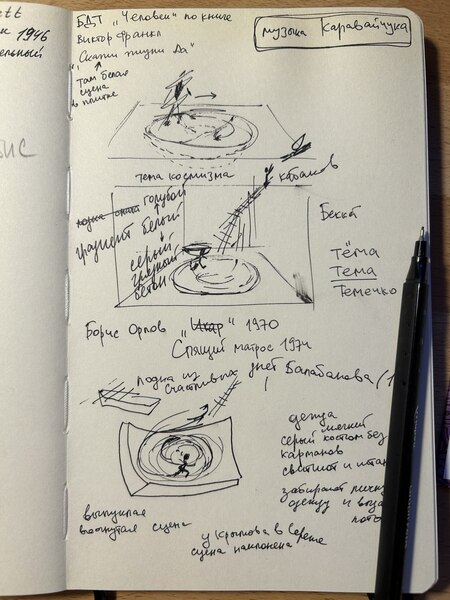
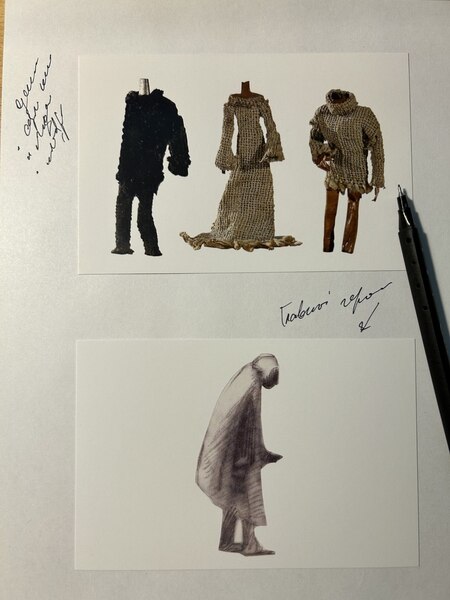
My sketch, artistic research, selection of materials, concept development, selection of images
Concept in briefThe play «Happy Days,» based on Alexei Balabanov’s film, is an existential parable about a «little man» lost between earthly and cosmic space. The protagonist, like Gogol’s Bashmachkin, exists within a closed cube-universe and endlessly attempts to escape the enormous spherical funnel at the center of the stage, simultaneously reminiscent of a memory pit, a crater, and a gravity trap. The set design, inspired by the works of Ilya Kabakov, combines a dilapidated domestic environment with the theme of cosmism: the gradient of the walls from dirty black to sky-blue transforms the space into a model of the universe, where a person finds himself alone with emptiness, memory, and the impossibility of liberation. Oleg Karavaichuk’s music creates a sense of internal decay and endless circular motion, while the boat becomes a symbol of hope, the path, and unattainable salvation.