Concept
The city is a constantly shifting space, filled with movement, people, and chance occurrences. Street photography allows us to capture these moments and transform ordinary scenes of daily life into artistic expressions.
Throughout the twentieth century, the perceptions of street photography’s expressive capabilities gradually evolved. In the 1930s, photographers paid special attention to light, spatial geometry, and the perfectly captured instant. In the following decades, human emotions, gestures, and interactions took center stage. Later, photographers began more actively employing unusual angles, grain, complex compositions, and color, broadening conventional understandings of photographic art.
Thus, street photography developed not only as a means of documenting urban life but also as an independent artistic language capable of interpreting the surrounding reality in diverse ways.
The goal of this study is to trace how the aesthetics of street photography changed throughout the twentieth century and what artistic techniques became significant in different decades.
The research question is: How did photographers transform everyday urban scenes into artistic images, and how did the methods of their depiction change over time?
The hypothesis is that the development of street photography in the twentieth century is related less to changes in subject matter and more to the expansion of artistic tools. Light, composition, movement, perspective, and color gradually gained new expressive potential.
The research method is comparative visual analysis of photographs from different decades. Primary attention is given to composition, lighting, perspective, the depiction of the human figure, and the use of color.
The chronological scope is primarily the 1930s–1980s of the twentieth century.
The main themes of the study are the city’s atmosphere, the human figure in the frame, intense documentary quality, visual complexity, and color.
This study examines the history of street photography as a gradual evolution in the artistic perspective on the city. It shows how photographers found new ways to convey daily life and uncovered artistic value in the most ordinary, chance, and unexpected moments.
City as Cinema: How Night Changes Everything
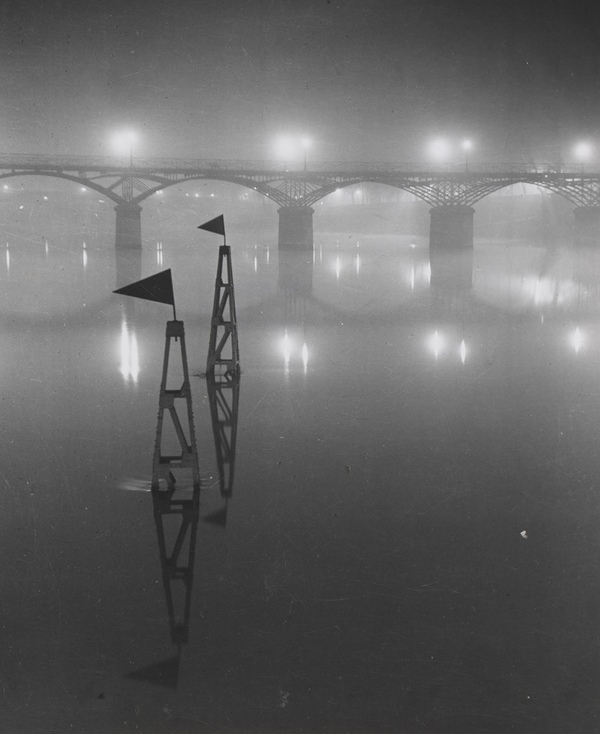
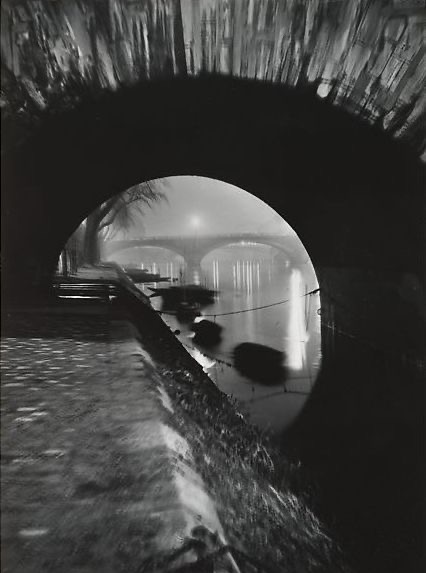
Brassaï. «Art Bridge in the Fog.» 1936. Brassaï. «View from under the Mari Bridge onto the Louis-Philippe Bridge, Paris.» 1930–1932.
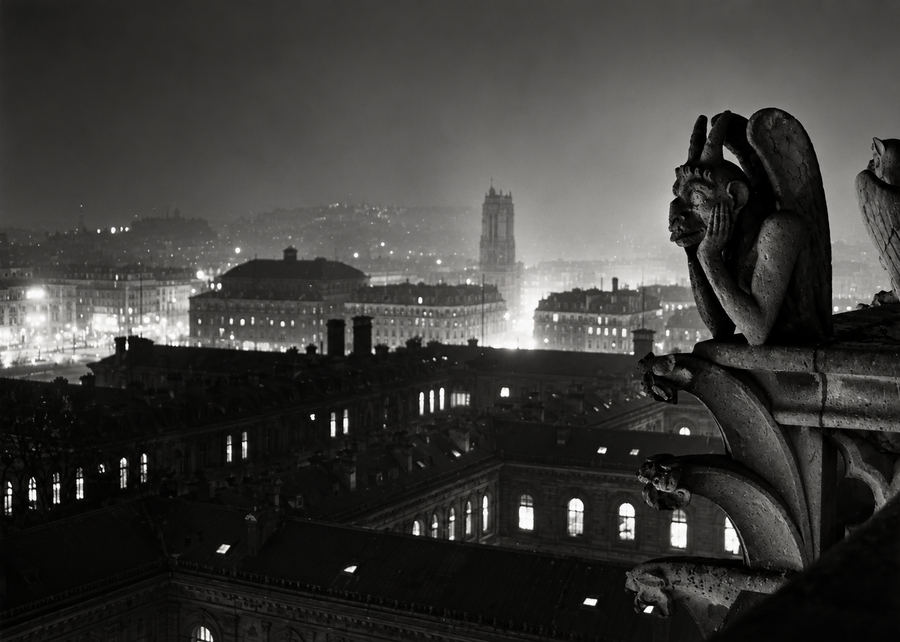
Brassai. «The Devil of Notre Dame and the Saint-Jacques Tower»
In these photographs, Paris at night transforms into an enigmatic space due to mist, artificial light, and deep shadows.
In «Bridge of Art in the Fog, ” blurred lights and reflections create a sense of uncertainty. In the depiction of the Pont Marie and Pont Louis-Philippe, the dark arch adds drama to the architecture, and in „Strix, ” the stone chimera turns the city into an almost fantastical backdrop.
Brassaï uses light not just to depict the city, but to convey mood. Atmosphere becomes more important than the event itself.
However, the expressiveness of urban photography can be created not only through light but also through unusual combinations of form, movement, and space.
Geometry of Chance
Andre Kertes. «Medom.» 1928.
In the photograph «Meydon, ” André Kerteis integrates the movement of the train, the viaduct architecture, and the human figure into a single composition.
Henri Cartier-Bresson. «Year, France.»
André Kertez. «Fair in Paris» 1931.
In Andre Kerters’ photograph «Medon, ” he unifies the motion of a train, the architecture of a viaduct, and the human figure into a single composition. In „Fair, ” he continues to explore the random interplay of movement and figures. Henri Cartier-Bresson uses a similar principle in „Jerez, France, ” where a passing cyclist complements the geometry of a staircase.
The expressiveness of these photographs is born in the moment when different elements of space coalesce into a unified whole.
A Moment That Cannot Be Repeated
Henri Cartier-Bresson. «Near the Saint-Lazare Station.» 1932.
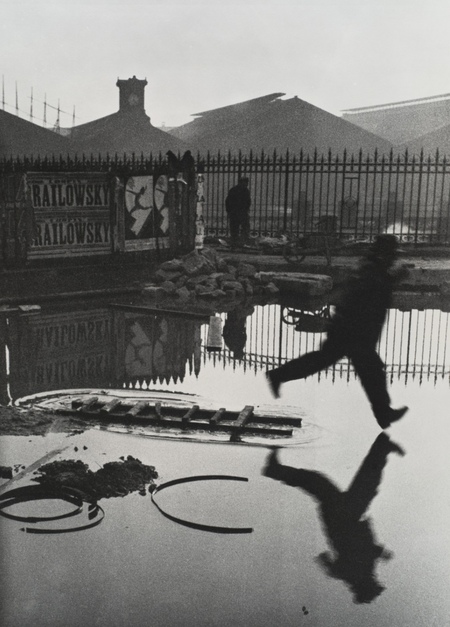
In the photograph «Near the Saint-Lazare Station, ” the jump of the person and their reflection create a compositional balance that will vanish in a moment.
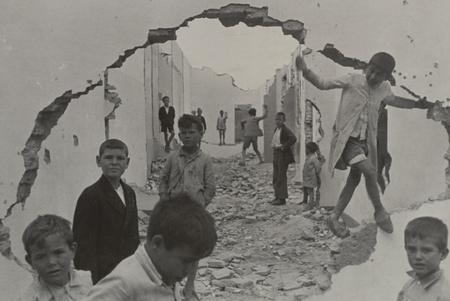
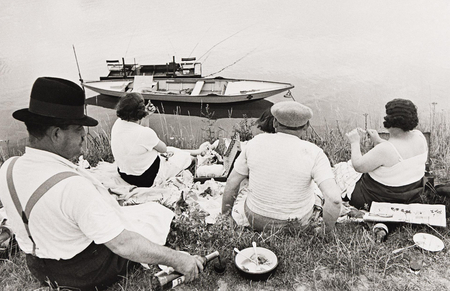
Henri Cartier-Bresson. «Children Playing Among the Ruins, Seville, Spain.» 1933. Henri Cartier-Bresson. «Sunday on the Banks of the Marne»
In «Seville,» architecture and human figures form a complex system of spatial relationships. In «Sunday on the Banks of the Seine,» attention gradually shifts to people, their postures, and everyday leisure. Thus, the photograph begins to convey not only the beauty of a fleeting moment but also the stories revealed through ordinary human gestures.
The Person in the Frame: The Street as Theater
Helen Levitt. «New York.» Circa 1940.
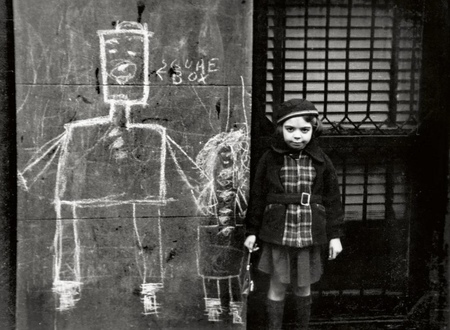
If Cartier-Bresson often made the person an element within a complex composition, Helen Levitt foregrounded human behavior. Her photographs capture the life of New York streets: kids, neighbors, passersby, and chance encounters. While these moments seem insignificant, within the frame they take on a expressive quality reminiscent of small theatrical scenes.
Helen Levitt. «New York.»
Helen Levitt. «Street Drawing».
Levitt’s work holds a special place in the drawings made with chalk on walls and sidewalks. These images, much like many moments of street life, are transient. Photography preserves them, transforming temporary traces of a child’s imagination into autonomous visual statements.
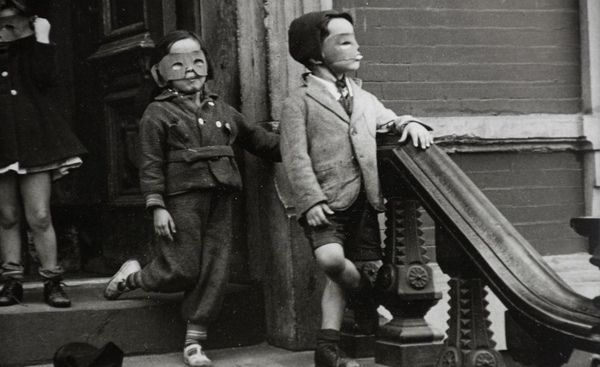
Helen Levitt. «Children in Masks.» Helen Levitt. «New York.» Circa 1940.
Levitt demonstrates that urban life can be expressive without exceptional events.
A History at a Glance
During this period, street photography increasingly focuses on human emotions, gestures, and serendipitous situations. Ordinary urban scenes are transformed into small visual narratives, filled with humor and unexpected meaning.
Robert Rauschenberg. «Oblique Gaze.» 1948. Un Regard Oblique. The Metropolitan Museum of Art