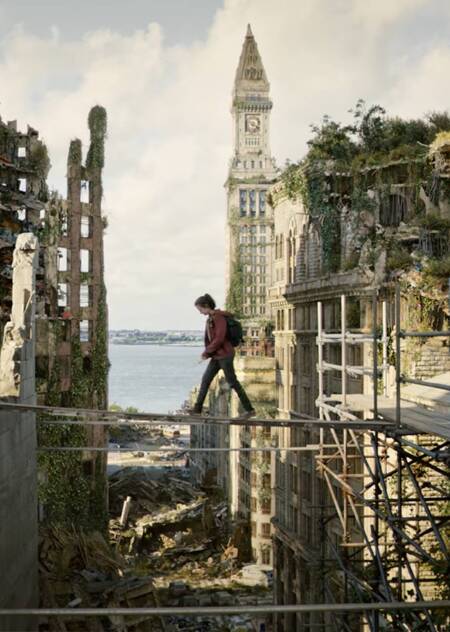
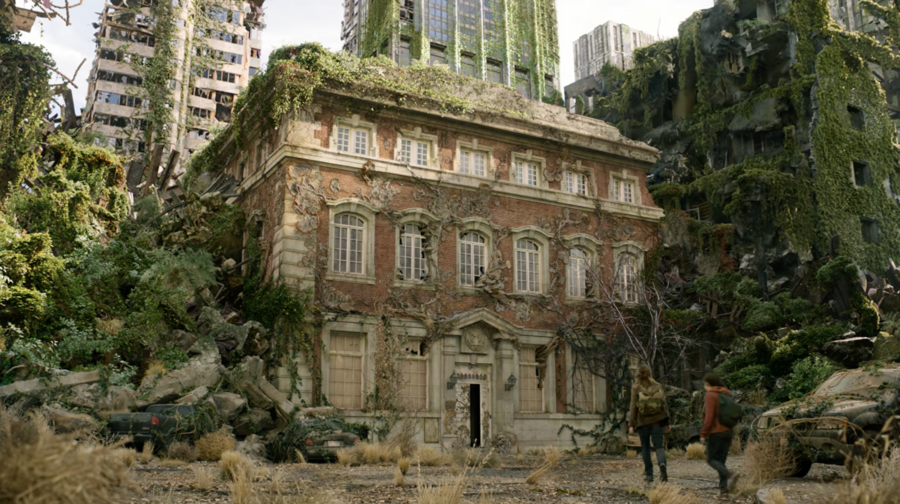
Frame from the series «The Last of Us,» 2023. Program creators — Neil Druckmann, Craig Mazin. Visual Effects Supervisor — Alex Wang
Concept
I have always been drawn to post-apocalyptic aesthetics—abandoned cities overgrown with moss and ivy, cracking concrete, and decaying cars left on the roads. In my view, this style is best represented in the «The Last of Us» video game series, though it has also been explored in cinema on numerous occasions. With the advent of visual effects, it has become possible to recreate existing cities in any style, including in a post-apocalyptic setting. In this visual study, I will examine how the technologies for rendering virtual decay and vegetation have evolved across three films: «I Am Legend» (2007), «Oblivion» (2013), and «The Last of Us» (2023).
The study examines the evolution of digital reconstruction and urban environment transformation methods—moving from processing photographic imagery and localized application of three-dimensional objects to creating complex digital environments using procedural generation for architectural damage and vegetation.
The evolution of these methods can be traced through three screen productions created across different periods: «I Am Legend» (2007), «Blade Runner» (2017), and «The Last of Us» (2023). In each of them, a similar artistic challenge is addressed—to present a recognizable contemporary urban environment as a space that has undergone prolonged dereliction and decay. However, the approaches to achieving the visual result vary: from digital processing of real urban footage to the creation of detailed virtual buildings and procedural tools for generating destruction. Visual effects are essential here; sets of this caliber would cost a fortune.
The research question is: How have the technologies for creating digital environments of abandoned settings in film evolved?
Still from the series «The Last of Us,» 2023. Program Creators: Neil Druckmann, Craig Mazin. Visual Effects Supervisor: Alex Wang
It is worth noting that despite the significant time gap between the films (2007–2023), all three works achieved complete realism within the digital abandoned environment. This is why the visual study focuses not on the visual style of each example, but on the technologies employed in creating the visual effects.
Table of Contents
1. Analysis of the film «I, Legend»: digital processing of a real city.2. «Blade Runner 2049»: desolation not through destruction, but through a fundamental change in the city’s image.3. «The Last of Us»: procedural generation of a ruined environment.4. Comparative Analysis: geometry, decay, aging, and vegetation.5. Conclusion: how the process of creating a desolate city has changed.Chapter 1. Analysis of the film «I Am Legend» (2007): Digital Processing of a Real City.
Still from the film «I Am Legend,» 2007. Director: Francis Lawrence, Visual Effects Supervisor: Janek Sirrs.
In the film I Am Legend (2007), the task of creating a desolate Manhattan was primarily solved through the digital transformation of real urban spaces. Rather than building an entirely virtual copy of New York City, the Sony Pictures Imageworks team utilized on-location footage from the city streets and successively altered it—removing signs of human activity, adding traces of prolonged abandonment, architectural damage, and vegetation.
VFX Team
The visual effects for the film were overseen by the lead VFX Supervisor, Janek Sirrs. Jim Berney was responsible for the visual effects at Sony Pictures Imageworks. Key members of the team also included Digital Effects Supervisor David A. Smith and Effects Animation Supervisor Dave Stephens.Scene breakdown from the film «I Am Legend,» 2007. Director — Francis Lawrence, Visual Effects Supervisor — Janek Sirrs
In the article «I Am Legend: Apocalypse Now in Manhattan, ” Alain Bielik describes that the initial work on the environment involved eliminating any signs of human presence from the footage. The team removed cars, pedestrians, people behind building windows, traffic lights, billboards, and other electrical devices. After that, the urban surfaces were further altered to convey the impression of long-term neglect and disuse.
Scene breakdown from the film «I Am Legend,» 2007. Director: Francis Lawrence, Visual Effects Supervisor: Janek Sirrs
This approach is particularly evident in scenes where the camera captures lengthy stretches of streets and the facades of existing buildings. For such shots, it wasn’t necessary to model every structure as a separate, highly detailed 3D model. Instead, artists could work with photographs and project altered images onto simplified geometry.
We filmed across Manhattan. Therefore, we had to remove all signs of human life from the image. The streets are covered in cracks. Buildings are crumbling. Weeds are growing everywhere. Nature is reclaiming the city.
One of the primary ways to transform the urban environment has been through the use of photographic textures. According to Alena Byelika’s material, artists created textures in Photoshop or Cinema 4D, which were then projected into Maya and RenderMan onto low-polygon geometric representations of buildings that corresponded to the objects in the original footage. LiDAR technology was widely utilized in this process, enabling the scanning of large urban areas using drone photography, and subsequently transforming the captured frames into a 3D space.
Still from the film «I Am Legend, ” 2007. Directed by Francis Lawrence, with visual effects supervised by Janek Sirrs.
Digital Flora
A separate technical challenge involved creating vegetation that gradually colonizes streets and sidewalks. Unlike individual digital objects, the plants needed to be distributed across large areas of space, factoring in surface characteristics and coordinating their placement with camera movement.
The article fxguide describes the grass and weed generation system developed by Sony Pictures Imageworks. For placing grass, a library of patches—tiles sized from 10 to 50 feet (approximately 3 to 15 meters)—was used. Each tile contained its own vegetation pattern. The grass was created using a hair system, and its placement was tied to cracks and indentations on the surface.
The system allowed for the creation of various plant types based on defined algorithms. Artists could control the height and density of individual specimens, select leaves and flowers from pre-made models, and specify the vegetation density across different areas.
Plants grew in every frame as it was rendered. We had developed algorithms for each plant type. Each time a plant instance was created, the system generated a unique variation within predefined parameters. We could also procedurally add pre-modeled flowers, buds, and leaves.
Still from the film «I Am Legend, ” 2007. Directed by Francis Lawrence, Visual Effects Supervisor: Janek Sirrs.
Thus, the film combines various methods of creating a ruined city. It is worth noting that the scenes are not modeled from scratch—real urban architecture is almost always used and procedurally modified in 3D software.
Chapter 2. 2. «Blade Runner 2049»: Desolation not through destruction, but through a fundamental transformation of the city’s image
Still from the film «Blade Runner 2049,» 2017. Directed by Denis Villeneuve, with visual effects supervision by John Nelson.
Blade Runner 2049 was selected for this study for a reason. Las Vegas in the film is not depicted as a city with ruined facades and collapsing buildings. On the contrary, its architecture is largely preserved. It is deserted, buried under sand and dust, and the urban environment looks dead. This is an example of creating urban architecture in a state of abandonment, even if it is not set in the typical post-apocalyptic scenario where nature overtakes the city.
It is worth noting that John Nelson, the visual effects supervisor for the film Blade Runner 2049, received an Academy Award for his work.
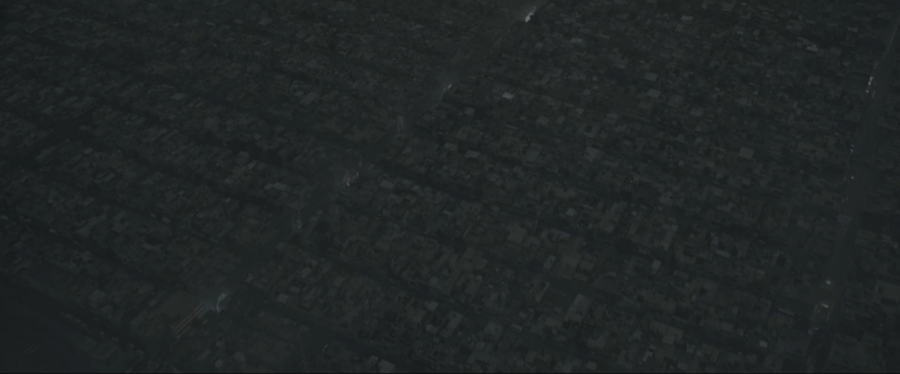
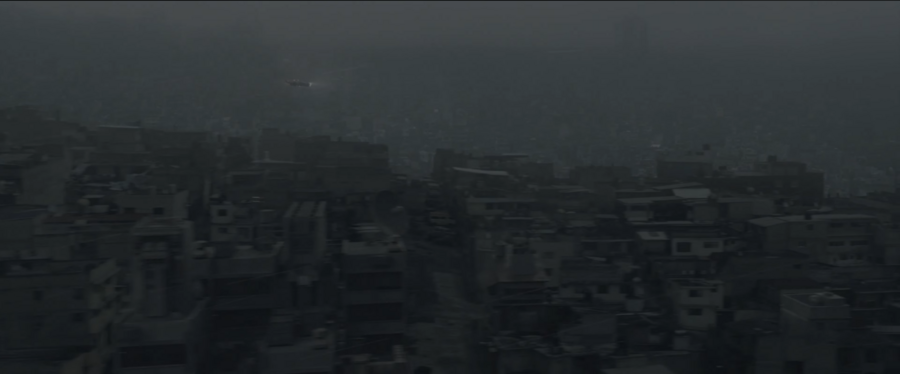
Stills from the film «Blade Runner 2049,» 2017. Director: Denis Villeneuve, Visual Effects Supervisor: John Nelson
https://www.awn.com/vfxworld/i-am-legend-apocalypse-now-manhattan (Accessed: Nov 14, 2026)
https://www.cgw.com/Publications/CGW/2007/Volume-30-Issue-12-Dec-2007-/Open-Before-Christmas.aspx (Accessed: Nov 14, 2026)