ДУША ВЕЩИ
И как художник изображает ее жизнь
Concept
I was captivated by the story where ordinary household items gain the ability to speak to a person. In the Japanese tale, «Tsukumogami-ki, ” discarded objects come to life, take revenge on their owners, and eventually turn toward Buddhist doctrine. But how does an artist make the viewer see a living being in an object? Even when the contours of an item hardly change, adding eyes, limbs, clothing, or a gesture makes it an active participant in the events. Although the Tsukumogami story concludes with their turn to Buddhism, what interests me most is the beginning of that journey—how the artist imbues an ordinary object with character and the ability to act autonomously.
I am examining Japanese art from the 16th to the 18th centuries, spanning from the late Muromachi period through the end of the 18th century. This includes the scroll from Shinzū-an, Yoshimitsu’s early Edo-period „Hyakki-no Zu, ” versions of the procession by Ogata Morifusa and Motizuki Kyokusen, painting by Ito Jakuchū, as well as individual printed books and works from the 18th century. The diversity of artistic formats allows me to trace the evolution of the Tsukumogami image and identify the characteristics of its representation across different periods. When selecting visual material, I relied on the dating provided by museum and archival collections. For a more detailed study of the characters, I referenced objects of Japanese daily life, comparing their form, construction, and purpose with the appearance of fantastical creatures. Images of other Yokai help determine the defining traits of the Tsukumogami within the context of Japanese supernatural representation tradition.
What artistic techniques allow a mundane object to be perceived as a living being, and how does its portrayal shift depending on the medium? I hypothesize that the recognizability of a tsukumogami is maintained through the object’s original form and its characteristic details. Even minor alterations—such as the appearance of eyes or limbs—can imbue the object with character and convey a mood. In horizontal scrolls, the character’s image is revealed through movement, gestures, and interaction with surrounding creatures. Vertical paintings and printmaking allow for a closer examination of its silhouette, structure, and individual features. To test this hypothesis, I compare images with varying degrees of anthropomorphism, paying close attention to instances where a sense of life emerges from minimal alteration of the object’s initial form.
While examining the illustrations, I noticed that artists frequently capitalize on the inherent structural characteristics of the objects themselves. For instance, a teapot’s spout might resemble a nose or a trunk, and a vessel’s handles become part of the character’s anatomy. It is these very details that help preserve similarity to familiar objects while simultaneously lending them a fantastical appearance.
Topics
01. The Object Becomes a Body Form and Anatomy of Animated Objects 02. The Object Begins to Move Plastics, Gestures, and Character Interaction 03. The Procession and Its Limit Composition of the Horizontal Scroll, Movement of the Procession, and Its Conclusion 04. Jakyū Ware Imagery of Tea Utensils in Vertical Composition 05. The Ritual Object Animated Items from Buddhist Daily Life 06. From Procession to Individual Image Depictions of Tsukumogami in 18th-Century Printed Books07. Conclusion
01. The Object Becomes the Body
An artist can convey a sense of life while retaining the familiar form of an object. In this chapter, I examine which details allow one to recognize the original item and how it acquires the characteristics of a living being.
Unknown Artist. «Nocturnal Procession of Old Demons, ” 16th century, Muramachi. Shinzū-an, Daitokuji, Kyoto Fragment. Creatures on a single sheet
Bodies of varying structures coexist in a single procession, among which thematic silhouettes stand out, featuring a noticeable red figure.
Head as a structure
The subject’s recognizability is maintained when repositioned to the top.
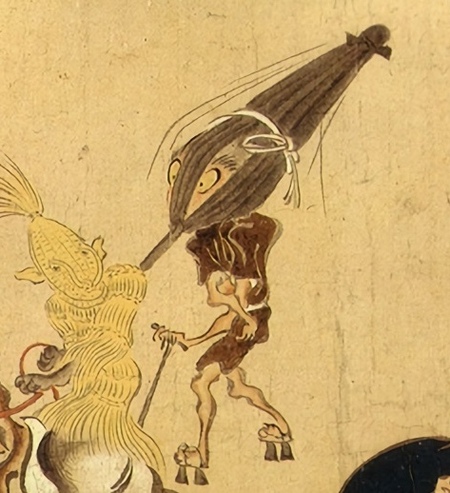
Unknown Artist (but traditionally attributed to Tosa Mitsunobu). «Night Procession of the Old Demons,» 16th Century, Muromachi Period. Shinzū-an, Daitokuji, Kyoto. Fragment. Upper right detail. Umbrella-like structure. The ribs of the folded umbrella form an elongated head, the feet resting on the ground create movement, and the geometry of the object does not disappear.
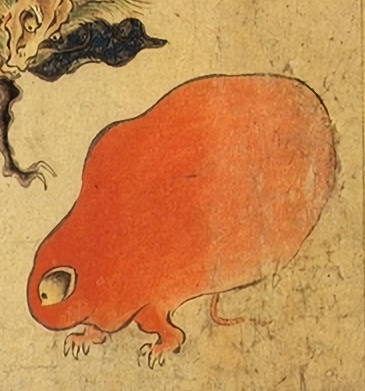
Unknown artist (though traditionally attributed to Tosa Mitsunobu). «Nocturnal Procession of the Old Demons, ” 16th century, Muromachi period. Shinsyu-an, Daitokuji, Kyoto. Fragment. Detail in the center. The almost continuous red contour of the body sharply contrasts with the broken lines of the neighboring figures. A visible eye and paws denote a living presence.
Fabric Instead of a Torso
Drapery creates the image of the body even without a clear face. Comparing two fragments allows one to distinguish the body made of fabric from the fabric being carried.
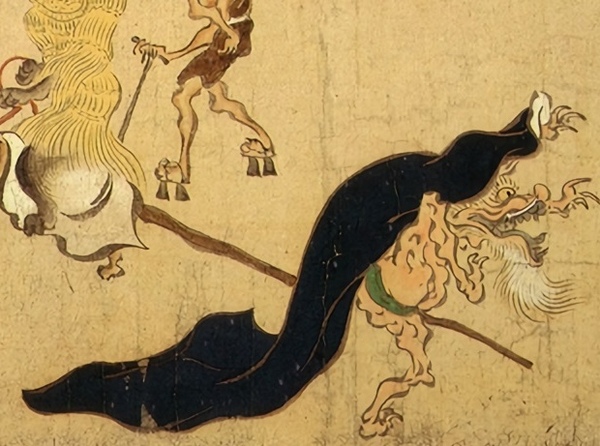
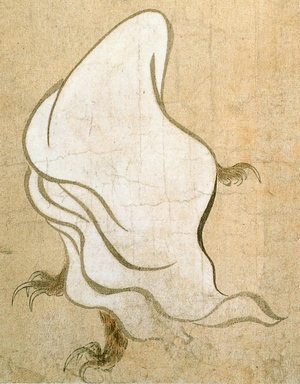
Figure A.
Unknown artist (but traditionally attributed to Tosa Mitsunobu). «Night Parade of a Hundred Demons,» 16th century, Muromachi period. Shinzū-an, Daitoku-ji, Kyoto. Fragment. Detail in the lower right. Dark canvas. A long, dark plane and slender limbs contrast; the folds of the fabric replace the typical anatomical boundary.Figure B.
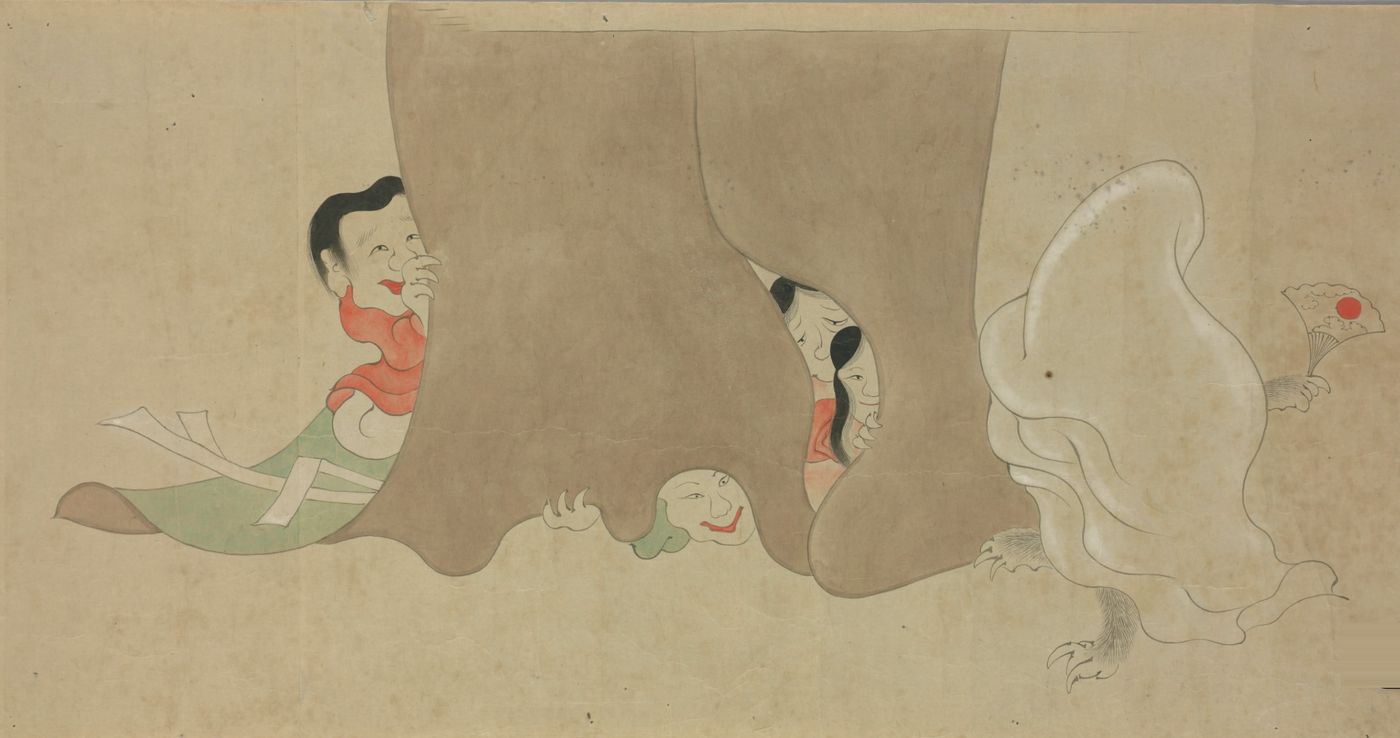
Unknown artist (but traditionally attributed to Tosa Mitsunobu). «Night Parade of a Hundred Demons,» 16th century, Muromachi period. Shinzū-an, Daitoku-ji, Kyoto. Fragment. A fabric-like creature. The light surface curves around a hidden body. Limbs emerge from beneath the folds, and a distinct face is absent.Sandals that you wear
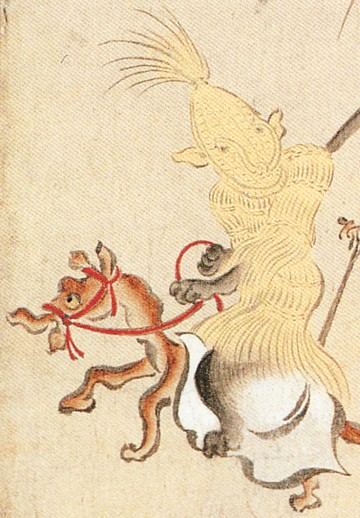
Unknown artist (traditionally attributed to Tosa Mitsunobu). «Night Parade of the One Hundred Demons» (Hyakki Yagyō Emaki), 16th century, Muromachi period. Shinzū-an, Daitokuji, Kyoto. Fragment. A living sandalIn this transformation arises a paradox: an object designed for human locomotion gains the ability to move on its own.
Face at the bottom of the vessel
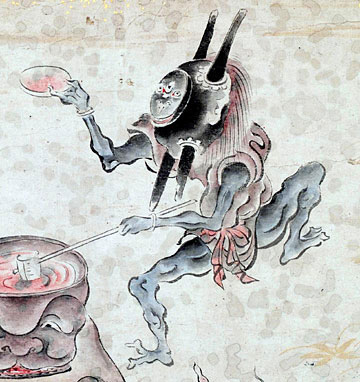
Yoshimitsu (吉光; per card). «Hyakki-no-zu» (Hundred Demons Picture), early Edo, 17th century (dating from the central publication). International Center for Japanese Studies, Fragment. The three-eyed Tsunodarai vesselTransferring facial features onto an existing surface is more economical than replacing the entire object’s form. The face occupies the bottom of the vessel, while the protrusions of the handles define the shape of the head. The clothing and the gesture with the ladle transform it into an active participant.
Damage becomes part of the image
Yoshimitsu (吉光; according to record). «Hyakki-no Tsu» (Picture of a Hundred Demons), Early Edo period, 17th century. International Center for Japanese Studies. Wooden memorial tablet, soto-ba.
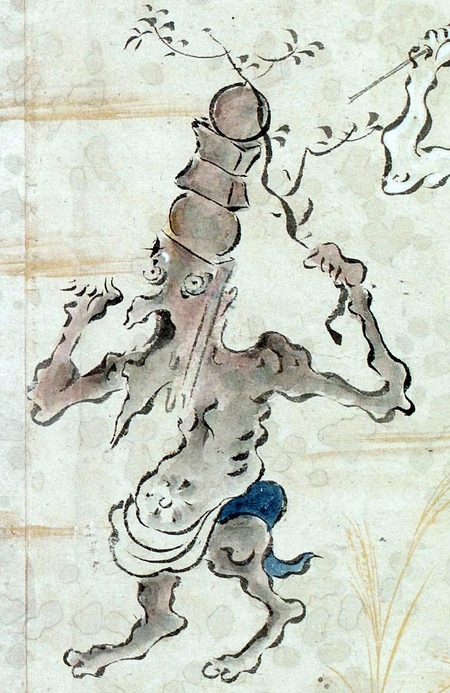
Yoshimitsu (吉光; per file card). «Hyakki no Zu» (Picture of One Hundred Demons), Early Edo period, 17th century (dating from the center publication). International Center for Japanese Studies. Fragment. Wooden Sōtoba memorial tablet.The face emerges from the break in the wooden tablet. The damage becomes part of the body, rather than a loss of its recognizability.
02. The object begins to move
Some characters retain nearly the entire form of the subject, while others are recognizable only by a single detail. Movement reveals their character: the direction of gaze, the twist of the body, and the gesture connect the figure with the surrounding creatures.
Tool in hand and body part
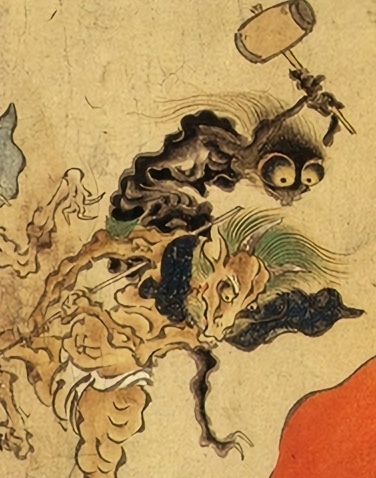
Unknown Artist (traditionally attributed to Tosa Mitsunobu). «Night Parade of One Hundred Demons» (Hyakki Yagyō Emaki), 16th Century, Muromachi period. Shōjin-an, Daitokuji, Kyoto. Fragment. Detail on the left. Figures with hammers and long implementsThe raised hammer and the bent figures introduce gestures. The tool in the hand should not automatically be interpreted as a living object.
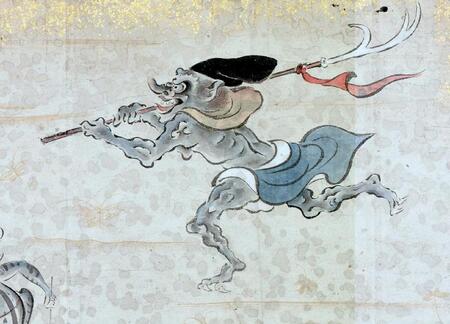
Yoshimitsu (吉光; according to the card). «Hyakki-no-zu» (A Hundred Demons Scroll), early Edo period, 17th century (dating from the center publication). International Center for Japanese Studies, BB10030851. Fragment. A long-snouted creature with a spearThe forward run and the long shaft create a diagonal. The spear remains a weapon, not a part of the body.