CATEGORIES
— Concept
— Runa Geedon
— The Locked Gate of Ezekiel
— Jacob’s Ladder
— The Burning Bush
— Conclusion
— Bibliography
— Image Sources
CONCEPT
In Christian art, the meaning of a Biblical image is not always confined to the depicted narrative. Old Testament events, objects, and natural phenomena can acquire additional significance, serving as prefigures for events and imagery in the New Testament. This method of interpreting Holy Scripture is called typology: an Old Testament subject is understood as a prefiguration whose meaning is revealed in a New Testament event. This principle is particularly evident in the depictions of the Theotokos (Mother of God). Her image is shaped not only through Gospel scenes but also through an entire system of symbols that trace back to Old Testament tradition.This research examines how Old Testament subjects gain new meaning within Christian tradition and how this is reflected in works of art. The Menorah of Gideon, the sealed gates of the prophet Ezekiel, Jacob’s Ladder, and the Burning Bush—at first glance, these are disparate images not unified by a single narrative. However, in Christian interpretation, each of these elements reveals a specific facet of the theological understanding of the Theotokos. The Menorah, receiving the heavenly dew, correlates with the Theotokos who received Christ; the sealed gates relate to her perpetual virginity; the ladder connecting earth and heaven relates to her role in the Savior’s arrival in the world; and the burning, yet unconsumed, bush represents Mary’s virgin motherhood.The main research question is how Old Testament subjects become a symbolic language for depicting the Theotokos, and what visual means allow artists to convey their new significance. The research hypothesis posits that Old Testament prefigures form an interconnected system of visual metaphors that reveal various aspects of the Theotokos’s image. Moreover, the meaning of each symbol is determined not only by the original Biblical narrative but also by the context of Christian tradition, within which it acquires a new reading.
The research material is selected based on the iconographic and thematic connection of the works to the image of the Theotokos. Primary focus is given to works where the Old Testament narrative is presented either as a distinct prototype or integrated into a more complex Christian composition. The visual selection encompasses icon painting, painting, book miniatures, and other forms of Christian art. When selecting materials, the historical context of the work, its iconographic features, and the possibility of establishing a link between the image and its corresponding theological interpretation are considered. A crucial condition remains the reliability of interpretation: symbolic meaning is not arbitrarily assigned to an image but is determined based on biblical texts, theological sources, and art history studies.
The study’s structure follows a thematic principle—moving from individual Old Testament figures to their integration within a complex iconographic system. Each section analyzes the original biblical narrative, its Christian interpretation, and the specific ways it is visually realized. The concluding section is dedicated to the image of the Immaculate Conception, which is significant not only for its independent symbolic content but also for the established iconography that unites several Old Testament prototypes of the Theotokos in a single composition. During the analysis, attention is paid both to the depicted characters and narratives, and to individual elements of the visual language: objects, architecture, natural motifs, gestures, color, and composition.
The textual foundation of the research consists of the Holy Scriptures, theological works, scholarly publications on Christian iconography, and art historical studies. When selecting and analyzing sources, their authenticity, authority, and direct relevance to the iconographic themes under consideration are taken into account. Biblical texts are compared with theological interpretations and art historical research to establish thematic connections between Old Testament narratives and the image of the Theotokos. Sources for visual material include collections from museums and churches, catalogs, and scientific digital archives.
RUNO GEDEON
«And Gideon said to God: ‘If you save Israel in my hand, as you have said, then I will spread out here on the goat’s fleece: if the dew falls only on the fleece and the ground is dry, I will know that you will save Israel in my hand, as you have said.’ So it happened: the next day, rising early, he began to shake the fleece and drew out a large bowl of dew from it. And Gideon said to God: ‘Do not be angry with me if I test the fleece one more time, just one more time: let the fleece be dry and the ground be covered with dew.’ And God did so that night: the fleece was dry, but the whole ground was covered with dew» (Judges 6:36–40).
The Book of Gideon (Judges 6:36–40) is an Old Testament story about how God performed a miracle twice with sheep’s wool to strengthen Gideon’s faith before battle. At that time, Israel had strayed from God. Because of this, the Lord allowed the Midianites to brutally oppress the Israelites. They attacked the country and plundered the harvests every year. People lived in poverty and hid in mountain caves. Then God called a young man named Gideon to become a military leader and free the country. Gideon himself felt unsuitable for this mission: his family was the poorest in the tribe of Manasseh, and he was the youngest in his father’s house. Because of this, he grew fearful and asked the Lord for confirmation of his calling. To do this, he used a wool fleece. At night, dew was supposed to fall only on the fleece, while the surrounding ground remained dry. The following night, Gideon requested a second sign: the fleece should remain dry while the surrounding ground was covered in dew. Both signs came true [1].
Christian Interpretation
In Christian tradition, this motif acquired additional significance: the Old Testament miracle came to be viewed as a prefiguration of the Annunciation and the miraculous conception of Christ. This interpretation is based on the typological principle, which posits that the events of the Old Testament foreshadow the events of the New Testament [2; 3; 4]. In Marian exegesis, individual elements of the miracle assume symbolic meaning. The reed becomes an image of the Theotokos (Mother of God), and the dew descending upon it symbolizes the Divine Word incarnate through her. The dew falls upon the reed from above, and it absorbs the moisture, while the surrounding earth remains dry. This contrast also carries symbolic weight: the Theotokos receives Christ while maintaining her virginity. One such interpretation is stated extremely concisely in the 13th-century Psalter of Petersburg: «Virginity is the reed, the Word is the dew, the dry earth is the virgin flesh» [4, pp. 511–513].
The Annunciation, Eve’s Temptation, and the Miracle of Gideon’s Rune. Sheet 1 (signature a) from the «Biblia Pauperum.» Netherlands, circa 1465–1470.
In Christian art, this theological meaning was embodied in diverse artistic forms. In late medieval book illustration, specifically on a leaf from the Biblia Pauperum (circa 1465), the connection between the Annunciation and the miracle of the sheep’s wool was conveyed through their visual juxtaposition. Several monuments from the 12th to the 15th centuries [4; 11] serve as illustrative examples of how the iconography of this narrative developed and became more complex.
Gideon and Rune. Stained glass panel from the Mariavalde Abbey cloister (Germany, Rhineland). Circa 1500–1520 (master Eberhard Rensing).
Enamel plaque «Gedeon and Runa,» c. 1160.
Gedeon and Runo. Plaque (presumed fragment of a retable or casing). Meuse River Valley (Mozan School), circa 1160–1170.
The Lille Plaque—one of the earliest surviving examples of the depiction of miracles in Medieval art. It is dedicated to the first sign when Gideon asks God to cause dew to fall on the rune while the surrounding ground remains dry. Gideon is depicted in military attire characteristic of a 12th-century European warrior: the hero wears mail armor, a protective tunic, a conical helmet, a sword at his belt, and a round shield in his hand. This portrayal places the biblical character within a contemporary artisan setting, presenting Gideon not as an ancient hero, but as a warrior comprehensible to the contemporary viewer. The figure is slightly inclined and turned toward God. A hand emerges from the clouds, blessing Gideon. Rays directed toward the rune signify the descending dew—the divine action is linked to the earthly object through focused lines of light. The rune itself is positioned in the lower part of the composition, next to a vessel into which Gideon collects the moisture. The shape of the plaque is a concave quarter circle. Researcher Marc Gilles, drawing on earlier works by Georg Swarzenski, suggests that the plaque may have been part of a larger enamel composition, possibly organized around an image of the Virgin Mary and the Child [6].
Miniature from «Speculum humanae salvationis», MS M.140, fol. 10r, 1350–1400.
The miniature on leaf 10r from the manuscript Speculum humanae salvationis («Mirror of Human Salvation, ” c. 1350–1400, Morgan Library) is a classic example of medieval biblical typology. To reveal the mystery of the Incarnation, the author juxtaposes the New Testament event with Old Testament prototypes [7; 8; 9]. On the left side of the leaf, Gideon is depicted—rendered by the artist as a medieval knight in armor with his helmet thrown back. Kneeling, he gazes upon the rune, miraculously nourished by heavenly dew in the middle of dry earth (Judges 6:36–40).
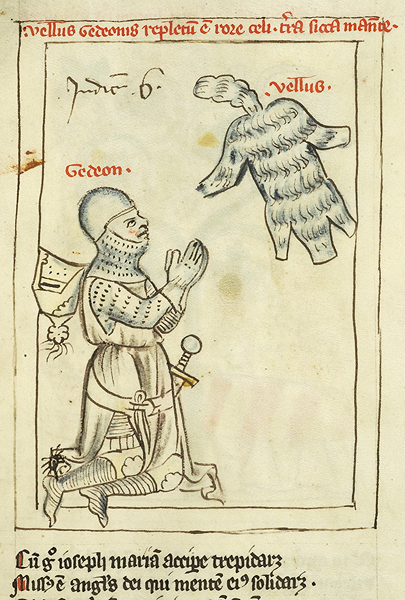
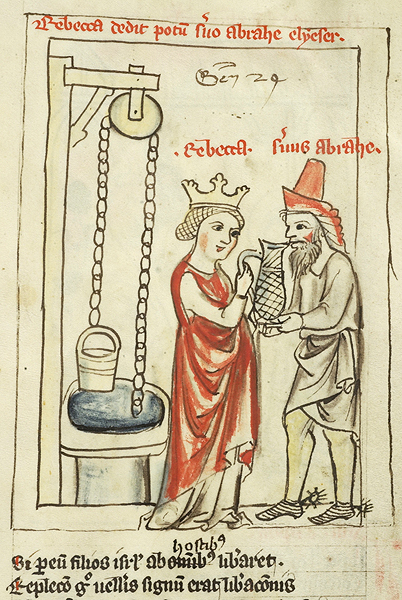
Gedeon and Runo (left); Rebecca by the well (right). Miniature from the manuscript «Speculum humanae salvationis.» Germany (likely Nuremberg), c. 1350–1400. Parchment, ink, watercolor. Morgan Library & Museum, New York (MS M.140, fol. 10r).
In the right portion, the meeting of Rebekah and Abraham’s servant Eliezer at the well is depicted (Genesis 24:15–20). The artist crowns Rebekah, suggesting an additional parallel with the Virgin Mary as the Queen of Heaven in her portrayal. Details such as the well gate and the spurs on the traveler’s boots lend the scene a vibrant authenticity. Here, we observe a multi-layered theological parallel: just as Eliezer comes to Rebekah with the mission to find a bride for Isaac, the archangel Gabriel appears to Mary with the good news. Rebekah’s readiness to water both the traveler and his camels draws a parallel between her and the image of the Theotokos—a humble and merciful advocate offering humanity the «living water» of salvation [8; 9].
Gedeon wringing water from a rune. Fresco from the Grachanitsa Monastery, 1321–1322.
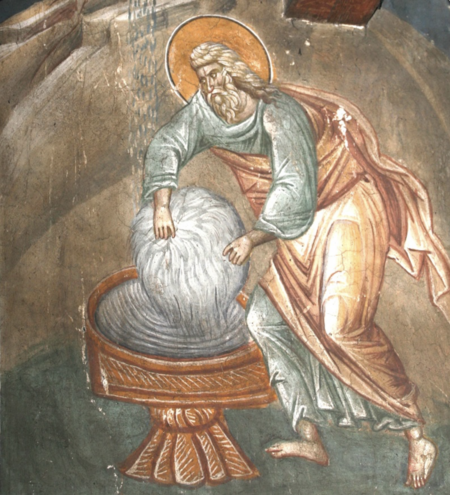
On the fresco (left: Gideon and the rod. Plaque (presumably a fragment of a retable or a panel). The Maas River Valley (Moesian School), circa 1160–1170), a Paleo-logos circle’s Old Testament narrative about Gideon’s rod receives a different visual interpretation. Whereas in Speculum humanae salvationis, the artist focuses on the moment of the miracle—the contemplation of the moistened rod amidst dry earth—here the following episode of the biblical narrative is captured: Gideon wringing water from the wool into a large bowl (Judges 6:38). The protagonist’s appearance also differs from the conventional portrayal of a military commander: the Byzantine master depicts him as a gray-haired elder dressed in garments stylized after antiquity [5, pp. 204–205]. The artist’s focus is on the action itself—Gideon drawing water from the rod, thus confirming the fulfillment of the sign. This episode allows us to see another moment in biblical history: not the anticipation of the miracle, but its material manifestation [3; 5].
«Gideon and Jephthah, with the election of Gideon’s warriors»
A good example of how the narrative of Gideon’s rune was utilized in a common biblical illustration is the pen and watercolor drawing from the Austrian School around 1420–1430, housed in the National Gallery of Art in Washington (originally a leaf from a German-language Bible). Unlike symbolic compositions, where the miracle involving the fleece is highlighted separately as a precursor to the Virgin Mary, here the artist unites two consecutive events from the Book of Judges onto a single sheet. In the upper part of the drawing, Gideon is kneeling before a sheepskin spread on a green hillside, praying to God, who blesses him from the clouds (Judges 6:36–40). Directly below this scene, by a stream, is shown the next step in his story—the selection of warriors at the water (Judges 7:4–7), where one soldier drinks directly from the flow while bent low to the ground, and another scoops water with his palm. This juxtaposition of scenes clearly demonstrates the difference between a simple text illustration and a Marian symbol: in the biblical narrative, the miracle with the rune remains merely part of Gideon’s preparation for battle, whereas in the iconography of the Mother of God, it is separated from the military narrative and acquires a new, independent meaning [10].
Gedeon and Rune, with the selection of Gideon’s warriors. Austrian School, circa 1420–1430. Pen and watercolor drawing on paper, manuscript fragment. National Gallery of Art, Washington.
Conclusion
Thus, by examining the works considered, one can see how a single Old Testament narrative acquires various forms of visual representation. In some cases, the miracle of Rhun is depicted as an independent event from the Book of Judges, while in others—it is incorporated into a system of archetypes of the Annunciation and acquires Marian significance. This Christian interpretation does not negate the original biblical narrative but rather reveals an additional layer of meaning within it. It is this transformation of an Old Testament event into a symbolic image of the Incarnation that defines the place of Rhun of Gideon in Christian iconography.
THE LOCKED GATES OF THE PROPHET ZECHURIAS
«And he brought me back to the outer gates of the sanctuary, which faced east, and they were shut. And the Lord said to me, ‘These gates will be shut; no one will go through them, for the Lord, the God of Israel, has gone through them, and they will be shut. But the prince shall sit in them to eat bread before the Lord; and he shall enter by the gate’s inner passage and go out by the same passage.’» (Ezekiel 44:1–3).
Sealed Gates (Ezekiel 44:1–3)—this is an image from Ezekiel’s prophetic vision concerning the future restored Jerusalem Temple. In chapter 43, the prophet sees the Glory of the God of Israel coming from the east and entering the sanctuary through the outer eastern gate, filling the entire temple space. In the next chapter, the angel leads Ezekiel to this entrance once more, but this time the gates are tightly closed. The Lord tells the prophet that these gates will remain sealed and that no human will pass through them, because the God of Israel Himself has already passed through this way. The mention of a prince permitted to sit in the gatehouse and eat bread before the Lord emphasizes the unique holiness of this place [1]. In medieval illustrated manuscripts, this image found a visual embodiment: the sealed gates were depicted as a distinct architectural motif connected to the prophecy.