Concept
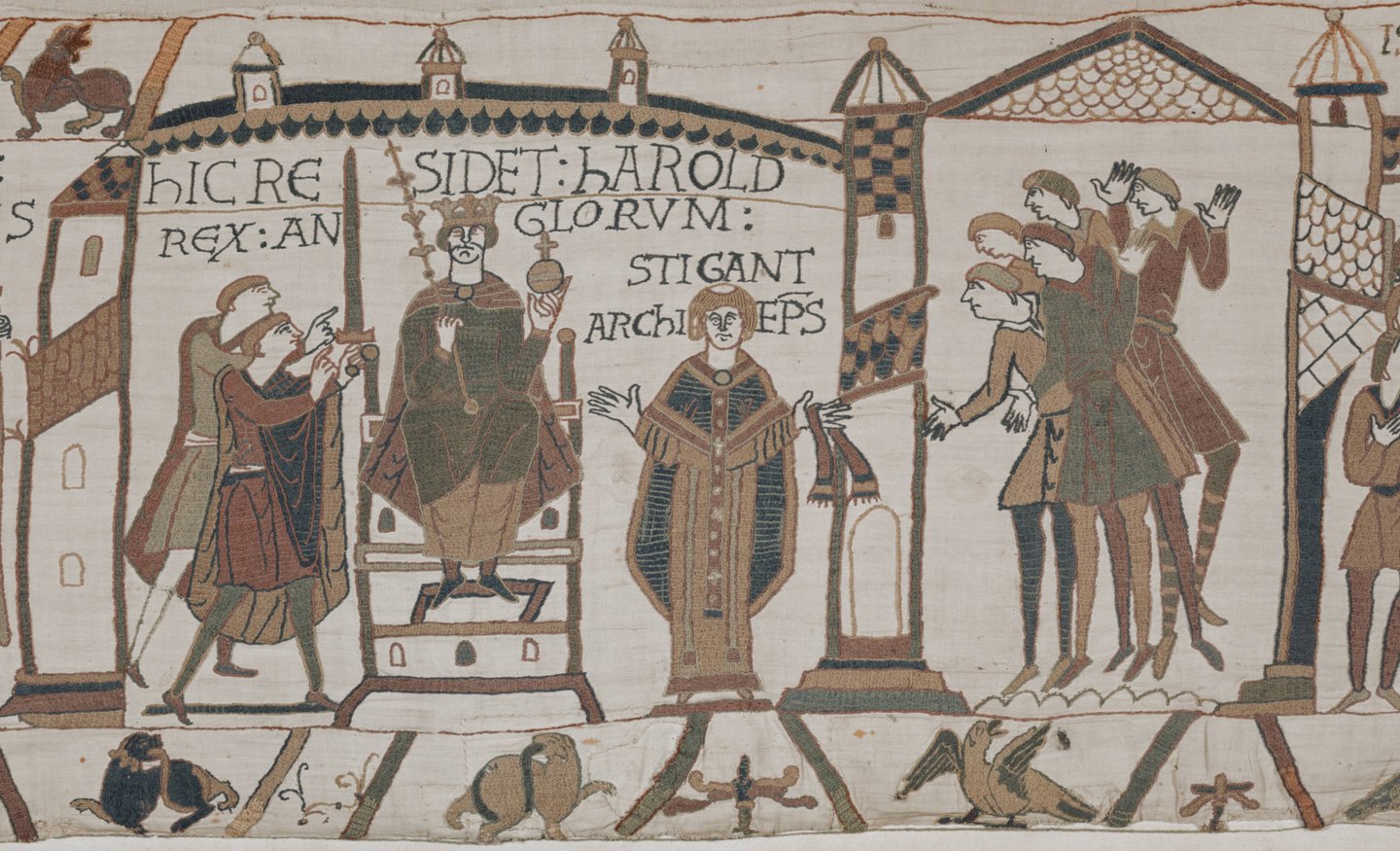
Bayeux embroidery is a unique monument of medieval art, possessing both artistic and historical value. Despite years of study, the piece continues to fascinate researchers due to numerous details whose significance is not always clearly established. According to the most prevalent hypothesis, the embroidery was created shortly after the Norman Conquest of England, likely between 1070 and 1080. The probable patron is considered to be Bishop Odo of Bayeux, half-brother of William the Conqueror.
I chose Bayesian embroidery—a unique artifact of medieval art. My interest in this piece stems from the unusual way events are conveyed through the embroidered images. Unlike traditional paintings, the narrative unfolds across a long textile canvas, uniting characters, inscriptions, and ornamentation.
Material Selection Principle
The primary object of study is the entire work of Bayeux tapestry and its individual fragments. Special attention was paid to the composition of the canvas, the decorative borders, the depiction of characters, the rendering of movement, and the interaction of individual scenes. The material was selected to successively reveal the artistic characteristics of the piece.
Principles of Research Structuring
The research is structured from the general to the specific. Initially, it examines the history, origins, and characteristics of embroidery. Subsequently, the composition, spatial organization, visual narrative, and individual artistic elements are analyzed. The concluding section is dedicated to the semantic and historical interpretation of the artwork.
Principles for Selecting and Analyzing Textual Sources
Key Research Question and Hypothesis
Key Question: What artistic and compositional elements did the master of Baye embroidery use to create a cohesive visual narrative?
Hypothesis: Baye embroidery is not merely an illustration of historical events, but a complex system of visual narrative, where the sequence of scenes, composition, inscriptions, and decorative elements form a unified whole.
1. https://commons.wikimedia.org/wiki/File:Bayeux_Tapestry_Scenes_30_and_31_(cropped).jpg? utm_source (Accessed: November 9, 2026).