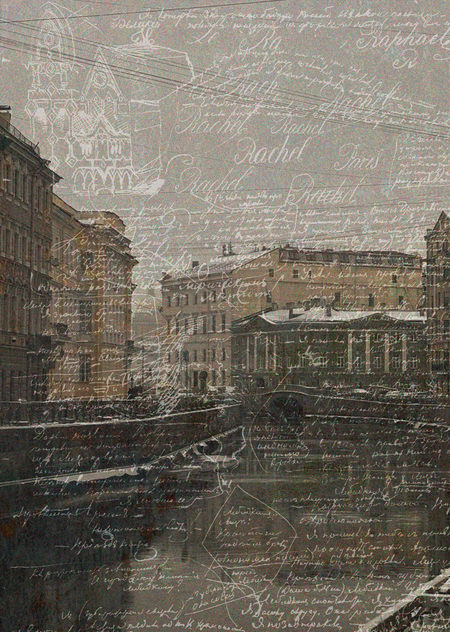
How did the architectural fabric of St. Petersburg—its perspectives, courtyard wells, thresholds, cordonniers, communal corridors, and partitions—evolve, giving rise to the syntax and tropes of four writers? Hypothesis: The writer inherits the state and mood of the city. Therefore, it is both important and interesting to trace how the architectural image of St. Petersburg changed, and along with it—people’s thoughts.
Nikolai Vasilyevich Gogol arrived in St. Petersburg in 1828—at the moment when classicism/Empire had reached its bureaucratically ordered apex. The city he encountered was a city of «exemplary projects»: facades were aligned with a ruler, and the arcades of Gostiny Dvor created that very «monotonous beauty» that Pushkin wrote about. Empire asserted: space is subservient to reason; the empire speaks in the language of columns and pediments.
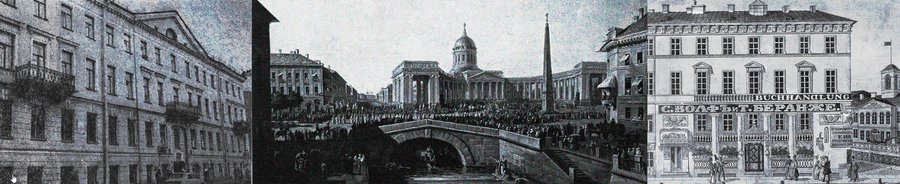
Gogol’s Petersburg
It is this totality of order that gives rise to Gogol’s observations. In «Nevsky Prospekt,» the facade is a lie. The architectural form here functions as a mechanism of deceit: «Everything you meet on Nevsky Prospekt adheres to propriety.» Behind this external gloss and «propriety» lies the coldness, falsity, deference to rank, and illusory nature of Petersburg life, where human drama and absurdity are hidden behind the grand facade. Gogol’s Imperial Petersburg is a city where the geometry and splendor of the facade do not align with the beauty of the human soul. The stricter the external form, the more catastrophic the internal decay. The architecture of Classicism, with its symmetry and hierarchy of orders, instills in the writer a specific perspective—a gaze that seeks the crack in the stucco, the flaw in the proportion. Gogolian grotesque is born from the collision between the perfect plan and the real life that this plan attempts to conceal.
By the 1860s, St. Petersburg ceased to be an imperial backdrop. The city became a landscape of tenement houses—by the end of the century, they constituted the majority of the urban fabric. This was a fundamentally different architectural environment. Tenement houses were structured along the vertical axis of social inequality. The first floor housed shops and stalls. The second and third floors held «master apartments.» The fourth floor and above were cramped rooms for students, civil servants, and commoners. There were no elevators—ascending the stairs was literally a function of one’s wealth. Dostoevsky places his characters precisely within this vertical structure. Raskolnikov ascends to the fourth floor not simply to reach his own quarters—that floor defines Rodion’s social standing.