Frans Snyders was one of the most prominent Flemish painters of the Golden Age, a master of still lifes and animal paintings. He lived and worked in Antwerp, was a student of Peter Paul Rubens and Hendrik van Balen, and a colleague of Peter Paul Rubens and Jacob Jordaens.
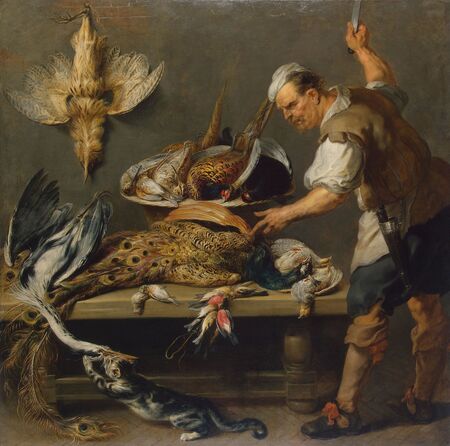
Schneider’s still lifes are characterized by their enormous scale; they often measure nearly three meters in length and two meters in height, which is comparable to his work in monumental and decorative arts. Among other distinctive features of his work, one can point to the hypertrophied abundance—such that the tables in his paintings seem to be overflowing—and the meticulous attention to small details, allowing one to identify every animal, bird, or fish, along with the inclusion of curious domestic details (for example, animals fighting over food or attempting to steal it).
Another detail is that shopkeepers or buyers are present very rarely, and if they are, they stand far away and do not draw attention. In the chaos of bounty that unfolds in Schneider’s canvases, the diversity and perfection of the game and other products are primary; the people selling them play a more decorative-symbolic role. Schneider’s shopkeepers do not attempt to present their wares to the viewer; instead, they always interact with someone off-frame or with the cats and dogs in their hands. They do not need to actively «solicit» the person viewing Schneider’s painting, as the merchandise on the stalls itself accomplishes the task of attracting attention.
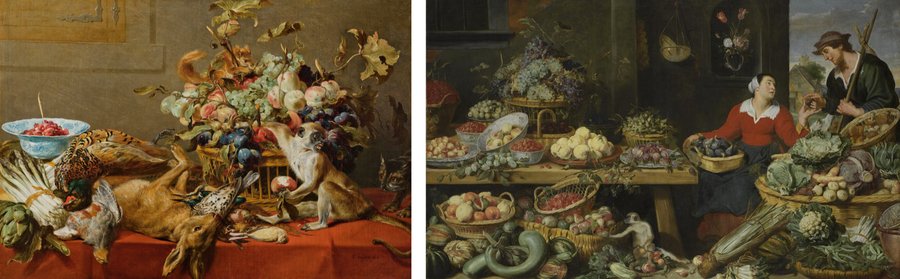
Cook at the Table with Game. 1630s (Top) Still Life with Fruits, Game, Vegetables, Monkey, Squirrel, and Cat. 1650s Stall with Fruits and Vegetables. 1634–1637
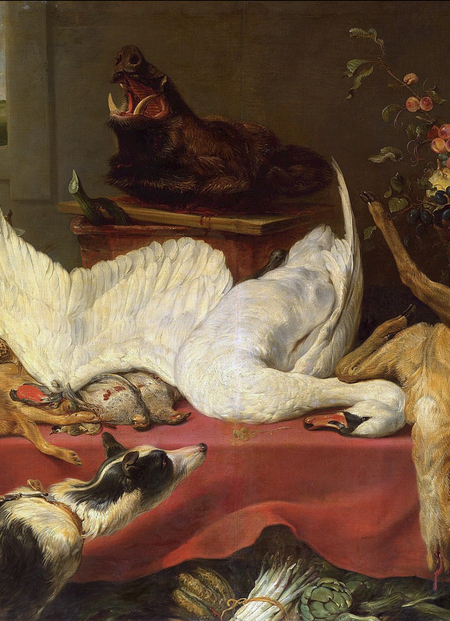
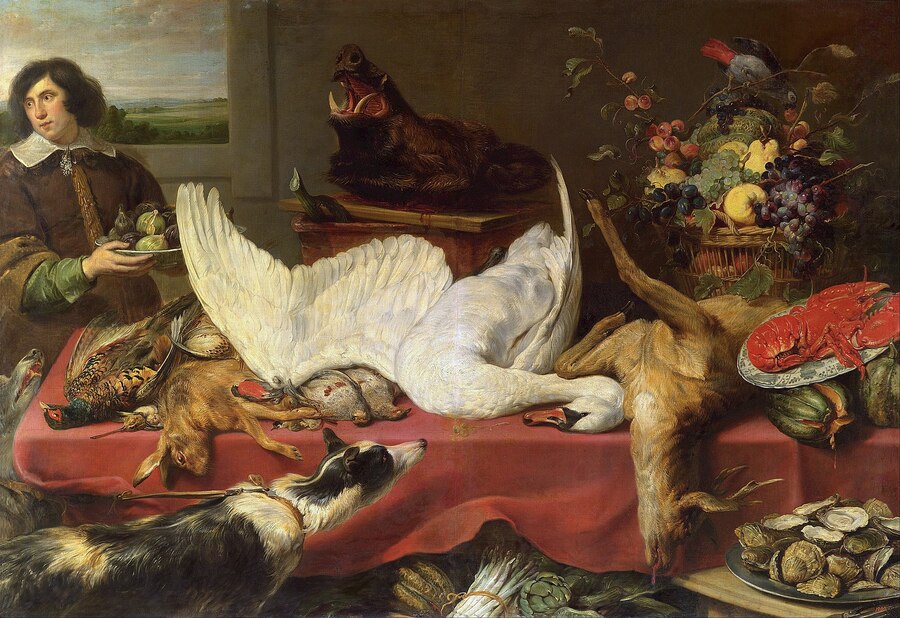
The canvas «Still Life with a Swan» is a fine example of Sneider’s mature period.
Still life with a swan. 1640s
It is large enough that the swan, positioned at the focal point of the composition and emphasized by the whiteness of its plumage, appears to be depicted life-size. This still life presents itself as an embodiment of the triumph of abundance. Although the game—and rather luxurious game—is the central focus, there are also vegetables visible beneath the red tablecloth, fruit in a basket on the table, and seafood. The deer’s head dangling from the table and the vegetables seem to spill out onto the viewer, unable to remain contained within the canvas, which is too small for them even at its giant scale.
Still life, literally translated from French as «dead nature.» It is even more interesting how Sneider successfully imbues these essentially lifeless forms with vibrant plasticity. It has been written about: «This is not ‘dead’ nature, but living nature.»
The deer’s legs jut upward in a running pose, although its head, dripping blood from its mouth, hangs downward. The swan’s wings are partially spread, its long neck gracefully curved. The dramatic arch of the wing and neck lends dynamism to the bird’s body. And the boar’s mouth is open, as if the animal is still alive.
The boundary between the living and the dead blurs, as it often does in Snyder’s work.
The composition also features living creatures. These include dogs and a small bird (a Jac parrot) on a basket of fruit. An invisible hand holds the dogs on a leash. Their owner has likely come into the shop for groceries and is conversing with the shopkeeper. His presence is indicated only by the tension with which the black-and-white dog in the foreground reaches for the swan but cannot enjoy it because of the leash pulled to its limit.
The composition is also dynamic. A primary diagonal can be traced through the focal point. This diagonal runs across the back of the black-and-white dog, the body of the swan slightly raised at the rear, and the greenery in the basket. This diagonal not only creates a sense of movement, emphasizing the dog’s desire to reach the swan and the resemblance to its raised wing, but also divides the composition into two planes. The main part of the produce is placed in the foreground and catches the light; the background features an empty wall, along with a dark boar’s head nearly blending into it, and a shopkeeper distracted by the buyer, holding a plate of figs.
Snyder often utilizes this compositional structure, employing a strong diagonal to divide the image into two zones, within which micro-narratives are built.
For example, in «Still Life with a Wine Cooler, ” the piled-up vegetables and carcasses of fowl and game meant for a future feast are separated from the basket of wine and the silhouettes of people engaged in domestic tasks. In a work created in collaboration with Van Dyck, the diagonal line separates the „zones of responsibility“ of the artists. Snæders painted a fish market, where the huge sturgeon immediately draws attention, and across its body, one can easily draw a diagonal line to separate the scene of money exchange painted by Van Dyck.
Still life with a wine chiller. 1610–1620 Fish market. c. 1621
The selection of the featured objects is not arbitrary. It is dictated by Christian symbolism that was incorporated into the still lifes to imbue them with not only aesthetic but also ethical value.
For example, grapes can be interpreted as a symbol of Christ’s sacrifice, while the swan and the deer symbolize a righteous soul, piety, and spirituality. It is fascinating to consider what attracts the dog to these elements. The rabbit might reference the theme of «the vanity of vanities, ” which was also present in the painting of the Dutch Golden Age. Figs can signify abundance and prosperity, but also the rejection of Christ’s words. Oysters are symbols of worldly temptations, and the lobster represents the transience of life. The peacock, which might seem unexpected to a modern viewer in this realm, is also deliberate. The presence of an exotic bird intensifies the sense of incredible luxury.
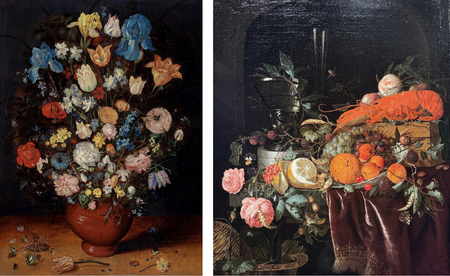
The motif of luxury and grandeur, in general, is central to Flemish still life, regardless of what is depicted. Even in vanitas paintings, attributes of an idle and wealthy life often appear—though these are usually countered by symbols of the transience of existence and all living things, as well as symbols related to the immortality of the soul.
For example, in Jan Brueghel the Elder’s work, «Bouquet of Irises, Tulips, Roses, and Narcissi in a Clay Vase,» a magnificent bouquet is composed of flowers that do not bloom in the same season, yet they enter into a dialogue within the still life. Jan Davidsz de Heem’s «Still Life with Roses, Lobster, and Glassware» is even closer to Snijders in its content: the table laden with food demonstrates the luxury and prosperity of the owner, but the lemon with its peeled rind hints at the fleeting nature of earthly festivity.
Snyder’s still lifes, in a way, also present a demonstration of opulence. The tables and benches he depicts, laden with game and fruit, tempt one toward gluttony. However, the beauty of the execution and the thematic depth lend them an atmosphere reminiscent of how Italian masters rendered biblical scenes with inspiration and a degree of idealization. The scene presented in the «Still Life with Swan» was likely impossible in reality, a fact indicated by the excessive abundance—the mingling of fruits and vegetables, birds, game, and seafood, all devoid of imperfection. Snyder painted a feast for the eyes, or perhaps, a feast of dreams.
Cook at the table with game. 1630s (top) / [Electronic resource] URL: https://artchive.ru/artists/9464~Frans_Snejders/works/28719~Povar_u_stola_s_dich%27ju
Still life with fruits, game, vegetables, a monkey, a squirrel, and a cat. 1650s / [Electronic resource] URL: https://www.art-spb.ru/goods/18265
Stall with fruits and vegetables. 1634–1637 / [Electronic resource] URL: https://portrets.ru/natyurmort/frans-snejders/prilavok-s-fruktami-i-ovoshchami.html
Still life with a swan. 1640s / [Electronic resource] URL: https://izi.travel/ru/44fd-frans-sneyders-natyurmort-s-lebedem/ru
Still life with a swan. 1640s / [Electronic resource] URL: https://portrets.ru/natyurmort/frans-snejders/natyurmort-s-vedyorkom-dlya-ohlazhdeniya-vina.html
Still life with a wine cooler bucket. 1610–1620 / [Electronic resource] URL: https://portrets.ru/natyurmort/frans-snejders/natyurmort-s-vedyorkom-dlya-ohlazhdeniya-vina.html
Fish market. c. 1621 / [Electronic resource] URL: https://portrets.ru/natyurmort/frans-snejders/rybnyj-rynok-kartina.html
Bouquet of irises, tulips, roses, and narcissi in a clay vase by Jan Breugel the Elder / [Electronic resource] URL: https://delartemagazine.com/art/dinastiya-brejgelej-i-art-rynok-segodnya/