The logo of an airline, a bank, or a soda brand on a football jersey rarely surprises anyone anymore. For clubs, a title sponsor is a steady source of income, and for fans, it’s a familiar element of jersey design.
But in the history of football, there have been instances where partnerships extended beyond simple advertising. Player chests featured names of Hollywood blockbusters, pop group logos, and even anti-smoking slogans. Once, a fast-food producer even created a uniform that changed its appearance when goals were scored—transforming the footballers into walking billboards.
We’ve compiled 10 of the most unusual sponsorship deals that made history in sports.
1. Atlético Madrid and Columbia Pictures. How a club sponsor changed alongside the movie theater’s poster
In 2003, the Madrid club Atlético struck a deal with Columbia Pictures. Instead of simply placing the film company’s name on the jerseys, the parties devised a far more engaging mechanism. The Atlético players began promoting specific films. During their partnership with Columbia Pictures, which ran from 2003 to 2005, Atlético’s kits featured titles such as «Bad Boys II, ” „Big Fish, ” „Gothic, ” „Hellboy: Hero from Hell, ” „White Chicks, ” „Resident Evil 2: Apocalypse, ” „The Hitcher’s Rules, ” and other blockbusters.
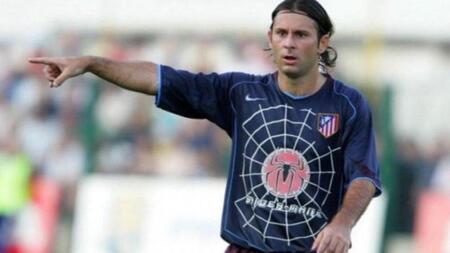
The jersey featuring the movie «Spider-Man 2» became particularly legendary. For the promotional campaign, a special dark blue uniform was created: a huge white spiderweb covered almost the entire front of the shirt, and the center featured the red spider symbol and the film’s title. This was a radical departure from the club’s traditional red and white striped design. However, there was also a more conventional red and white version of the jersey: on it, the spider symbol and film title were placed where the standard title sponsor logo would typically go. Therefore, you can now find several completely different shirts in this style online. Interestingly, twenty years later, the club returned to this story: in 2024, after acquiring Julián Álvarez, who is nicknamed La Araña—"The Spider"—Atlético signed him specifically wearing the iconic Spider-Man shirt.
2. «Hetaffe» and Burger King.
How advertising was hidden inside a t-shirt
In 2009, the Spanish team Getafe announced a partnership with Burger King. The contract was set for three seasons, and the chain’s logo appeared in its usual place—center of the game jersey. But the most interesting advertising space was in a location spectators never even saw.
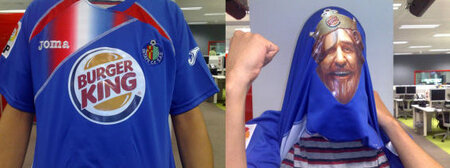
The idea was built around one of the most recognizable football gestures: celebrating a goal by pulling the jersey over one’s head. Whenever a Getafe player did this, an smiling King would appear on screen instead of his face.
It created a brilliant trick: even when covering the main logo on the chest, the player still left the brand visible in the frame. The advertisement was literally turned inside out.
Furthermore, the players were not required to celebrate goals in this manner. In fact, this very mechanic was somewhat provocative; according to the rules, a player could receive a yellow card for removing or pulling up their jersey. Therefore, the campaign primarily functioned as a bold PR move, prompting discussion about the uniform itself.
And it worked. The story went far beyond Spain and reached international media. Moreover, the «Carácter Geta» campaign, through which Burger King and Getafe presented their partnership, won gold at the El Sol Festival in the PR category in 2010.
The scope did not end with the jersey. In the continuation of the campaign, 60 real fans from Getafe fan clubs became the featured characters. Instead of using football stars, the brand highlighted those who attend the stands every week to support their club.
3. «Stevenage» and Burger King.
How a fourth-tier English league club «signed» Messi and Ronaldo thanks to the FIFA video game
In 2019, the same Burger King unexpectedly became the title sponsor of Stevenage—a small club in England’s League Two, the fourth-tier division.
At first glance, the choice seemed completely illogical. Stevenage could not offer the brand a multi-million audience, nor international Premier League-level broadcasts, nor global football stars.
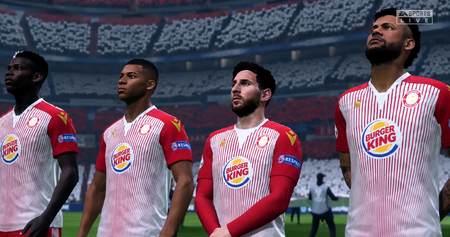
But Burger King was interested not so much in the real Stevenage, but in its digital counterpart.
Marketers noticed a loophole in the extremely popular video game FIFA: licensed clubs from lower divisions are represented in it on equal footing with giants like Real or Juventus, and their kits perfectly mirror the real ones. The logic was simple: by placing the logo on a real Stevenage jersey, the brand automatically gained it within the video game.
And in career mode, nothing prevented a player from transforming a modest club into a super team by assembling Messi, Ronaldo, Mbappé, and other superstars. Thus, Burger King found a way to get the world’s top footballers to virtually advertise their brand—without paying them for an advertising contract.
However, mere presence in the game wasn’t enough, so the brand launched the #StevenageChallenge. Gamers were invited to start a career with Stevenage, build a star-studded squad, and complete in-game challenges, posting their results on social media. In return, Burger King offered real prizes: branded whoppers, free food, and delivery via Uber Eats.
4. «Ipswich Town» and Ed Sheeran. How the club marketed the concert tour
In May 2021, Ed Sheeran became the title sponsor for Ipswich Town. For one of the world’s most popular musicians, this was more than just a publicity stunt: he grew up in Suffolk County, near Ipswich, and has supported the club since childhood. Sheeran explained his decision simply: football plays a huge role in the life of the local community, and he wanted to contribute to its development. Notably, the sponsorship agreement covered both the men’s and women’s teams.

Instead of the musician’s name, a mysterious logo appeared on the jersey: + − = ÷ × TOUR. The mathematical symbols referenced the titles of Sheeran’s albums («Plus, ” „Minus, ” „Equals, ” „Divide, ” „Multiply“). Essentially, the club’s T-shirt transformed into an advertisement for his discography and world tour.
Initially, the contract was signed for just one season (2021/22). At that time, Ipswich played in League 1 (the third division), and the partnership with a global pop star was a sensation in itself, instantly taking the club far beyond its local audience.
But then came a plot twist that no one could have predicted in 2021. Sheeran extended the sponsorship, and Ipswich began a rapid ascent: in the 2022/23 season, the team reached the Championship, and a year later, the Premier League. In the 2023/24 season, the club sold over 63,000 shirts, directly linking this commercial success to the singer’s name.
In the summer of 2024, their relationship moved to a new level: Sheeran bought 1,4% of Ipswich Town’s shares. This stake is passive—the musician did not receive a seat on the board of directors—but it secured him a lifetime VIP box at the stadium.
And in the 2024/25 season, the story found a beautiful continuation. Sheeran personally participated in the creation of a special pink jersey dedicated to Suffolk. Its design featured silhouettes of local landmarks, the contours of the coast, and even the sound wave of the roar from Portman Road’s stands.
5. «Cladbank» and Wet Wet Wet.
How a pop group replaced a brand on a t-shirt
In 1993, the Scottish bank, Clydebank, had the band Wet Wet Wet as its title sponsor. For the football world of that time, it was quite a spectacle: instead of the bank’s or bookmaker’s logo on the players' chests, the name of one of the UK’s leading 90s pop groups appeared.
But this collaboration was no accident. The members of Wet Wet Wet attended Clydebank High School together, and the group itself formed here in the early 1980s. The sponsorship became a way for the musicians to support the football team from their hometown.
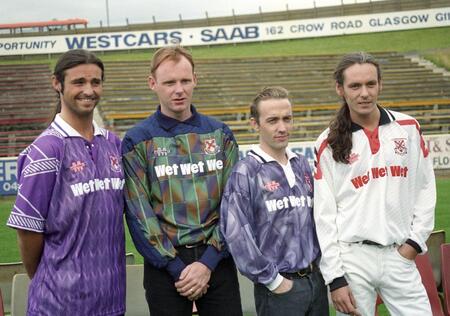
The official history of Clydebank calls the agreement the first in history sponsored contract between a football club and a pop group. Incidentally, before Wet Wet Wet, Clydebank did not have a title sponsor on their jerseys—meaning the first major logo on the players' chests was not a company, but the name of a local band.The timing was nearly perfect. Sponsorship began in 1993, and in 1994, Wet Wet Wet released their version of «Love Is All Around» for the film Four Weddings and a Funeral. The song spent 15 weeks at number one on the British charts and transformed the group into international stars.It was a rather amusing situation: a small Scottish club wore the name of a band on their uniform that was experiencing its greatest commercial success precisely during this collaboration.And this wasn’t just a one-off promotional stunt for photographs. Wet Wet Wet remained on the jerseys for several seasons, from 1993 to 1997. During this time, the band’s name appeared on various home and away kits for the team.There are even wonderful archival photographs where the members of Wet Wet Wet pose with three different versions of the uniform featuring their name on the chest.
6. «Hamburg» and London. How advertising for condoms had to be covered with a black stripe
During the 1987/88 season, the small German club Hamburg faced a fairly typical problem for a football club—they needed money, and securing a title sponsor proved difficult.
Ultimately, the club president, Manfred Ohmer, signed a contract worth approximately 200,000 German marks with the company London. The team jerseys featured a concise oval logo displaying the brand’s name.
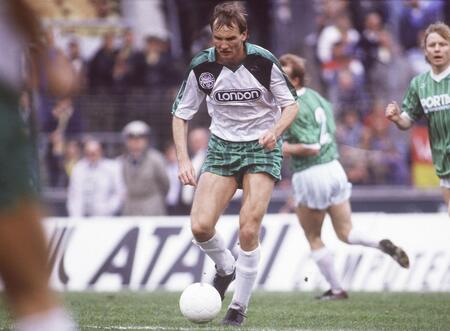
But there was one problem: the London Rubber Company manufactured condoms. For the German football management of the late 1980s, this was enough to ignite a major scandal.The German Football Association (DFB) deemed such advertising incompatible with standards of «morality and ethics.» The club was fined, threatened with point deductions, and the players had to take the field with a large black stripe pasted directly over the sponsor’s name. It was at this moment that the ban began to backfire on the DFB itself, because everyone understood what was hidden beneath the stripe.Former Hamburg player Christian Streich later recalled that for London, this uproar turned into a massive, free advertising campaign: discussions constantly surrounded the banned logo, photos of players with the mysterious black stripe appeared in the press, and journalists repeatedly explained to readers what the censorship was concealing.The German press remembered an instance where the stadium announcer explained to the fans the appearance of the black stripe roughly like this: today, Hamburg is playing with hidden advertising, but anyone who knows the capital of England understands what is underneath.Ultimately, a court in Frankfurt ruled that condom advertising did not violate moral standards, and Hamburg gained the right to use the London logo without censorship. The players were once again able to take the field with the clear inscription on their chests.Interestingly, 36 years later, in 2023, the club capitalized on this legendary story before a DFB Cup match: advertising for another condom manufacturer—Billy Boy—appeared on the sleeve of Hamburg’s special kit.
7. Eintracht Braunschweig and Jägermeister.
How a club changed its own emblem for advertising purposes
Today, a sponsorship logo on a football jersey is commonplace. But in the early 1970s, commercialism in German football was strictly prohibited: the rules of the German Football Association (DFB) allowed only the club crest and the player’s number on the uniform. It was this barrier that Günter Mast, owner of the famous Jägermeister herbal liqueur brand, decided to circumvent.
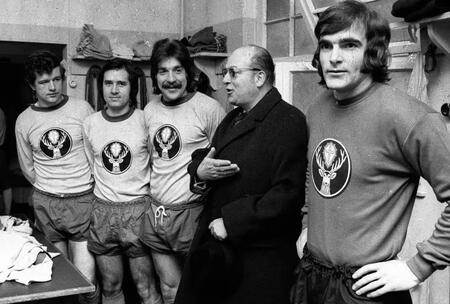
His idea was simple and insane at the same time: if the logo couldn’t be placed next to the emblem, why not make it the emblem itself?
Until then, the symbol of «Eintracht» was the traditional red Braunschweig lion. But on January 9, 1973, at an extraordinary meeting, a proposal was put forward to replace it with a deer head from the Jägermeister label. The vote ended with a landslide victory: 145 votes in favor, 7 against, and 3 abstentions. Thus, after 78 years, the traditional lion gave way to a new emblem—an almost exact copy of the sign from the liqueur bottle.
Under the terms of the deal, Jägermeister paid the club 100,000 German marks per year (500,000 over five years). For Eintracht, which was facing financial difficulties at the time, this was good money.
Formally, the club was breaking no rules: there was no advertising on the jersey; it was simply our new emblem, its management claimed. But the German Football Association (DFB) did not agree with such logic. Negotiations began over size. The club initially wanted a 20 cm deer, then 18 cm was discussed. Ultimately, the federation compromised: the emblem was reduced to 14 cm, and the letters E and B (Eintracht Braunschweig) were added inside so that the sign would at least formally differ from the original Jägermeister logo.
And on March 24, 1973, Eintracht took to the home field against Schalke 04 with the deer on their chests. The game ended in a 1–1 draw, but today people remember not the score, but the kit: it was the first Bundesliga match in history where a team took the field with official commercial advertising.