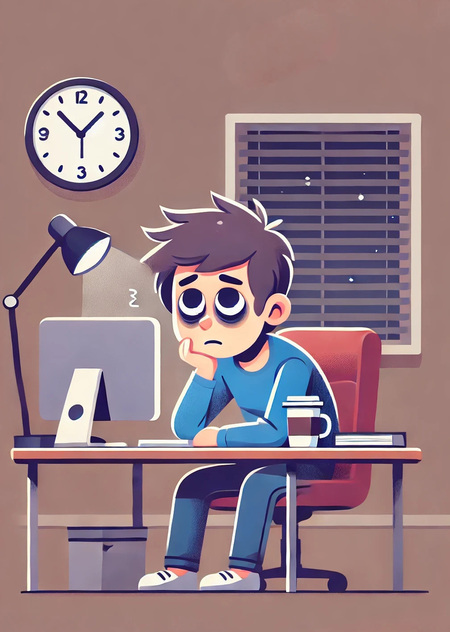
Although Randy Gardner’s record-breaking feat is rare, the act of staying up late has become a widespread behavior in modern society. Many people, particularly young adults, often find themselves sacrificing sleep for various reasons, leading to a growing trend of sleep deprivation.
What time do most people consider as staying up late?
Some studies and recommendations suggest that the optimal time to go to sleep is between 10:00 PM and 11:00 PM, as it aligns with the body’s circadian rhythm.
If one does not fall asleep by this time, especially after midnight, it may be considered as 'staying up late'.
So, according to surveys, what do young people think about staying up late?
Survey data shows that 49,9% of people believe that going to bed after 12:00 AM is considered staying up late.
Following this, 38,2% think that going to bed between 11:00 PM and 12:00 AM qualifies as staying up late.
Another 9,3% consider 10:00 PM to 11:00 PM as staying up late.
Only a very small percentage believe that going to bed between 9:00 PM and 10:00 PM, or before 9:00 PM, is considered staying up late.
*Interestingly, 36,6% of the survey participants go to bed even later than the time they personally consider as staying up late.
Besides, it was found that people who go to bed late are more likely to experience lack of sleep.
The later you go to bed, the worse your sleep quality will be.
What causes them to stay up late?
Identifying when young people stay up late is only part of the story. To truly grasp the widespread nature of this phenomenon, we must delve into the reasons why they choose to stay up late in the first place.
Take Sarah, a 28-year-old office worker, as an example. Her day begins early, filled with back-to-back meetings, deadlines, and commuting. By the time she gets home, it’s already late, and though she’s exhausted, she finds herself scrolling through social media and watching videos late into the night. For Sarah, this is her only chance to have 'me time, ' even though she knows it will make her more tired the next day.
Jack, a 27-year-old outdoor enthusiast, often enjoys going on solo camping trips in the mountains. For him, staying up late outdoors under the stars feels liberating. He believes that staying up late in nature doesn’t have the same negative effects as doing so in the city. After setting up camp, Jack stays awake well past midnight, watching the stars and enjoying the tranquility. Despite his love for the outdoors, Jack often wakes up tired the next morning, feeling groggy and sluggish. However, he tells himself that the experience of connecting with nature is worth the fatigue.
Lisa is a 22-year-old university student juggling multiple assignments and exams. Every evening, she plans to go to bed early, but her workload keeps her up late. Even though she feels exhausted and wants to sleep, she can’t seem to finish her essays or study for her exams on time. As the night drags on, Lisa watches the clock tick past midnight, knowing she should sleep, but feeling the pressure to keep working. Despite her best efforts, the unfinished tasks keep her awake until the early hours of the morning, leaving her both mentally and physically drained.
Alan, a 30-year-old marketing manager, faces constant pressure at work. His days are filled with meetings, deadlines, and emails, leaving him mentally drained by the time he gets home. Despite being exhausted, Alan often finds himself staying up late. Instead of going to bed, he scrolls through social media or watches TV shows into the early hours of the morning. He knows he should sleep, but after a long day of work, this late-night personal time feels like the only moment he has for himself. This habit of delaying sleep, known as revenge bedtime procrastination, gives him a brief sense of freedom, even though it makes him even more tired the next day.
George, a 35-year-old accountant, has been struggling with insomnia for months. Every night, despite feeling tired, he finds himself tossing and turning in bed, unable to fall asleep. His mind races with thoughts about work, finances, and life in general. The more he tries to sleep, the more frustrated he becomes. Even after reducing his screen time before bed and trying relaxation techniques, George still finds himself staring at the ceiling well past midnight. His lack of sleep is starting to affect his work and mood, but no matter how hard he tries, he just can’t seem to fall asleep at night.
Is Staying Up Late Really Worth It?
We’ve all been there—staying up late to finish that last episode, scrolling endlessly through social media, or squeezing in just a bit more work. It might feel harmless at the moment, and maybe even necessary, but how often have you woken up the next day feeling exhausted, regretting the late night? The truth is, while staying up late may seem like a small sacrifice, it can have a bigger impact on your body and mind than you think. From feeling constantly tired to struggling with focus, the effects can start to pile up. So, before you hit 'next episode, ' it’s worth asking yourself: is this really worth the cost to your health?